


Computer supported collaborative learning in a clerkship: an exploratory study on the relation of discussion activity and revision of critical appraisal papers
- PMID: 22906218
- PMCID: PMC3507639
- DOI: 10.1186/1472-6920-12-79
Computer supported collaborative learning in a clerkship: an exploratory study on the relation of discussion activity and revision of critical appraisal papers
Abstract
Background: Medical students in clerkship are continuously confronted with real and relevant patient problems. To support clinical problem solving skills, students perform a Critical Appraisal of a Topic (CAT) task, often resulting in a paper. Because such a paper may contain errors, students could profit from discussion with peers, leading to paper revision. Active peer discussion by a Computer Supported Collaborative Learning (CSCL) environment show positive medical students perceptions on subjective knowledge improvement. High students' activity during discussions in a CSCL environment demonstrated higher task-focussed discussion reflecting higher levels of knowledge construction. However, it remains unclear whether high discussion activity influences students' decisions revise their CAT paper. The aim of this research is to examine whether students who revise their critical appraisal papers after discussion in a CSCL environment show more task-focussed activity and discuss more intensively on critical appraisal topics than students who do not revise their papers.
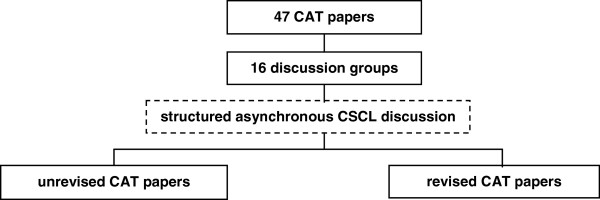
Methods: Forty-seven medical students, stratified in subgroups, participated in a structured asynchronous online discussion of individual written CAT papers on self-selected clinical problems. The discussion was structured by three critical appraisal topics. After the discussion, the students could revise their paper. For analysis purposes, all students' postings were blinded and analysed by the investigator, unaware of students characteristics and whether or not the paper was revised. Postings were counted and analysed by an independent rater, Postings were assigned into outside activity, non-task-focussed activity or task-focussed activity. Additionally, postings were assigned to one of the three critical appraisal topics. Analysis results were compared by revised and unrevised papers.
Results: Twenty-four papers (51.6%) were revised after the online discussion. The discussions of the revised papers showed significantly higher numbers of postings, more task-focussed activities, and more postings about the two critical appraisal topics: "appraisal of the selected article(s)", and "relevant conclusion regarding the clinical problem".
Conclusion: A CSCL environment can support medical students in the execution and critical appraisal of authentic tasks in the clinical workplace. Revision of CAT papers appears to be related to discussions activity, more specifically reflecting high task-focussed activity of critical appraisal topics.
References
-
- O’Brien BC, Poncelet AN. Transition to clerkship courses: Preparing students to enter the workplace. Academic Med. 2010;85(12):1–8. - PubMed
-
- Collis B, Margaryan A. Applying activity theory to computer-supported collaborative learning and work-based activities in corporate settings. Educ Technol Res Dev. 2004;52(4):1042–1629.
-
- Manley K, Titchen A, Hardy S. Work-based learning in the context of contemporary health care education and practice: A concept analysis. Pract Dev Health Care. 2009;8(2):87–127. doi: 10.1002/pdh.284. - DOI
-
- Rhodes G, Shiel G. Meeting the needs of the workplace and the learner through work-based learning. J Work Learn. 2007;19(2):173–187.
Publication types
MeSH terms
LinkOut - more resources
Full Text Sources
Miscellaneous
