


Genomic imprinting and genetic effects on muscle traits in mice
- PMID: 22906226
- PMCID: PMC3475036
- DOI: 10.1186/1471-2164-13-408
Genomic imprinting and genetic effects on muscle traits in mice
Abstract
Background: Genomic imprinting refers to parent-of-origin dependent gene expression caused by differential DNA methylation of the paternally and maternally derived alleles. Imprinting is increasingly recognized as an important source of variation in complex traits, however, its role in explaining variation in muscle and physiological traits, especially those of commercial value, is largely unknown compared with genetic effects.
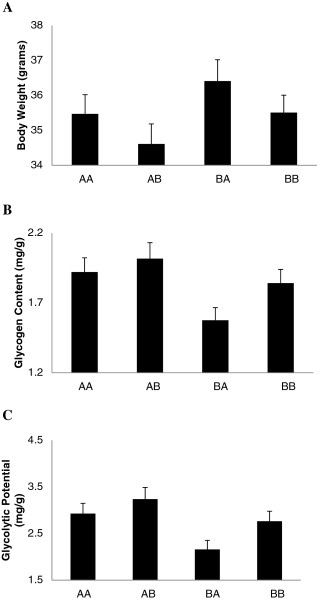
Results: We investigated both genetic and genomic imprinting effects on key muscle traits in mice from the Berlin Muscle Mouse population, a key model system to study muscle traits. Using a genome scan, we first identified loci with either imprinting or genetic effects on phenotypic variation. Next, we established the proportion of phenotypic variation explained by additive, dominance and imprinted QTL and characterized the patterns of effects. In total, we identified nine QTL, two of which show large imprinting effects on glycogen content and potential, and body weight. Surprisingly, all imprinting patterns were of the bipolar type, in which the two heterozygotes are different from each other but the homozygotes are not. Most QTL had pleiotropic effects and explained up to 40% of phenotypic variance, with individual imprinted loci accounting for 4-5% of variation alone.
Conclusion: Surprisingly, variation in glycogen content and potential was only modulated by imprinting effects. Further, in contrast to general assumptions, our results show that genomic imprinting can impact physiological traits measured at adult stages and that the expression does not have to follow the patterns of paternal or maternal expression commonly ascribed to imprinting effects.
Figures
References
Publication types
MeSH terms
Substances
LinkOut - more resources
Full Text Sources
Molecular Biology Databases
