


Anterior delayed gadolinium-enhanced MRI of cartilage values predict joint failure after periacetabular osteotomy
- PMID: 22907475
- PMCID: PMC3492640
- DOI: 10.1007/s11999-012-2519-9
Anterior delayed gadolinium-enhanced MRI of cartilage values predict joint failure after periacetabular osteotomy
Abstract
Background: Several available compositional MRIs seem to detect early osteoarthritis before radiographic appearance. Delayed gadolinium-enhanced MRI of cartilage (dGEMRIC) has been most frequently used in clinical studies and reportedly predicts premature joint failure in patients undergoing Bernese periacetabular osteotomies (PAOs).
Questions/purposes: We asked, given regional variations in biochemical composition in dysplastic hips, whether the dGEMRIC index of the anterior joint would better predict premature joint failure after PAOs than the coronal dGEMRIC index as previously reported.
Methods: We retrospectively reviewed 43 hips in 41 patients who underwent Bernese PAO for hip dysplasia. Thirty-seven hips had preserved joints after PAOs and six were deemed premature failures based on pain, joint space narrowing, or subsequent THA. We used dGEMRIC to determine regional variations in biochemical composition. Preoperative demographic and clinical outcome score, radiographic measures of osteoarthritis and severity of dysplasia, and dGEMRIC indexes from different hip regions were analyzed in a multivariable regression analysis to determine the best predictor of premature joint failure. Minimum followup was 24 months (mean, 32 months; range, 24-46 months).
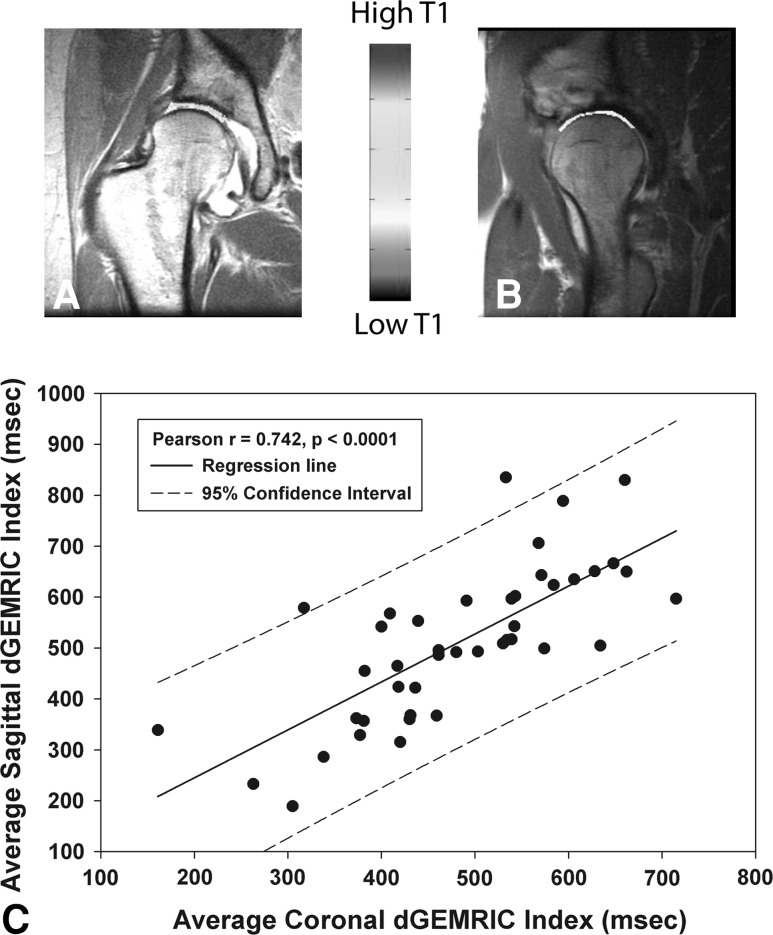
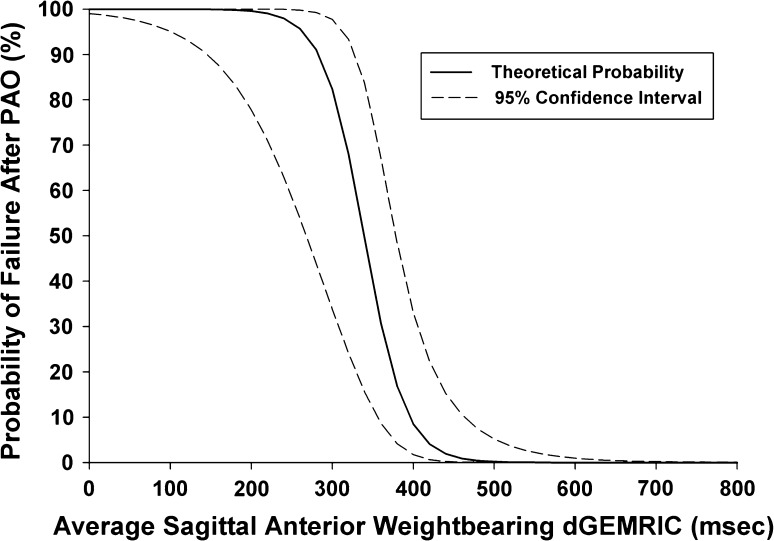
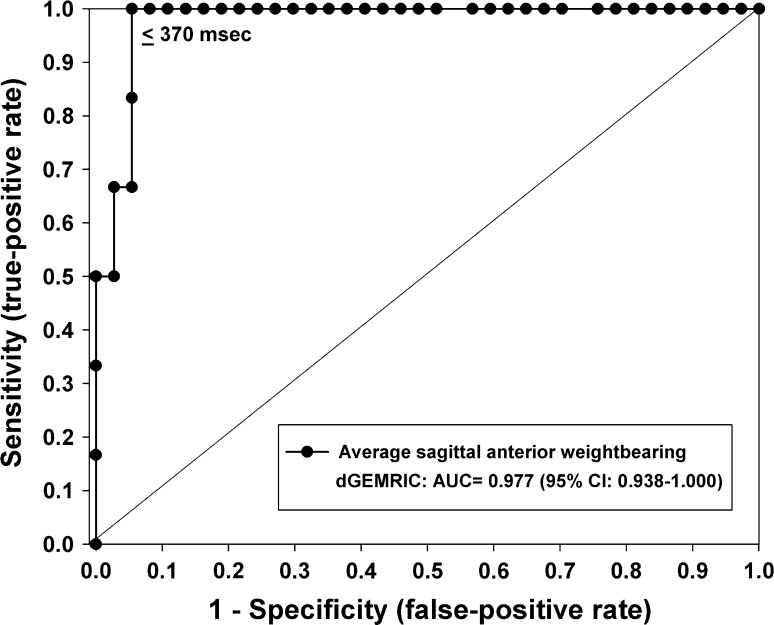
Results: The two cohorts were similar in age and sex distribution. Severity of dysplasia was similar as measured by lateral center-edge, anterior center-edge, and Tönnis angles. Preoperative pain, joint space width, Tönnis grade, and coronal and sagittal dGEMRIC indexes differed between groups. The dGEMRIC index in the anterior weightbearing region of the hip was lower in the prematurely failed group and was the best predictor.
Conclusions: Success of PAO depends on the amount of preoperative osteoarthritis. These degenerative changes are seen most commonly in the anterior joint. The dGEMRIC index of the anterior joint may better predict premature joint failure than radiographic measures of hip osteoarthritis and coronal dGEMRIC index.
Level of evidence: Level II, prognostic study. See Instructions for Authors for a complete description of levels of evidence.
Figures
References
-
- Aronson J. Osteoarthritis of the young adult hip: etiology and treatment. Instr Course Lect. 1986;35:119–128. - PubMed
MeSH terms
Substances
LinkOut - more resources
Full Text Sources
Medical
Research Materials
