


Randomized multicenter and stratified phase II study of gemcitabine alone versus gemcitabine and docetaxel in patients with metastatic or relapsed leiomyosarcomas: a Federation Nationale des Centres de Lutte Contre le Cancer (FNCLCC) French Sarcoma Group Study (TAXOGEM study)
- PMID: 22907974
- PMCID: PMC3448415
- DOI: 10.1634/theoncologist.2011-0467
Randomized multicenter and stratified phase II study of gemcitabine alone versus gemcitabine and docetaxel in patients with metastatic or relapsed leiomyosarcomas: a Federation Nationale des Centres de Lutte Contre le Cancer (FNCLCC) French Sarcoma Group Study (TAXOGEM study)
Abstract
Background: This study aimed to evaluate the efficacy and toxicity of single-agent gemcitabine versus gemcitabine plus docetaxel as second-line therapy in patients with uterine and nonuterine leiomyosarcoma (LMS).
Patients and methods: Patients had metastatic or unresectable LMS and had received one prior anthracycline-based regimen. A total of 90 patients received either single-agent gemcitabine (arm A; gemcitabine, 1,000 mg/m(2) i.v. for 100 minutes on days 1, 8, and 15 of a 28-day cycle) or a combination of gemcitabine and docetaxel (arm B; gemcitabine, 900 mg/m(2) i.v. for 90 minutes on days 1 and 8, plus docetaxel, 100 mg/m(2) i.v. for 1 hour on day 8 of a 21-day cycle with lenograstim). The primary endpoint was the objective response rate.
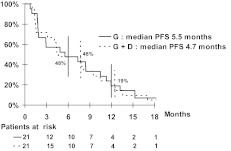
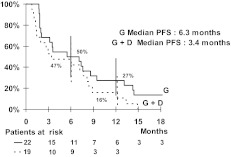
Results: The objective response rates were 19% and 24% in arm A (gemcitabine) and arm B (gemcitabine plus docetaxel), respectively, for patients with uterine LMS. For patients with nonuterine LMS, the objective response rates were 14% and 5% for arms A and B, respectively. The median progression-free survival times for arms A and B were 5.5 months and 4.7 months, respectively, for patients with uterine LMS. For patients with nonuterine LMS, the median progression-free survival times were 6.3 months and 3.8 months for arms A and B, respectively. One toxic death occurred in arm B.
Conclusions: Both single-agent gemcitabine and gemcitabine plus docetaxel were found to be effective second-line therapies for leiomyosarcomas, with a 3-month progression-free survival rate of 40% for LMS with both uterine and nonuterine sites of origin. Single-agent gemcitabine yielded results similar to those of gemcitabine plus docetaxel in this trial, but patients using single-agent gemcitabine experienced less toxicity.
Conflict of interest statement
Figures
Comment in
-
Randomization and statistical power: paramount in trial reproducibility (even for rare cancers).Oncologist. 2012;17(9):1129-32. doi: 10.1634/theoncologist.2012-0209. Epub 2012 Aug 22. Oncologist. 2012. PMID: 22915060 Free PMC article.
References
-
- Toro JR, Travis LB, Wu HJ, et al. Incidence patterns of soft tissue sarcomas, regardless of primary site, in the surveillance, epidemiology and end results program, 1978–2001: An analysis of 26,758 cases. Int J Cancer. 2006;119:2922–2930. - PubMed
-
- Pautier P, Genestie C, Rey A, et al. Analysis of clinicopathologic prognostic factors for 157 uterine sarcomas and evaluation of a grading score validated for soft tissue sarcoma. Cancer. 2000;88:1425–1431. - PubMed
-
- O'Cearbhaill R, Hensley ML. Optimal management of uterine leiomyosarcoma. Expert Rev Anticancer Ther. 2010;10:153–169. - PubMed
-
- Amant F, Coosemans A, Debiec-Rychter M, et al. Clinical management of uterine sarcomas. Lancet Oncol. 2009;10:1188–1198. - PubMed
-
- Van Glabbeke M, van Oosterom AT, Oosterhuis JW, et al. Prognostic factors for the outcome of chemotherapy in advanced soft tissue sarcoma: An analysis of 2,185 patients treated with anthracycline- containing first-line regimens—A European Organization for Research and Treatment of Cancer Soft Tissue and Bone Sarcoma Group study. J Clin Oncol. 1999;17:150–157. - PubMed
Publication types
MeSH terms
Substances
LinkOut - more resources
Full Text Sources
Medical
