Trends in the incidence and outcomes of heart failure in Ontario, Canada: 1997 to 2007
- PMID: 22908143
- PMCID: PMC3470643
- DOI: 10.1503/cmaj.111958
Trends in the incidence and outcomes of heart failure in Ontario, Canada: 1997 to 2007
Abstract
Background: Heart failure is a leading cause of admission to hospital, but whether the incidence of heart failure is increasing or decreasing is uncertain. We examined temporal trends in the incidence and outcomes of heart failure in Ontario, Canada.
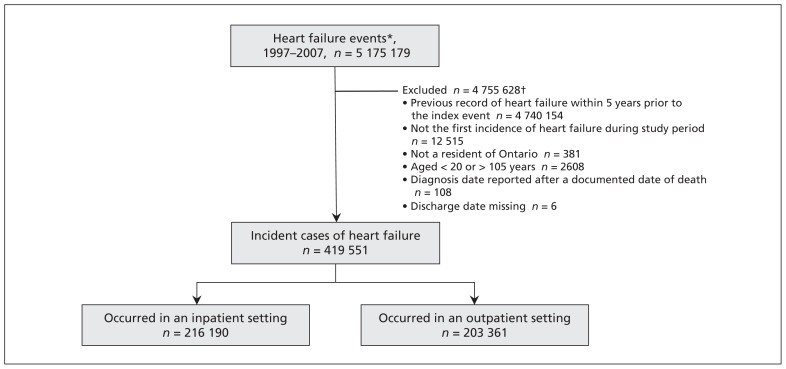
Methods: Using population-based administrative databases of hospital discharge abstracts and physician health insurance claims, we identified 419 551 incident cases of heart failure in Ontario between Apr. 1, 1997, and Mar. 31, 2008. All patients were classified as either inpatients or outpatients based on the patient's location at the time of the initial diagnosis. We tracked subsequent outcomes through linked administrative databases.
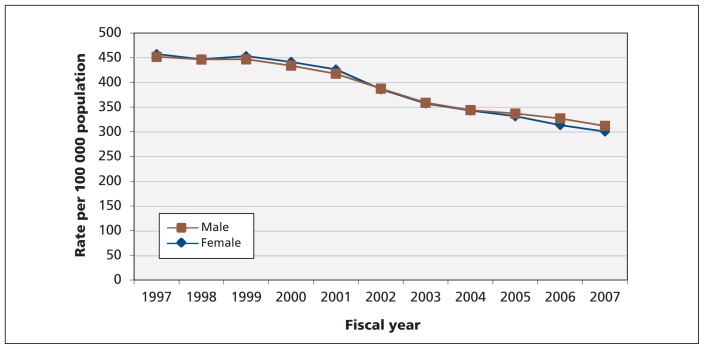
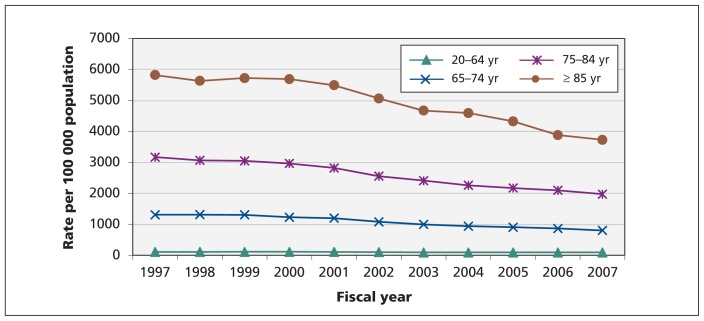
Results: The age- and sex-standardized incidence of heart failure decreased 32.7% from 454.7 per 100 000 people in 1997 to 306.1 per 100 000 people in 2007 (p < 0.001). A comparable decrease in incidence occurred in both inpatient and outpatient settings. The greatest relative decrease occurred in patients aged 85 and over. Over the study period, 1-year risk-adjusted mortality decreased from 17.7% in 1997 to 16.2% in 2007 (p = 0.02) for outpatients, with a nonsignificant decrease from 35.7% in 1997 to 33.8% in 2007 (p = 0.1) for inpatients.
Interpretation: The incidence of heart failure decreased substantially during the study period. Nevertheless, the prognosis for patients with heart failure remains poor and is associated with high mortality.
Figures
References
-
- Johansen H, Strauss B, Arnold JM, et al. On the rise: the current and projected future burden of congestive heart failure hospitalization in Canada. Can J Cardiol 2003;19:430–5 - PubMed
-
- Tsuyuki RT, Shibata MC, Nilsson C, et al. Contemporary burden of illness of congestive heart failure in Canada. Can J Cardiol 2003; 19:436–8 - PubMed
-
- Lee DS, Mamdani MM, Austin PC, et al. Trends in heart failure outcomes and pharmacotherapy: 1992 to 2000. Am J Med 2004; 116:581–9 - PubMed
-
- Campbell NR, Brant R, Johansen H, et al. Increases in antihypertensive prescriptions and reductions in cardiovascular events in Canada. Hypertension 2009;53:128–34 - PubMed
Publication types
MeSH terms
Grants and funding
LinkOut - more resources
Full Text Sources
Medical
Miscellaneous