. 2012 Nov;56(11):5642-9.
doi: 10.1128/AAC.00756-12. Epub 2012 Aug 20.

Rapid killing of Acinetobacter baumannii by polymyxins is mediated by a hydroxyl radical death pathway

Affiliations

Rapid killing of Acinetobacter baumannii by polymyxins is mediated by a hydroxyl radical death pathway

Timothy R Sampson et al. Antimicrob Agents Chemother. 2012 Nov.

Abstract

Acinetobacter baumannii is an opportunistic pathogen that is a cause of clinically significant nosocomial infections. Increasingly, clinical isolates of A. baumannii are extensively resistant to numerous antibiotics, and the use of polymyxin antibiotics against these infections is often the final treatment option. Historically, the polymyxins have been thought to kill bacteria through membrane lysis. Here, we present an alternative mechanism based on data demonstrating that polymyxins induce rapid cell death through hydroxyl radical production. Supporting this notion, we found that inhibition of radical production delays the ability of polymyxins to kill A. baumannii. Notably, we demonstrate that this mechanism of killing occurs in multidrug-resistant clinical isolates of A. baumannii and that this response is not induced in a polymyxin-resistant isolate. This study is the first to demonstrate that polymyxins induce rapid killing of A. baumannii and other Gram-negatives through hydroxyl radical production. This significantly augments our understanding of the mechanism of polymyxin action, which is critical knowledge toward the development of adjunctive therapies, particularly given the increasing necessity for treatment with these antibiotics in the clinical setting.


Figures
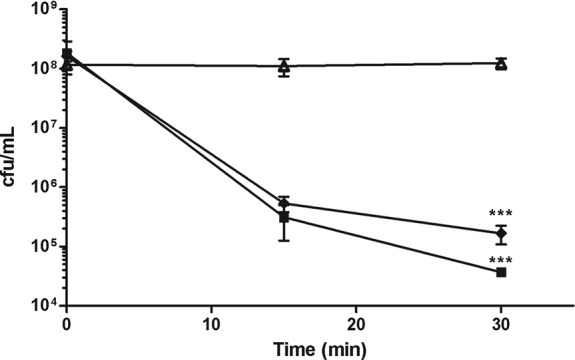
Fig 1
Fig 1
Polymyxins induce rapid killing of A. baumannii. A. baumannii cultures were treated with 2 μg of polymyxin B/ml (■) or colistin/ml (⧫) or left untreated (△). At 0, 15, and 30 min, cultures were plated, and the CFU were enumerated. The data are representative of three independent experiments. Points represent the means and bars represent the standard deviation of triplicate samples. ***, P < 0.0001.
Fig 2
Fig 2
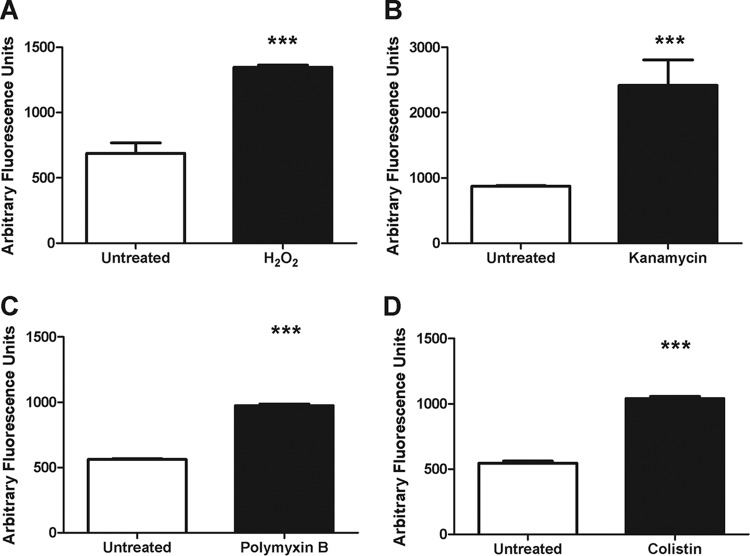
Polymyxins induce hydroxyl radical production. A. baumannii cultures were left untreated or were treated with 0.15% hydrogen peroxide (H2O2) (A), 5 μg of kanamycin/ml (B), 2 μg of polymyxin B/ml (C), or 2 μg of colistin/ml (D) for 30 min. After treatment, the hydroxyl radical specific fluorescent dye 3′-(p-hydroxyphenyl) fluorescein was added, and the fluorescence was measured (490 nm/515 nm). The data are representative of three independent experiments. Bars represent the means and standard deviations of triplicate samples. ***, P < 0.0001.
Fig 3
Fig 3
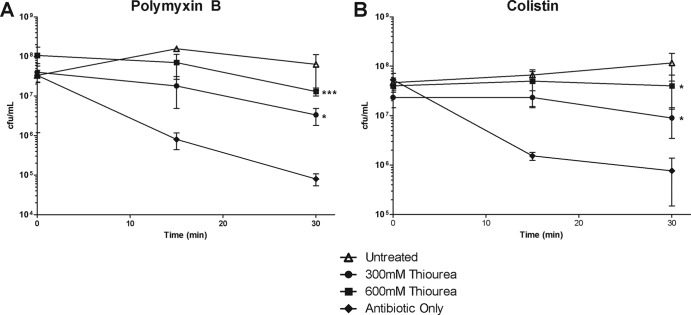
Polymyxin killing is delayed by hydroxyl radical quenching. A. baumannii cultures were treated with either 2 μg of polymyxin B/ml (A) or 2 μg of colistin/ml (B) alone (⧫) or in combination with either 300 mM thiourea (●) or 600 mM thiourea (■), or they were left untreated in culture medium (△). At 0, 15, and 30 min, the cultures were plated, and the CFU were enumerated. The data are representative of three independent experiments. Points represent the means and bars represent the standard deviations of triplicate samples. ***, P < 0.0001; *, P < 0.05.
Fig 4
Fig 4
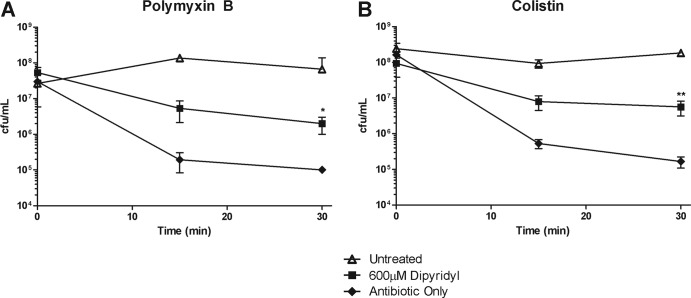
Polymyxin killing is mediated by iron. A. baumannii cultures were treated with either 2 μg of polymyxin B/ml (A) or 2 μg of colistin (B) alone (⧫) or in combination with 600 μM dipyridyl (■), or they were left untreated in culture medium (△). At 0, 15, and 30 min, the cultures were plated, and the CFU were enumerated. The data are representative of three independent experiments. Points represent the means and bars the standard deviations of triplicate samples. **, P < 0.005; *, P < 0.05.
Fig 5
Fig 5
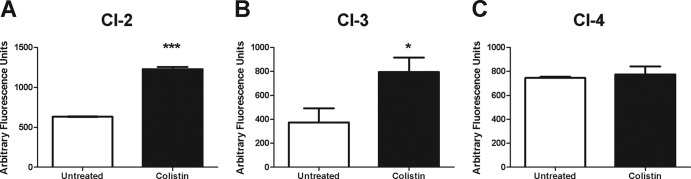
Colistin induces hydroxyl radical production in MDR clinical isolates. Cultures of colistin-sensitive MDR strain CI-2 (A) or CI-3 (B) or a colistin-resistant PDR A. baumannii strain CI-4 (C) were treated with 2 μg of colistin/ml or left untreated for 30 min. After treatment, the hydroxyl radical specific fluorescent dye 3′-(p-hydroxyphenyl) fluorescein was added, and fluorescence was measured (490 nm/515 nm). The data are representative of two independent experiments. Bars represent the means and standard deviations of triplicate samples. ***, P < 0.0001; *, P < 0.05.
Fig 6
Fig 6
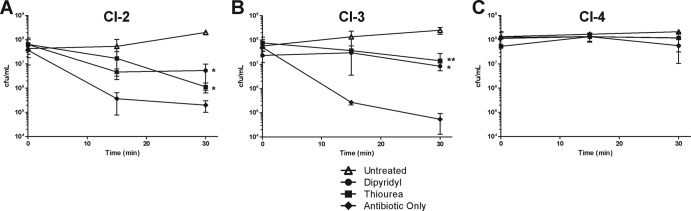
Clinical isolates are killed through hydroxyl radical production during polymyxin treatment. The colistin-sensitive MDR clinical isolates CI-2 (A) and CI-3 (B) or the colistin-resistant PDR A. baumannii strain CI-4 (C) were treated with 2 μg of colistin/ml (⧫) alone or in combination with either 600 μM dipyridyl (●) or 600 mM thiourea (■), or they were left untreated in culture medium (△). At 0, 15, and 30 min, the cultures were plated, and the CFU were enumerated. The data are representative of two independent experiments. Points represent the means and bars represent the standard deviation of triplicate samples. **, P < 0.005; *, P < 0.05.

References

    1. Adams MD, et al. 2009. Resistance to colistin in Acinetobacter baumannii associated with mutations in the PmrAB two-component system. Antimicrob. Agents Chemother. 53:3628–3634 - PMC - PubMed
    1. Arroyo LA, et al. 2011. The pmrCAB operon mediates polymyxin resistance in Acinetobacter baumannii ATCC 17978 and clinical isolates through phosphoethanolamine modification of lipid A. Antimicrob. Agents Chemother. 55:3743–3751 - PMC - PubMed
    1. Baang JH, et al. 2012. Longitudinal epidemiology of multidrug-resistant (MDR) Acinetobacter species in a tertiary care hospital. Am. J. Infect. Control 40:134–137 - PMC - PubMed
    1. Beceiro A, et al. 2011. Phosphoethanolamine modification of lipid A in colistin-resistant variants of Acinetobacter baumannii mediated by the pmrAB two-component regulatory system. Antimicrob. Agents Chemother. 55:3370–3379 - PMC - PubMed
    1. Bergogne-Berezin E. 2001. The increasing role of Acinetobacter species as nosocomial pathogens. Curr. Infect. Dis. Rep. 3:440–444 - PubMed

Publication types

MeSH terms