HIV: cell binding and entry
- PMID: 22908191
- PMCID: PMC3405824
- DOI: 10.1101/cshperspect.a006866
HIV: cell binding and entry
Abstract
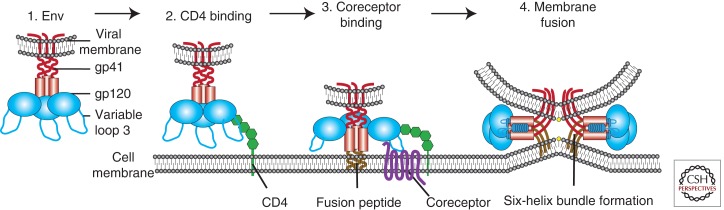
The first step of the human immunodeficiency virus (HIV) replication cycle-binding and entry into the host cell-plays a major role in determining viral tropism and the ability of HIV to degrade the human immune system. HIV uses a complex series of steps to deliver its genome into the host cell cytoplasm while simultaneously evading the host immune response. To infect cells, the HIV protein envelope (Env) binds to the primary cellular receptor CD4 and then to a cellular coreceptor. This sequential binding triggers fusion of the viral and host cell membranes, initiating infection. Revealing the mechanism of HIV entry has profound implications for viral tropism, transmission, pathogenesis, and therapeutic intervention. Here, we provide an overview into the mechanism of HIV entry, provide historical context to key discoveries, discuss recent advances, and speculate on future directions in the field.
Figures
References
-
- Alkhatib G, Combadiere C, Broder CC, Feng Y, Kennedy PE, Murphy PM, Berger EA 1996. CC CKR5: A RANTES, MIP-1α, MIP-1β receptor as a fusion cofactor for macrophage-tropic HIV-1. Science 272: 1955–1958 - PubMed
-
- Alkhatib G, Locati M, Kennedy PE, Murphy PM, Berger EA 1997. HIV-1 coreceptor activity of CCR5 and its inhibition by chemokines: Independence from G protein signaling and importance of coreceptor downmodulation. Virology 234: 340–348 - PubMed
-
- Arthos J, Cicala C, Martinelli E, Macleod K, Van Ryk D, Wei D, Xiao Z, Veenstra TD, Conrad TP, Lempicki RA, et al. 2008. HIV-1 envelope protein binds to and signals through integrin α4β7, the gut mucosal homing receptor for peripheral T cells. Nat Immunol 9: 301–309 - PubMed
-
- Babcock GJ, Farzan M, Sodroski J 2003. Ligand-independent dimerization of CXCR4, a principal HIV-1 coreceptor. J Biol Chem 278: 3378–3385 - PubMed
-
- Bakri Y, Schiffer C, Zennou V, Charneau P, Kahn E, Benjouad A, Gluckman JC, Canque B 2001. The maturation of dendritic cells results in postintegration inhibition of HIV-1 replication. J Immunol 166: 3780–3788 - PubMed
Publication types
MeSH terms
Substances
Grants and funding
LinkOut - more resources
Full Text Sources
Other Literature Sources
Medical
Research Materials