Review
doi: 10.1101/cshperspect.a009688.
Vascular anomalies: from genetics toward models for therapeutic trials
Affiliations
- PMID: 22908197
- PMCID: PMC3405833
- DOI: 10.1101/cshperspect.a009688
Item in Clipboard
Review
Vascular anomalies: from genetics toward models for therapeutic trials
Cold Spring Harb Perspect Med.
.
Abstract
Vascular anomalies are localized abnormalities that occur during vascular development. Several causative genes have been identified not only for inherited but also for some sporadic forms, and the molecular pathways involved are becoming understood. This gives us the opportunity to generate animals carrying the causative genetic defects, which we hope model the phenotype seen in human patients. These models would enable us not only to test known antiangiogenic drugs, but also to develop novel approaches for treatment, directly targeting the mutated protein or molecules implicated in the pathophysiological signaling pathways.
Figures
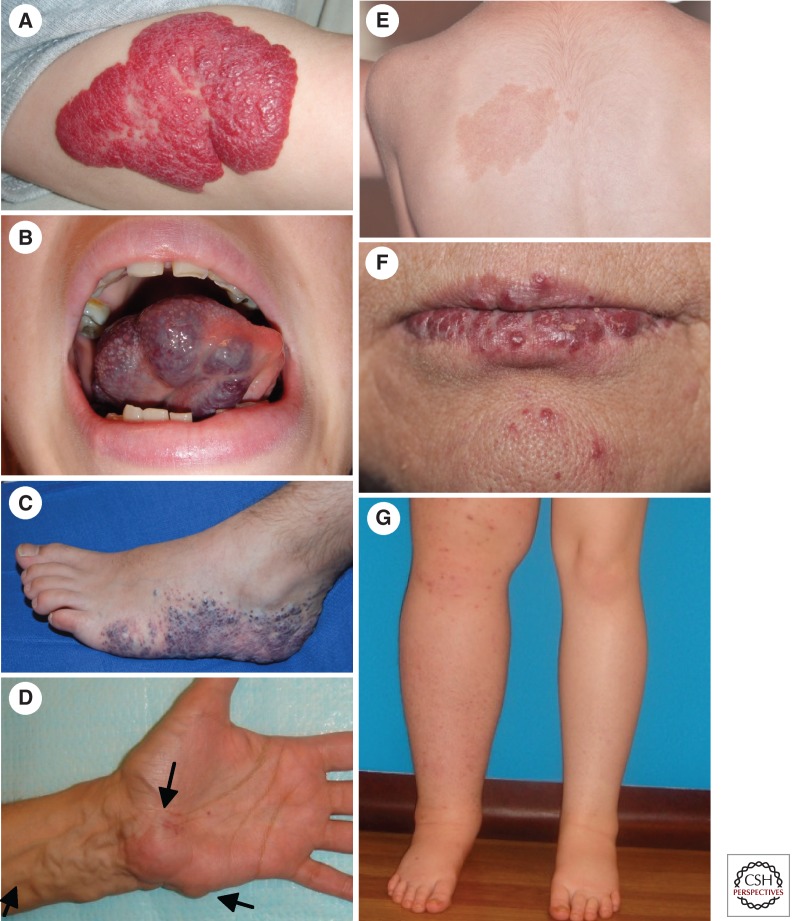
Selected vascular anomalies. (A) Hemangioma on forearm. (B) Venous malformation (VM) on tongue. (C) Glomuvenous malformation (GVM) on foot. (D) Arteriovenous malformation (AVM) on hand. (E) Capillary malformation (CM) of capillary malformation–arteriovenous malformation (CM-AVM) on back. (F) Hereditary hemorrhagic telangiectasias (HHT) on lips. (G) Primary lymphedema on right leg.
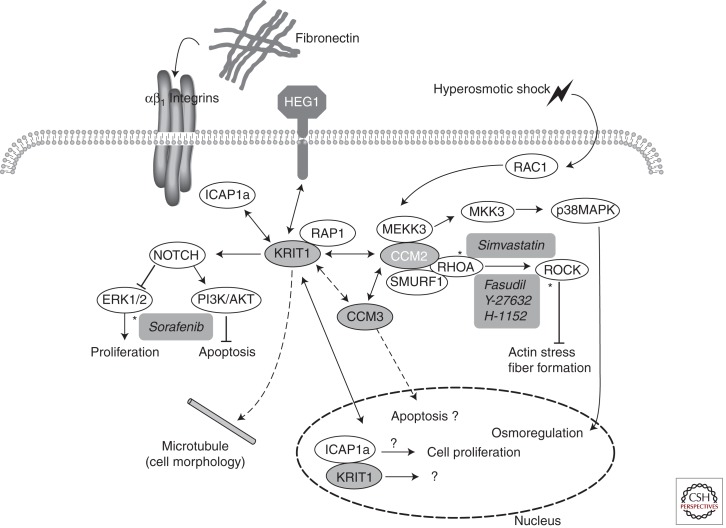
Schematic presentation of pathways involved in CCM: KRIT1, CCM2, or CCM3 mutated (highlighted in gray); hypothetical interactions (dashed lines). Candidate molecules for targeted therapy (italic, highlighted in gray); the site of action is marked by an asterisk.
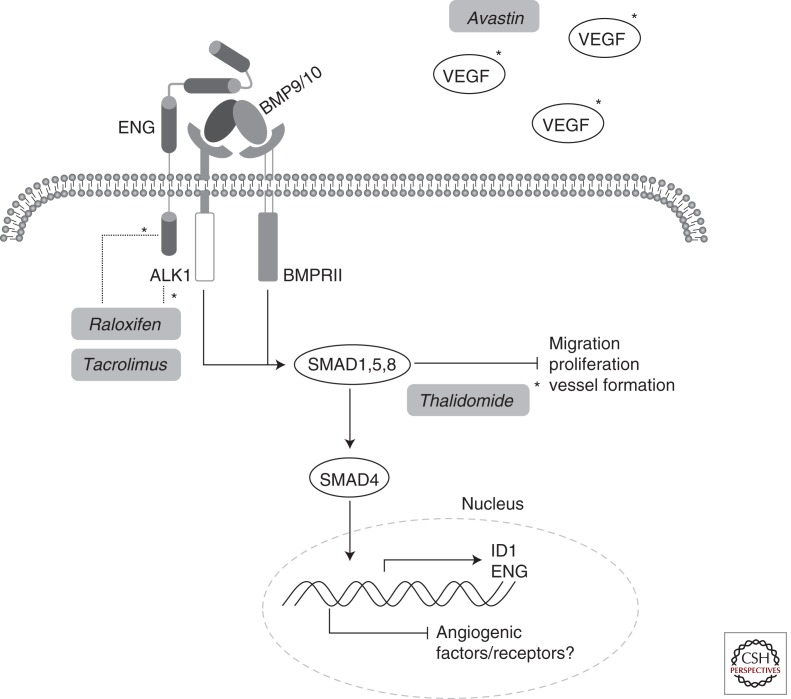
Schematic presentation of pathways involved in HHT: ALK1, ENG, or SMAD4 mutated. Candidate molecules for targeted therapy (italic, highlighted in gray); the site of action is marked by an asterisk.
References
-
- Albiñana V, Bernabeu-Herrero ME, Zarrabeitia R, Bernabeu C, Botella LM 2010. Estrogen therapy for hereditary haemorrhagic telangiectasia (HHT): Effects of raloxifene, on endoglin and ALK1 expression in endothelial cells. Thromb Haemost 103: 525–534 - PubMed
-
- Albiñana V, Sanz-Rodriguez F, Recio-Poveda L, Bernabéu C, Botella LM 2011. Immunosuppressor FK506 increases endoglin and activin receptor–like kinase 1 expression and modulates transforming growth factor-β1 signaling in endothelial cells. Mol Pharmacol 79: 833–843 - PubMed
-
- Annabi B, Lachambre MP, Plouffe K, Moumdjian R, Beliveau R 2009. Propranolol adrenergic blockade inhibits human brain endothelial cells tubulogenesis and matrix metalloproteinase-9 secretion. Pharmacol Res 60: 438–445 - PubMed
Publication types
MeSH terms
Grants and funding
LinkOut - more resources
Full Text Sources
Other Literature Sources