


Anatomically modern human in Southeast Asia (Laos) by 46 ka
- PMID: 22908291
- PMCID: PMC3437904
- DOI: 10.1073/pnas.1208104109
Anatomically modern human in Southeast Asia (Laos) by 46 ka
Abstract
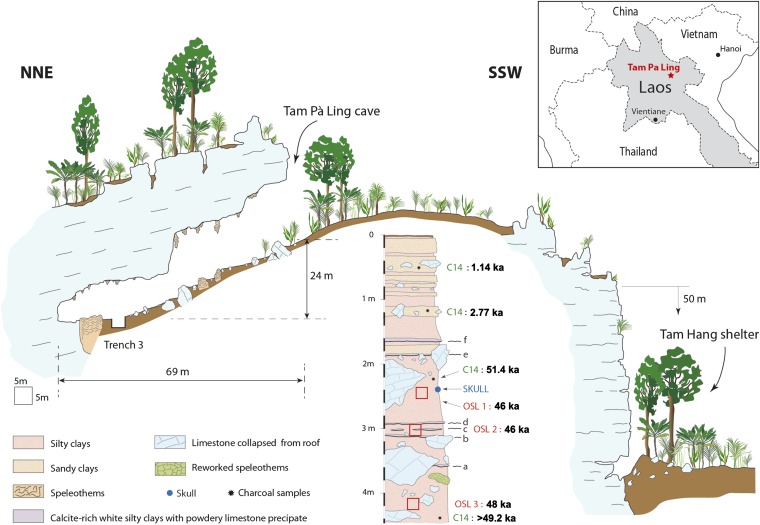
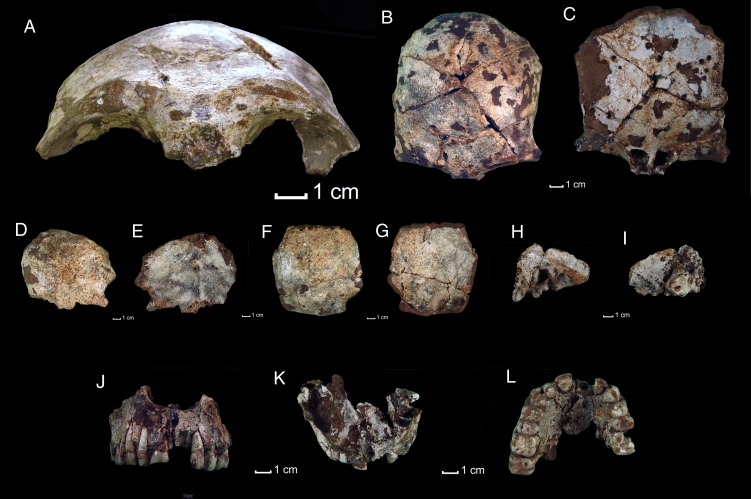
Uncertainties surround the timing of modern human emergence and occupation in East and Southeast Asia. Although genetic and archeological data indicate a rapid migration out of Africa and into Southeast Asia by at least 60 ka, mainland Southeast Asia is notable for its absence of fossil evidence for early modern human occupation. Here we report on a modern human cranium from Tam Pa Ling, Laos, which was recovered from a secure stratigraphic context. Radiocarbon and luminescence dating of the surrounding sediments provide a minimum age of 51-46 ka, and direct U-dating of the bone indicates a maximum age of ~63 ka. The cranium has a derived modern human morphology in features of the frontal, occipital, maxillae, and dentition. It is also differentiated from western Eurasian archaic humans in aspects of its temporal, occipital, and dental morphology. In the context of an increasingly documented archaic-modern morphological mosaic among the earliest modern humans in western Eurasia, Tam Pa Ling establishes a definitively modern population in Southeast Asia at ~50 ka cal BP. As such, it provides the earliest skeletal evidence for fully modern humans in mainland Southeast Asia.
Conflict of interest statement
The authors declare no conflict of interest.
Figures
Comment in
-
Irreconcilable differences between stratigraphy and direct dating cast doubts upon the status of Tam Pa Ling fossil.Proc Natl Acad Sci U S A. 2012 Dec 18;109(51):E3523; author reply E3524–5. doi: 10.1073/pnas.1216774109. Epub 2012 Dec 12. Proc Natl Acad Sci U S A. 2012. PMID: 23236137 Free PMC article. No abstract available.
References
-
- Oppenheimer S. The great arc of dispersal of modern humans: Africa to Australia. Quat Int. 2009;202:2–13.
-
- Bräuer G. The origin of modern anatomy: By speciation or intraspecific evolution? Evol Anthropol. 2008;17:22–37.
-
- Wu XZ, Poirier FE. Human Evolution in China. New York: Oxford Univ Press; 1995.
-
- Shen G, et al. U-Series dating of Liujiang hominid site in Guangxi, Southern China. J Hum Evol. 2002;43:817–829. - PubMed
-
- Norton CJ, Jin JHJ. The evolution of modern human behavior in East Asia: Current perspectives. Evol Anthropol. 2009;18:247–260.
Publication types
MeSH terms
Substances
LinkOut - more resources
Full Text Sources
Research Materials
