. 2012 Sep 11;109(37):15042-7.
doi: 10.1073/pnas.1206273109. Epub 2012 Aug 20.

The nerve of ovulation-inducing factor in semen

Affiliations

The nerve of ovulation-inducing factor in semen

Marcelo H Ratto et al. Proc Natl Acad Sci U S A. .

Abstract

A component in seminal fluid elicits an ovulatory response and has been discovered in every species examined thus far. The existence of an ovulation-inducing factor (OIF) in seminal plasma has broad implications and evokes questions about identity, tissue sources, mechanism of action, role among species, and clinical relevance in infertility. Most of these questions remain unanswered. The goal of this study was to determine the identity of OIF in support of the hypothesis that it is a single distinct and widely conserved entity. Seminal plasma from llamas and bulls was used as representative of induced and spontaneous ovulators, respectively. A fraction isolated from llama seminal plasma by column chromatography was identified as OIF by eliciting luteinizing hormone (LH) release and ovulation in llamas. MALDI-TOF revealed a molecular mass of 13,221 Da, and 12-23 aa sequences of OIF had homology with human, porcine, bovine, and murine sequences of β nerve growth factor (β-NGF). X-ray diffraction data were used to solve the full sequence and structure of OIF as β-NGF. Neurite development and up-regulation of trkA in phaeochromocytoma (PC(12)) cells in vitro confirmed NGF-like properties of OIF. Western blot analysis of llama and bull seminal plasma confirmed immunorecognition of OIF using polyclonal mouse anti-NGF, and administration of β-NGF from mouse submandibular glands induced ovulation in llamas. We conclude that OIF in seminal plasma is β-NGF and that it is highly conserved. An endocrine route of action of NGF elucidates a previously unknown pathway for the direct influence of the male on the hypothalamo-pituitary-gonadal axis of the inseminated female.


Conflict of interest statement

The authors declare no conflict of interest.

Figures
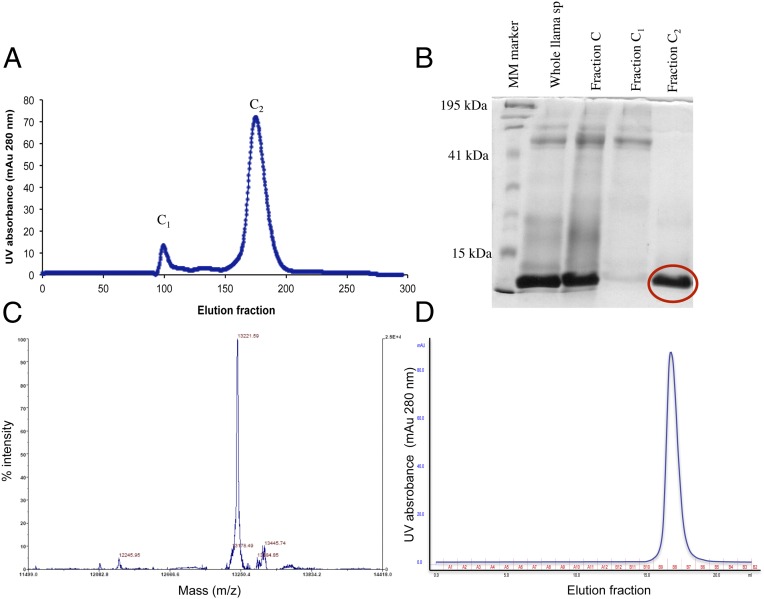
Fig. 1.
Fig. 1.
Separation and molecular mass of ovulation-inducing factor (OIF) in llama seminal plasma. (A) Separation of fraction C was done using sephacryl gel filtration fast protein liquid chromatography and isocratic elution with PBS. Fraction C was isolated previously by hydroxylapatite column chromatography. (B) Protein band at about 14 kDa on denaturing 12% SDS/PAGE (circled) was the major constituent of fraction C2. (C) Mass spectra (mass-to-charge ratio; m/z) of OIF (fraction C2 isolated from llama seminal plasma) by MALDI-TOF analysis showing a single peak at 13,221 Da, corresponding to the monomeric subunit of the homodimer of β-NGF. (D) Narrow peak appeared at 16.755 mL of elution volume after loading a nondenatured sample of fraction C2 into a calibrated superdex gel filtration column, corresponding to the molecular mass of β-NGF (i.e., homodimer of 26 kDa).
Fig. 2.
Fig. 2.
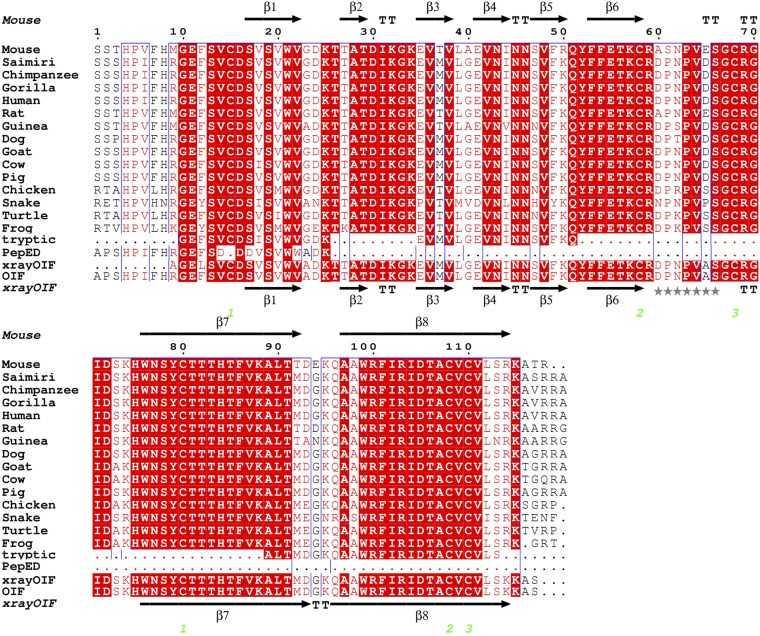
Structure-based sequence alignment of ovulation-inducing factor (OIF) from seminal plasma and nerve growth factor (NGF). Sequence alignments of mature OIF (determined by X-ray crystallography sequencing) with NGF from different species (mouse, PDB 1bet; Saimiri boliviensis, Q5ISB0.2; chimpanzee, BAA90438.1; gorilla, Q9N2F0.1; human, PDB 1sg1; rat, P25427.2; guinea pig, P19093.1; dog, AAY16195.1; goat, AFA52664.1; cow, NP_001092832.1; pig, Q29074.1; chicken, P05200.1; snake venom, Q5YF90.1; turtle, ACY72443.1; and frog, P21617.2). Tryptic is the tryptic peptide sequence of llama OIF (residues:10–23, 35–51, 89–99, and 100–113) obtained by LC-MS/MS and PepED is the N-terminal amino acid sequence of llama OIF obtained by internal Edman degradation. Residues are numbered in black and follow the sequence of mouse NGF (PDB 1bet). Solid black arrows indicate β-strands. TT indicates tight turns. Strictly conserved residues are indicated by white letters on a red background. Conservatively substituted residues are indicated by red letters on a white background. The three disulfide bridges between Cys15 and Cys80, Cys58 and C108, and C68 and Cys110 are shown in green numbers. Loops are labeled L1–L4 (blue). Stars indicate flexible loop 3.
Fig. 3.
Fig. 3.
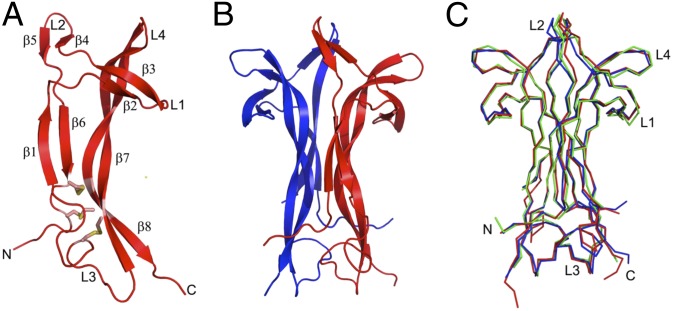
Protein structure of ovulation-inducing factor (OIF) from seminal plasma. (A) Monomer of OIF. β-Strands are labeled (β1–β8). Loops are labeled L1–L4. The three disulfide bridges between Cys15 and Cys80, Cys58 and C108, and C68 and Cys110 are shown in stick representation. (B) Biological dimer of OIF, rotated 90° with respect to A. OIF monomers are colored red and blue. (C) Cα superpositions of OIF (blue), mouse NGF (PDB code 1btg; red), and human NGF (1sg1; green). Superpositions of the three dimers reveal high structural similarity between OIF and NGF. Loops of one of the two monomers are labeled L1–L4.
Fig. 4.
Fig. 4.
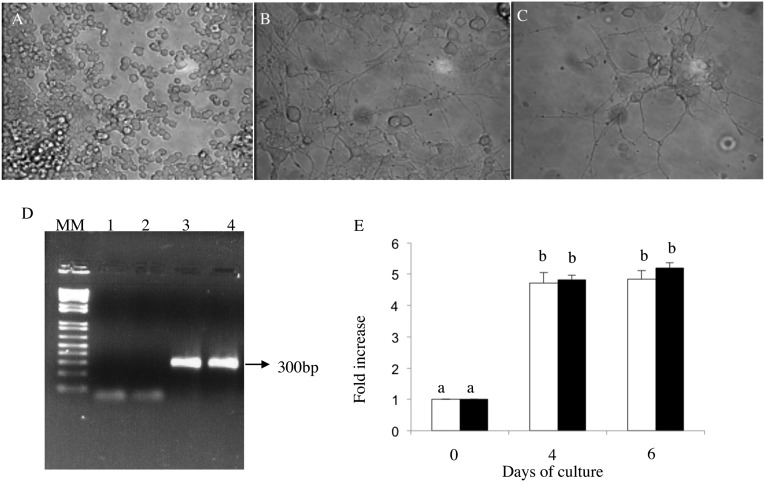
Purified OIF (fraction C2 isolated from llama seminal plasma) induced neurite growth and NGF-specific receptor trkA in immortalized rat phaeochromocytoma (PC12) cells in vitro. PC12 cells after 6 d of in vitro culture with (A) no treatment (negative control), (B) treatment with 50 ng/mL of recombinant mouse NGF (positive control), or (C) treatment with 50 ng/mL of purified OIF (fraction C2 from llama seminal plasma). (D) Transcript expression for the NGF-specific receptor trkA in PC12 cells after 6 d of in vitro culture with 50 ng/mL of recombinant mouse NGF or 50 ng/mL of purified OIF. MM: DNA ladder 100–1100 bp. Lanes 1 and 2: Control template without primers. Lane 3: trkA product in PC12 cells treated with rNGF. Lane 4: trkA product in PC12 cells treated with OIF. (E) Response in mRNA for trkA in PC12 cells after 6 d of in vitro culture with 50 ng/mL recombinant mouse NGF (white bar) or 50 ng/mL of purified OIF (black bar). Mean ± SEM of three independent experiments. (a and b) Values with different superscripts are different (P < 0.01).
Fig. 5.
Fig. 5.
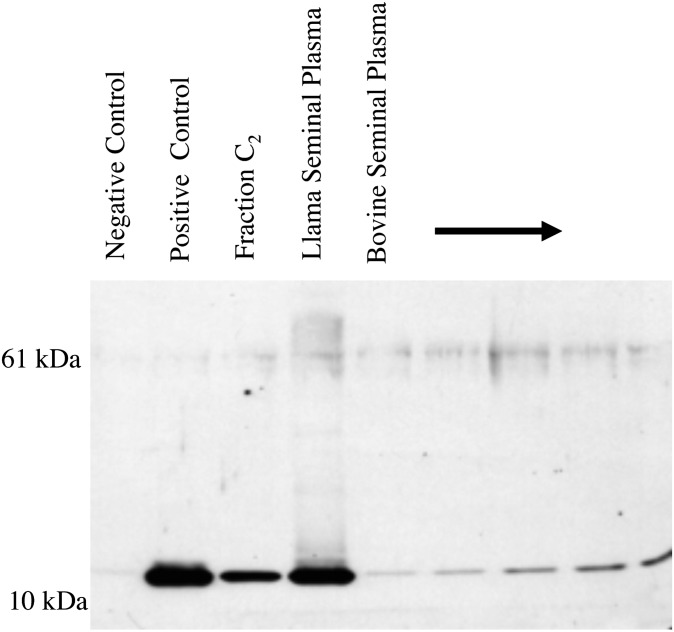
Immunoblot analysis of the seminal plasma of llamas and bulls with a polyclonal mouse anti-NGF. Negative control: cytochrome C (300 ng). Positive control: recombinant mouse NGF (300 ng). Fraction C2: OIF purified from llama seminal plasma (300 ng). Whole llama seminal plasma (800 ng total protein). Whole bovine seminal plasma (0.8, 1.6, 3.2, 4.8, and 6.4 μg total protein, respectively).

References

    1. Mann T. Biochemistry of Semen and of the Male Reproductive Tract. Frome, UK: Butler, Tanner Ltd; 1964. p. 493.
    1. Adams GP, Ratto MH, Huanca W, Singh J. Ovulation-inducing factor in the seminal plasma of alpacas and llamas. Biol Reprod. 2005;73:452–457. - PubMed
    1. Ratto MH, Huanca W, Adams GP. Ovulation-inducing factor: A protein component of llama seminal plasma. Reprod Biol Endocrinol. 2010;8:44. - PMC - PubMed
    1. Ratto MH, Delbaere LTJ, Leduc YA, Pierson RA, Adams GP. Biochemical isolation and purification of ovulation-inducing factor (OIF) in seminal plasma of llamas. Reprod Biol Endocrinol. 2011;9:24. - PMC - PubMed
    1. Bedford JM. Enigmas of mammalian gamete form and function. Biol Rev Camb Philos Soc. 2004;79:429–460. - PubMed

Publication types

MeSH terms

Associated data