


Striatal D(2)/D(3) receptor availability is inversely correlated with cannabis consumption in chronic marijuana users
- PMID: 22909787
- PMCID: PMC3532956
- DOI: 10.1016/j.drugalcdep.2012.07.016
Striatal D(2)/D(3) receptor availability is inversely correlated with cannabis consumption in chronic marijuana users
Abstract
Background: Although the incidence of cannabis abuse/dependence in Americans is rising, the neurobiology of cannabis addiction is not well understood. Imaging studies have demonstrated deficits in striatal D(2)/D(3) receptor availability in several substance-dependent populations. However, this has not been studied in currently using chronic cannabis users.
Objective: The purpose of this study was to compare striatal D(2)/D(3) receptor availability between currently using chronic cannabis users and healthy controls.
Methods: Eighteen right-handed males age 18-34 were studied. Ten subjects were chronic cannabis users; eight were demographically matched controls. Subjects underwent a [(11)C]raclopride (RAC) PET scan. Striatal RAC binding potential (BP(ND)) was calculated on a voxel-wise basis. Prior to scanning, urine samples were obtained from cannabis users for quantification of urine Δ-9-tetrahydrocannabinol (THC) and THC metabolites (11-nor-Δ-9-THC-9-carboxylic acid; THC-COOH and 11-hydroxy-THC;OH-THC).
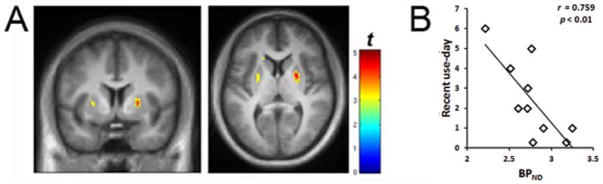
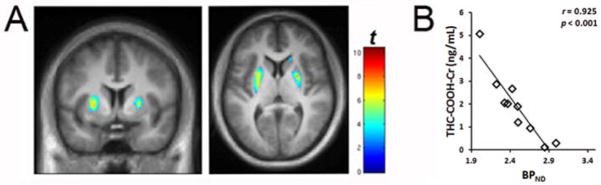
Results: There were no differences in D(2)/D(3) receptor availability between cannabis users and controls. Voxel-wise analyses revealed that RAC BP(ND) values were negatively associated with both urine levels of cannabis metabolites and self-report of recent cannabis consumption.
Conclusions: In this sample, current cannabis use was not associated with deficits in striatal D(2)/D(3) receptor availability. There was an inverse relationship between chronic cannabis use and striatal RAC BP(ND). Additional studies are needed to identify the neurochemical consequences of chronic cannabis use on the dopamine system.
Copyright © 2012 Elsevier Ireland Ltd. All rights reserved.
Conflict of interest statement
The authors declare no conflict of interest.
Figures
References
-
- Barkus E, Morrison PD, Vuletic D, Dickson JC, Ell PJ, Pilowsky LS, Brenneisen R, Holt DW, Powell J, Kapur S, Murray RM. Does intravenous {Delta}9-tetrahydrocannabinol increase dopamine release? A SPET study. J Psychopharmacol. 2011;25:1462–1468. - PubMed
-
- Bossong MG, van Berckel BN, Boellaard R, Zuurman L, Schuit RC, Windhorst AD, van Gerven JM, Ramsey NF, Lammertsma AA, Kahn RS. Delta 9-tetrahydrocannabinol induces dopamine release in the human striatum. Neuropsychopharmacology. 2009;34:759–766. - PubMed
-
- Brunet B, Doucet C, Venisse N, Hauet T, Hebrard W, Papet Y, Mauco G, Mura P. Validation of large white pig as an animal model for the study of cannabinoids metabolism: application to the study of THC distribution in tissues. Forensic Sci Int. 2006;161:169–174. - PubMed
-
- Chen JP, Paredes W, Li J, Smith D, Lowinson J, Gardner EL. Delta 9-tetrahydrocannabinol produces naloxone-blockable enhancement of presynaptic basal dopamine efflux in nucleus accumbens of conscious, freely-moving rats as measured by intracerebral microdialysis. Psychopharmacology (Berl) 1990;102:156–162. - PubMed
Publication types
MeSH terms
Substances
Grants and funding
LinkOut - more resources
Full Text Sources
Other Literature Sources
Medical
Miscellaneous
