Review
. 2012 May-Jun;6(3):141-8.
doi: 10.4161/chan.20292.

Macrophage function in atherosclerosis: potential roles of TRP channels

Affiliations
Review

Macrophage function in atherosclerosis: potential roles of TRP channels

Jean-Yves K Tano et al. Channels (Austin). 2012 May-Jun.

Abstract

Cation channels of the Transient Receptor Potential Canonical (TRPC) group, which belong to the larger TRP superfamily of channel proteins, are critical players in cardiovascular disease. Recent studies underscored a role of TRPC3 in macrophage survival and efferocytosis, two critical events in atherosclerosis lesion development. Also, other members of the TRP channel superfamily are found expressed in monocytes/macrophages, where they participate in processes that might be of significance to atherogenesis. These observations set a framework for future studies aimed at defining the ultimate functions not only of TRPC3, but probably other TRP channels, in macrophage biology. The purpose of this manuscript is to provide a timely revision of existing evidence on the role of members of the TRP channel superfamily, in particular TRPCs, in macrophages and discuss it in the context of the macrophage's function in atherogenesis.


Figures
None
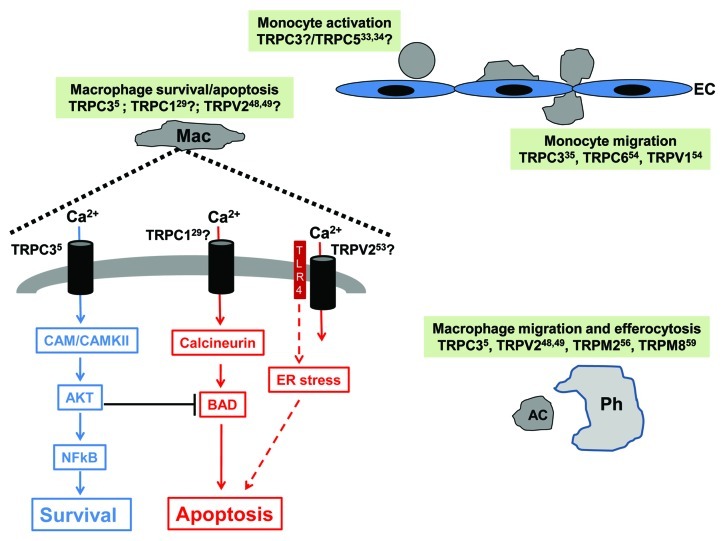
Figure 1. This figure summarizes the evidence discussed in the text regarding potential contribution of TRP channels to monocyte/macrophage function in the context of atherorelevant events. Members of the TRPC and TRPV groups emerge as potential players in processes related to monocyte activation and migration to the subintima, while members of the TRPC, TRPV and TRPM groups might participate in signaling associated to survival, apoptosis and/or efferocytosis (see text for details). Question marks indicate a potential, but not yet examined role for that particular TRP based on published evidence (corresponding reference indicated as a superscript number next to the channel’s name) on its role on related monocyte/macrophage processes. Mac: macrophage; CAM/CAMKII: calmodulin/calmodulin-dependent kinase II; TLR4: Toll-like receptor 4; AC: apoptotic cell; Ph: phagocyte; EC: endothelial cell.

References

    1. Association AH. Heart Disease and Stroke Statistics. Update, Dallas TX, AHA 2008.
    1. Tabas I. Macrophage death and defective inflammation resolution in atherosclerosis. Nat Rev Immunol. 2010;10:36–46. doi: 10.1038/nri2675. - DOI - PMC - PubMed
    1. Smedlund K, Tano J-Y, Vazquez G. The constitutive function of native TRPC3 channels modulates vascular cell adhesion molecule-1 expression in coronary endothelial cells through nuclear factor kappaB signaling. Circ Res. 2010;106:1479–88. doi: 10.1161/CIRCRESAHA.109.213314. - DOI - PubMed
    1. Smedlund K, Vazquez G. Involvement of native TRPC3 proteins in ATP-dependent expression of VCAM-1 and monocyte adherence in coronary artery endothelial cells. Arterioscler Thromb Vasc Biol. 2008;28:2049–55. doi: 10.1161/ATVBAHA.108.175356. - DOI - PubMed
    1. Tano J-Y, Smedlund K, Lee R, Abramowitz J, Birnbaumer L, Vazquez G. Impairment of survival signaling and efferocytosis in TRPC3-deficient macrophages. Biochem Biophys Res Commun. 2011;410:643–7. doi: 10.1016/j.bbrc.2011.06.045. - DOI - PubMed

Publication types
