


Threshold of musculoskeletal pain intensity for increased risk of long-term sickness absence among female healthcare workers in eldercare
- PMID: 22911772
- PMCID: PMC3401109
- DOI: 10.1371/journal.pone.0041287
Threshold of musculoskeletal pain intensity for increased risk of long-term sickness absence among female healthcare workers in eldercare
Abstract
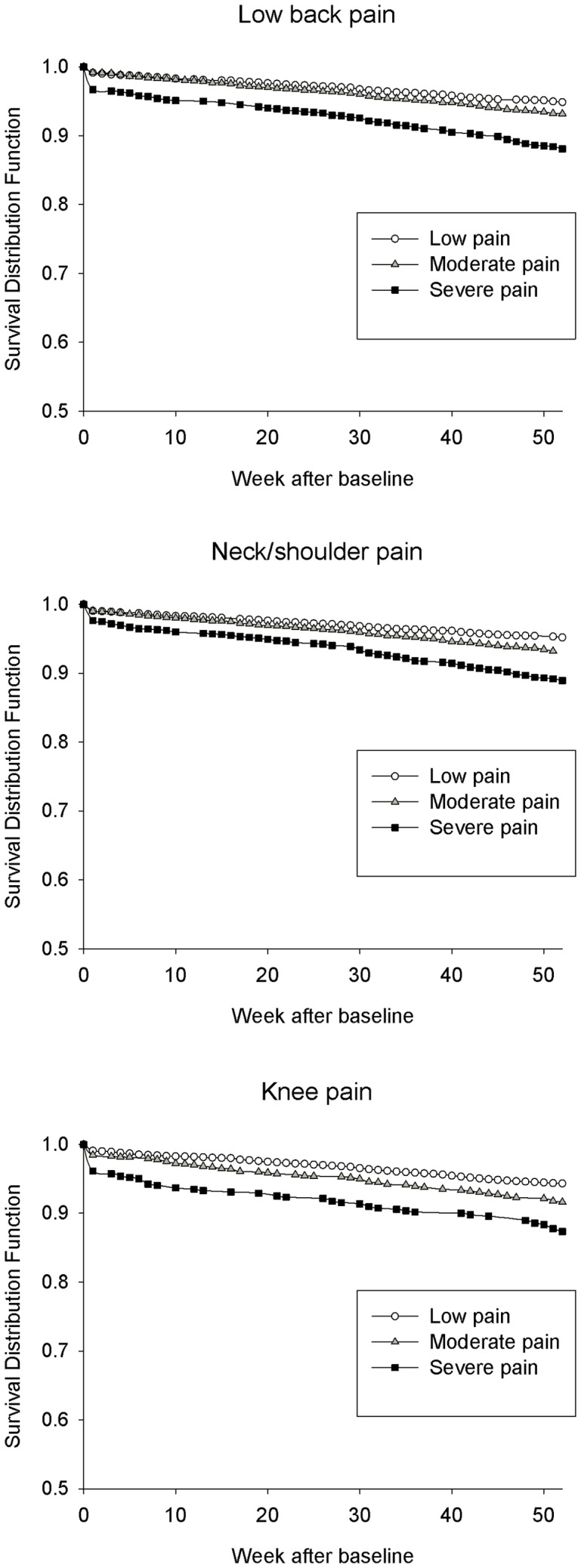
Purpose: Musculoskeletal disorders increase the risk for absenteeism and work disability. However, the threshold when musculoskeletal pain intensity significantly increases the risk of sickness absence among different occupations is unknown. This study estimates the risk for long-term sickness absence (LTSA) from different pain intensities in the low back, neck/shoulder and knees among female healthcare workers in eldercare.
Methods: Prospective cohort study among 8,732 Danish female healthcare workers responding to a questionnaire in 2004-2005, and subsequently followed for one year in a national register of social transfer payments (DREAM). Using Cox regression hazard ratio (HR) analysis we modeled risk estimates of pain intensities on a scale from 0-9 (reference 0, where 0 is no pain and 9 is worst imaginable pain) in the low back, neck/shoulders and knees during the last three months for onset of LTSA (receiving sickness absence compensation for at least eight consecutive weeks) during one-year follow-up.
Results: During follow-up, the 12-month prevalence of LTSA was 6.3%. With adjustment for age, BMI, smoking and leisure physical activity, the thresholds of pain intensities significantly increasing risk of LTSA for the low back (HR 1.44 [95%CI 1.07-1.93]), neck/shoulders (HR 1.47 [95%CI 1.10-1.96]) and knees (HR 1.43 [95%CI 1.06-1.93]) were 5, 4 and 3 (scale 0-9), respectively, referencing pain intensity of 0.
Conclusion: The threshold of pain intensity significantly increasing the risk for LTSA among female healthcare workers varies across body regions, with knee pain having the lowest threshold. This knowledge may be used in the prevention of LTSA among health care workers.
Conflict of interest statement
Figures
References
-
- Høgelund J, Filges T, Jensen S. Long-term sickness absence − what happens and how does it go? The Danish National Institute of Social Research, Copenhagen. Report. 2003;03:20.
-
- Waddell G, Burton K. Is Work Good for Your Health and Well-being? London: The Stationary Office. 2006.
-
- Veale DJ, Woolf AD, Carr AJ. Chronic musculoskeletal pain and arthritis: impact, attitudes and perceptions. Ir Med J. 2008;101:208–210. - PubMed
-
- Bevan S, Quadrello T, McGee R, Mahdon M, Vovrovsky A, et al. Fit For Work – Musculoskeletal disorders in the European workforce. 2009. pp. 1–143.
Publication types
MeSH terms
LinkOut - more resources
Full Text Sources
