


Linkage disequilibrium in Angus, Charolais, and Crossbred beef cattle
- PMID: 22912646
- PMCID: PMC3418579
- DOI: 10.3389/fgene.2012.00152
Linkage disequilibrium in Angus, Charolais, and Crossbred beef cattle
Abstract
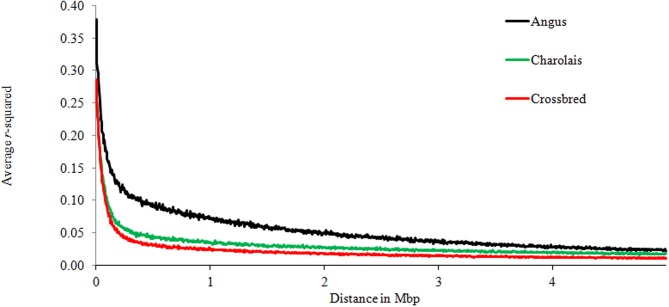
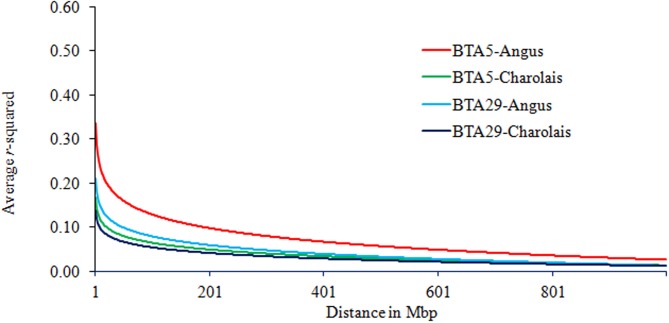
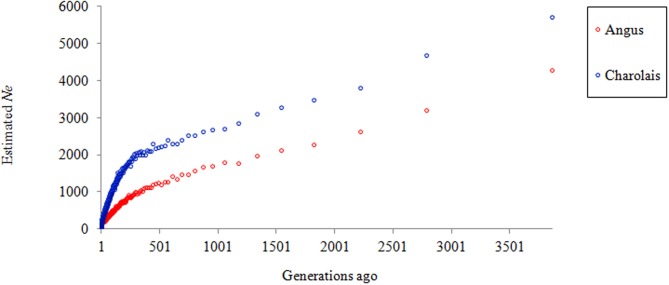
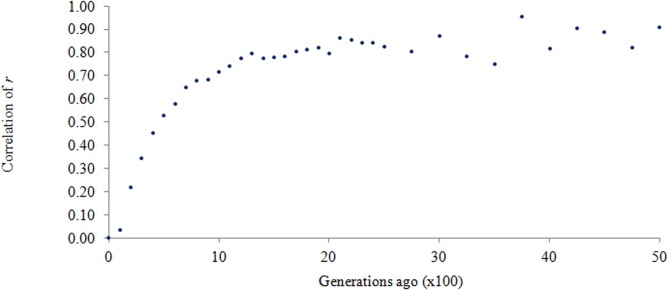
Linkage disequilibrium (LD) and the persistence of its phase across populations are important for genomic selection as well as fine scale mapping of quantitative trait loci (QTL). However, knowledge of LD in beef cattle, as well as the persistence of LD phase between crossbreds (C) and purebreds, is limited. The objective of this study was to understand the patterns of LD in Angus (AN), Charolais (CH), and C beef cattle based on 31,073, 32,088, and 33,286 SNP in each population, respectively. Amount of LD decreased rapidly from 0.29 to 0.23 to 0.19 in AN, 0.22 to 0.16 to 0.12 in CH, 0.21 to 0.15 to 0.11 in C, when the distance range between markers changed from 0-30 kb to 30-70 kb and then to 70-100 kb, respectively. Breeds and chromosomes had significant effects (P < 0.001) on LD decay. There was significant interaction between breeds and chromosomes (P < 0.001). Correlations of LD phase were high between C and AN (0.84), C and CH (0.81), as well as between AN and CH (0.77) for distances less than or equal to 70 kb. These dropped when the distance increased. Estimated effective population sizes for AN and CH were 207 and 285, respectively, for 10 generations ago. Given a useful LD of at least 0.3 between pairs of SNPs, the LD phase between any pair of the three breed groups was highly persistent. The current SNP density would allow the capture of approximately 49% of useful LD between SNP and marker QTL in AN, and 38% in CH. A higher density SNP panel or redesign of the current panel is needed to achieve more of useful LD for the purpose of genomic selection beef cattle.
Keywords: beef cattle; linkage disequilibrium.
Figures
References
-
- Abecasis G. R., Noguchi E., Heinzmann A., Traherne J. A., Bhattacharyya S., Leaves N. I., Anderson G. G., Zhang Y., Lench N. J., Carey A., Cardon L. R., Moffatt M. F., Cookson W. O. (2001). Extent and distribution of linkage disequilibrium in three genomic regions. Am. J. Hum. Genet. 68, 191–197 10.1086/316944 - DOI - PMC - PubMed
-
- Affymetrix Inc. (2011). Data sheet. Available online at http://media.affymetrix.com/support/technical/datasheets/axiom_gw_bos1_a... [Accessed April 25, 2012].
-
- American Angus Association. (2012). Genetic trend – EPD by birth year. Available online at http://www.angus.org/Nce/GeneticTrends.aspx [Accessed April 25, 2012].
-
- Casas E., Shackelford S. D., Keele J. W., Stone R. T., Kappes S. M., Koohmaraie M. (2000). Quantitative trait loci affecting growth and carcass composition of cattle segregating alternate forms of myostatin. J. Anim. Sci. 78, 560–569 - PubMed
LinkOut - more resources
Full Text Sources
Research Materials
