


Altered anesthetic sensitivity of mice lacking Ndufs4, a subunit of mitochondrial complex I
- PMID: 22912761
- PMCID: PMC3422219
- DOI: 10.1371/journal.pone.0042904
Altered anesthetic sensitivity of mice lacking Ndufs4, a subunit of mitochondrial complex I
Abstract
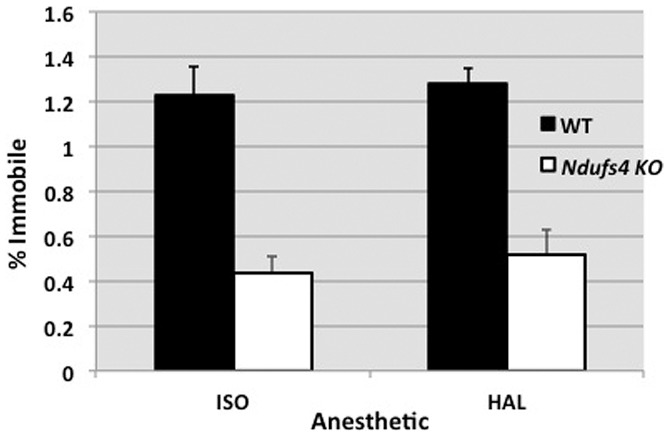
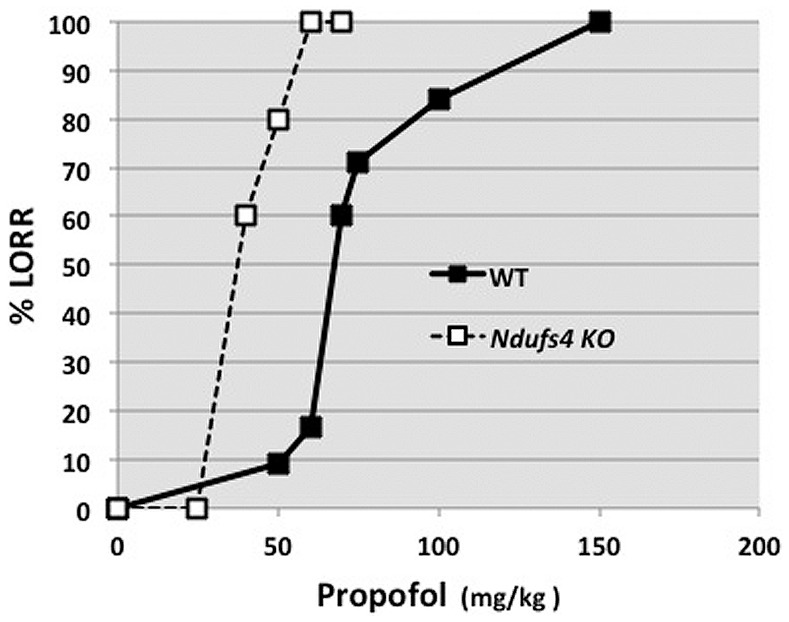
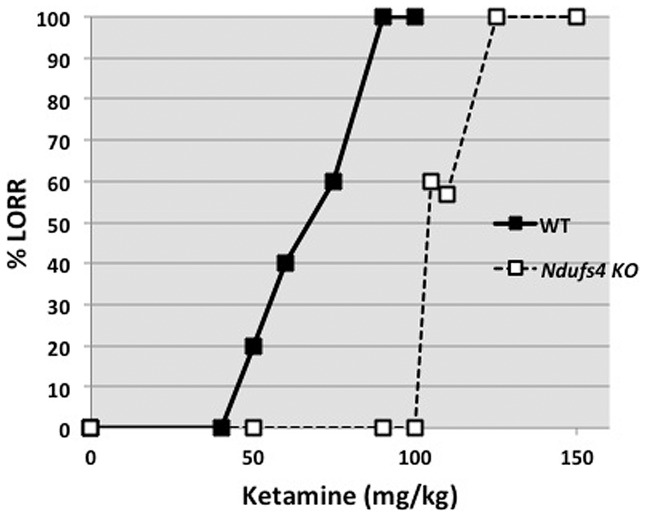
Anesthetics are in routine use, yet the mechanisms underlying their function are incompletely understood. Studies in vitro demonstrate that both GABA(A) and NMDA receptors are modulated by anesthetics, but whole animal models have not supported the role of these receptors as sole effectors of general anesthesia. Findings in C. elegans and in children reveal that defects in mitochondrial complex I can cause hypersensitivity to volatile anesthetics. Here, we tested a knockout (KO) mouse with reduced complex I function due to inactivation of the Ndufs4 gene, which encodes one of the subunits of complex I. We tested these KO mice with two volatile and two non-volatile anesthetics. KO and wild-type (WT) mice were anesthetized with isoflurane, halothane, propofol or ketamine at post-natal (PN) days 23 to 27, and tested for loss of response to tail clamp (isoflurane and halothane) or loss of righting reflex (propofol and ketamine). KO mice were 2.5 - to 3-fold more sensitive to isoflurane and halothane than WT mice. KO mice were 2-fold more sensitive to propofol but resistant to ketamine. These changes in anesthetic sensitivity are the largest recorded in a mammal.
Conflict of interest statement
Figures
References
-
- Franks NP, Lieb WR (1994) Molecular and cellular mechanisms of general anaesthesia. Nature 367: 607–614. - PubMed
-
- Humphrey JA, Sedensky MM, Morgan PG (2002) Understanding anesthesia: making genetic sense of the absence of senses. Hum Mol Genet 11: 1241–1249. - PubMed
-
- Campagna JA, Miller KW, Forman SA (2003) Mechanisms of actions of inhaled anesthetics. N Engl J Med 348: 2110–2124. - PubMed
-
- Eger EI 2nd, Liao M, Laster MJ, Won A, Popovich J, et al. (2006) Contrasting roles of the N-methyl-D-aspartate receptor in the production of immobilization by conventional and aromatic anesthetics. Anesth Analg 102: 1397–1406. - PubMed
-
- Liao M, Sonner JM, Jurd R, Rudolph U, Borghese CM, et al. (2005) Beta3-containing gamma-aminobutyric acidA receptors are not major targets for the amnesic and immobilizing actions of isoflurane. Anesth Analg 101: 412–418, table of contents. - PubMed
Publication types
MeSH terms
Substances
Grants and funding
LinkOut - more resources
Full Text Sources
Molecular Biology Databases
Research Materials
