


Diversity and physiological characterization of D-xylose-fermenting yeasts isolated from the Brazilian Amazonian Forest
- PMID: 22912807
- PMCID: PMC3418277
- DOI: 10.1371/journal.pone.0043135
Diversity and physiological characterization of D-xylose-fermenting yeasts isolated from the Brazilian Amazonian Forest
Abstract
Background: This study is the first to investigate the Brazilian Amazonian Forest to identify new D-xylose-fermenting yeasts that might potentially be used in the production of ethanol from sugarcane bagasse hemicellulosic hydrolysates.
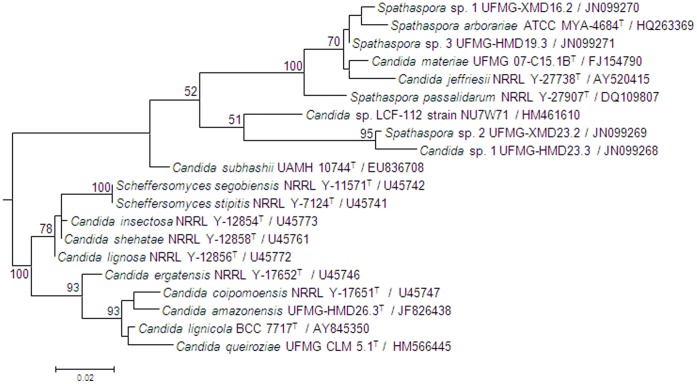
Methodology/principal findings: A total of 224 yeast strains were isolated from rotting wood samples collected in two Amazonian forest reserve sites. These samples were cultured in yeast nitrogen base (YNB)-D-xylose or YNB-xylan media. Candida tropicalis, Asterotremella humicola, Candida boidinii and Debaryomyces hansenii were the most frequently isolated yeasts. Among D-xylose-fermenting yeasts, six strains of Spathaspora passalidarum, two of Scheffersomyces stipitis, and representatives of five new species were identified. The new species included Candida amazonensis of the Scheffersomyces clade and Spathaspora sp. 1, Spathaspora sp. 2, Spathaspora sp. 3, and Candida sp. 1 of the Spathaspora clade. In fermentation assays using D-xylose (50 g/L) culture medium, S. passalidarum strains showed the highest ethanol yields (0.31 g/g to 0.37 g/g) and productivities (0.62 g/L · h to 0.75 g/L · h). Candida amazonensis exhibited a virtually complete D-xylose consumption and the highest xylitol yields (0.55 g/g to 0.59 g/g), with concentrations up to 25.2 g/L. The new Spathaspora species produced ethanol and/or xylitol in different concentrations as the main fermentation products. In sugarcane bagasse hemicellulosic fermentation assays, S. stipitis UFMG-XMD-15.2 generated the highest ethanol yield (0.34 g/g) and productivity (0.2 g/L · h), while the new species Spathaspora sp. 1 UFMG-XMD-16.2 and Spathaspora sp. 2 UFMG-XMD-23.2 were very good xylitol producers.
Conclusions/significance: This study demonstrates the promise of using new D-xylose-fermenting yeast strains from the Brazilian Amazonian Forest for ethanol or xylitol production from sugarcane bagasse hemicellulosic hydrolysates.
Conflict of interest statement
Figures
References
-
- Pokhrel CP, Yadav RKP, Ohga S (2008) Agricultural waste residues as potential sources of bioethanol. Sci World 6: 19–23.
-
- Kim S, Dale BE (2005) Lyfe cycle assessment of various cropping systems utilized for producing biofuels: bioethanol and biodiesel. Biomass Bioenerg 29: 426–439.
-
- Aristidou A, Penttila M (2000) Metabolic engineering applications to renewable resource utilization. Curr Opin Biotechnol 11: 187–198. - PubMed
-
- Nakamura N, Yamada R, Katahira S, Tanaka T, Fukuda H, et al. (2008) Effective xylose/cellobiose co-fermentation and ethanol production by xylose-assimilating S. cerevisiae via expression of β-glucosidase on its cell surface. Enzyme MicrobTech 43; 233–236.
-
- Chandel AK, Singh OV, Chandrasekhar G, Rao LV, Narasu ML (2010) Key-drivers influencing the commercialization of ethanol based biorefineries. J Comm Biotechnol 16: 239–257.
Publication types
MeSH terms
Substances
LinkOut - more resources
Full Text Sources
Molecular Biology Databases
