Review
. 2012 Sep;5(5):595-607.
doi: 10.1242/dmm.009613.

The evolution of human adiposity and obesity: where did it all go wrong?

Affiliations
Review

The evolution of human adiposity and obesity: where did it all go wrong?

Jonathan C K Wells. Dis Model Mech. 2012 Sep.

Abstract

Because obesity is associated with diverse chronic diseases, little attention has been directed to the multiple beneficial functions of adipose tissue. Adipose tissue not only provides energy for growth, reproduction and immune function, but also secretes and receives diverse signaling molecules that coordinate energy allocation between these functions in response to ecological conditions. Importantly, many relevant ecological cues act on growth and physique, with adiposity responding as a counterbalancing risk management strategy. The large number of individual alleles associated with adipose tissue illustrates its integration with diverse metabolic pathways. However, phenotypic variation in age, sex, ethnicity and social status is further associated with different strategies for storing and using energy. Adiposity therefore represents a key means of phenotypic flexibility within and across generations, enabling a coherent life-history strategy in the face of ecological stochasticity. The sensitivity of numerous metabolic pathways to ecological cues makes our species vulnerable to manipulative globalized economic forces. The aim of this article is to understand how human adipose tissue biology interacts with modern environmental pressures to generate excess weight gain and obesity. The disease component of obesity might lie not in adipose tissue itself, but in its perturbation by our modern industrialized niche. Efforts to combat obesity could be more effective if they prioritized 'external' environmental change rather than attempting to manipulate 'internal' biology through pharmaceutical or behavioral means.


Figures
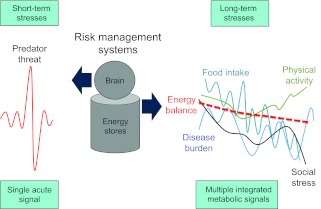
Fig. 1.
Fig. 1.
Adiposity as risk management. This model treats adipose tissue as an endocrine regulatory system integrating multiple signals of energy supply and demand in order to optimize the allocation of energy across competing functions. This slower-response endocrine system contrasts with the faster-response regulation of behavior by the neural system (the brain), in response to acute signals. The example shows an individual responding to negative energy balance caused by increasing energy demand and decreasing supply.
Fig. 2.
Fig. 2.
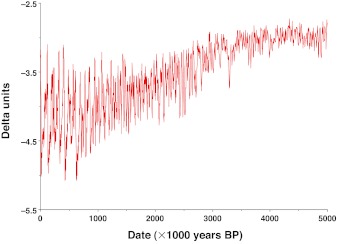
Isotopic trends over the last 5 million years. Oxygen-18 (18O) isotope levels are directly equivalent to average global temperature. As the world became steadily cooler, shorter-term climate stochasticity also increased substantially, indicating less stable ecological conditions. Based on published data (Lisiecki and Raymo, 2005). BP, before present.
Fig. 3.
Fig. 3.
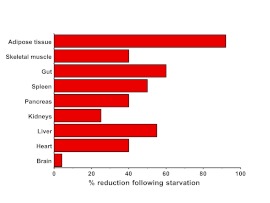
Percentage reduction in the mass of various organs and tissues during starvation. During starvation, the amount of adipose tissue decreases substantially, but most other tissues also decline. Based on published data (Rivers, 1988).
Fig. 4.
Fig. 4.
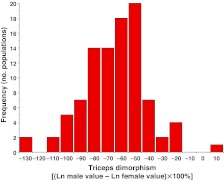
Histogram of sexual dimorphism in triceps skinfold thickness in 96 non-industrialized populations. These data indicate the trend for substantially greater arm fat in females compared with males, but also substantial variability among populations in this dimorphism. Reprinted with permission (Wells, 2012b).
Fig. 5.
Fig. 5.
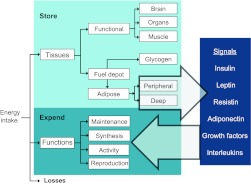
Energy metabolism as an ‘allocation game’, with incoming energy allocated to ongoing biological functions (energy expenditure) or a range of energy stores. The allocation ‘decisions’ are assumed to be orchestrated by various signaling molecules. Adapted with permission (Wells, 2009a).
Fig. 6.
Fig. 6.
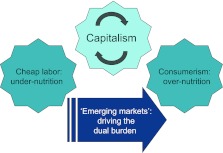
Schematic diagram of the role of capitalism in global under-nutrition and over-nutrition. In recent decades, the exponential growth of the globalized economy has led to rapid economic development in many countries, resulting in populations further undergoing rapid shifts from chronic under-nutrition to chronic energy excess. In each case, powerful commercial companies privatize the profits arising from manipulating the global supply of food, but socialize the health costs (Albritton, 2009).

References

    1. Abi-Rached L., Jobin M. J., Kulkarni S., McWhinnie A., Dalva K., Gragert L., Babrzadeh F., Gharizadeh B., Luo M., Plummer F. A., et al. (2011). The shaping of modern human immune systems by multiregional admixture with archaic humans. Science 334, 89–94 - PMC - PubMed
    1. Adam T. C., Epel E. S. (2007). Stress, eating and the reward system. Physiol. Behav. 91, 449–458 - PubMed
    1. Ahima R. S. (2006). Adipose tissue as an endocrine organ. Obesity 14 Suppl. 5, 242S–249S - PubMed
    1. Albritton R. (2009). Let Them Eat Junk. London: Pluto Press
    1. Altmann J., Schoeller D., Altmann S. A., Muruthi P., Sapolsky R. M. (1993). Body size and fatness of free-living baboons reflect food availability and activity levels. Am. J. Primatol. 30, 149–161 - PubMed

Publication types