


Missed Opportunities: barriers to HIV testing during pregnancy from a population based cohort study in rural Uganda
- PMID: 22916089
- PMCID: PMC3420922
- DOI: 10.1371/journal.pone.0037590
Missed Opportunities: barriers to HIV testing during pregnancy from a population based cohort study in rural Uganda
Abstract
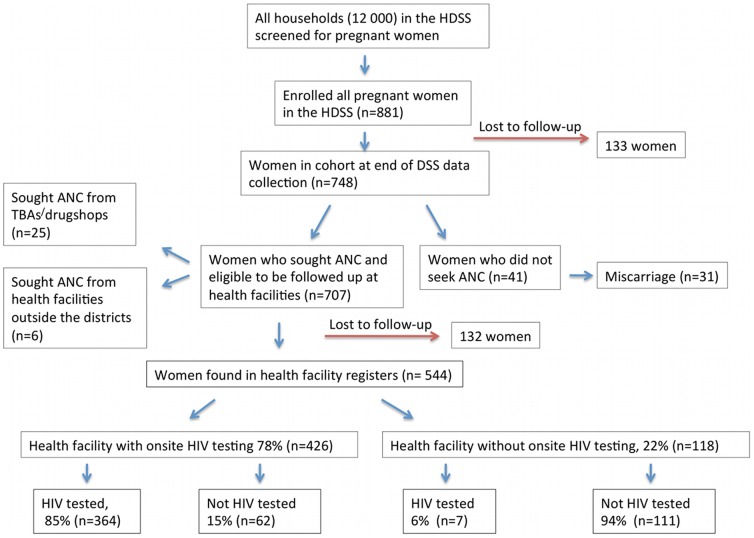
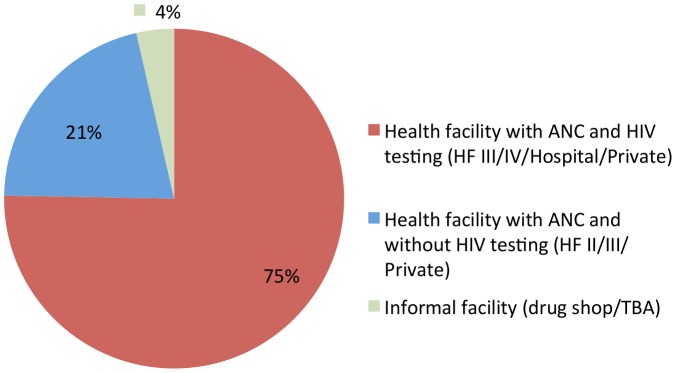
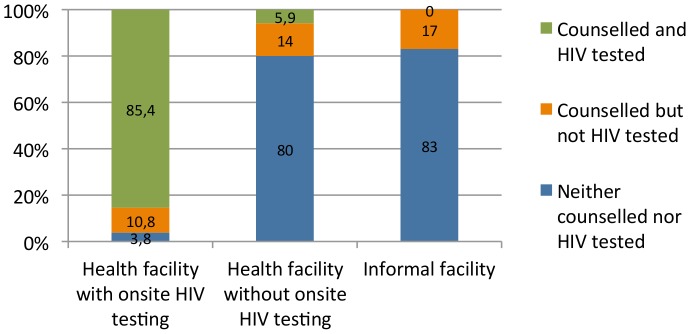
The aim was to assess population-level HIV-testing uptake among pregnant women, key for access to prevention-of mother to child transmission (PMTCT) services, and to identify risk factors for not being HIV tested,The study was conducted May 2008-May 2010 in the Iganga/Mayuge Health and Demographic Surveillance Site (HDSS), Eastern Uganda, during regular surveillance of 68,000 individuals. All women identified to be pregnant May-July 2008 (n=881) were interviewed about pregnancy-related issues and linked to the HDSS database for socio-demographic data. Women were followed-up via antenatal care (ANC) register reviews at the health facilities to collect data related to ANC services received, including HIV testing. Adjusted relative risk (aRR), and 95% confidence intervals (CI) for not being HIV tested were calculated using multivariable binomial regression among the 544 women who remained after record review.Despite high ANC attendance (96%), the coverage of HIV testing was 64%. Only 6% of pregnant women who sought ANC at a facility without HIV testing services were referred for testing and only 20% received counseling regarding HIV. At ANC facilities with HIV testing services, 85% were tested. Only 4% of the women tested had been couple tested for HIV. Living more than three kilometers away from a health facility with HIV testing services was associated with not being tested both among the poorest (aRR,CI; 1.44,1.02-2.04) and the least poor women (aRR,CI;1.72,1.12-2.63).The lack of on site HIV testing services and distant ANC facilities lead to missed opportunities for PMTCT, especially for the poorest women. Referral systems for HIV testing need to be improved and testing should be expanded to lower level health facilities. This is in order to ensure that the policy of HIV testing during pregnancy is implemented more effectively and that testing is accessible for all.
Conflict of interest statement
Figures
References
-
- UNAIDS (2010) Global report: UNAIDS report on the global AIDS epidemic 2010.
-
- Uganda Bureau of Statistics, Macro International Inc. (2007) Uganda Demographic and Health Survey 2006.
-
- WHO, UNAIDS, UNICEF (2011) Global HIV/AIDS response. Epidemic update and health sector progress towards Universal Access. Progress report 2011.
-
- UNAIDS (2011) Global Plan towards the elimination of new HIV infections among children by 2015 and keeping their mothers alive. 2011–2015. - PubMed
-
- Kilewo C, Karlsson K, Massawe A, Lyamuya E, Swai A, et al. (2008) Prevention of Mother-to-Child Transmission of HIV-1 Through Breast-Feeding by Treating Infants Prophylactically With Lamivudine in Dar es Salaam, Tanzania: The Mitra Study. J Acquir Immune Defic Syndr - PubMed
Publication types
MeSH terms
LinkOut - more resources
Full Text Sources
Medical
