


Antimicrobial and antioxidant activities of the extracts and compounds from the leaves of Psorospermum aurantiacum Engl. and Hypericum lanceolatum Lam
- PMID: 22916964
- PMCID: PMC3576290
- DOI: 10.1186/1472-6882-12-136
Antimicrobial and antioxidant activities of the extracts and compounds from the leaves of Psorospermum aurantiacum Engl. and Hypericum lanceolatum Lam
Abstract
Background: Psorospermun aurantiacum and Hypericum lanceolatum are plants locally used in Cameroon and other parts of Africa for the treatment of gastrointestinal and urinary tract infections, skin infections, venereal diseases, gastrointestinal disorder, infertility, epilepsy as well as microbial infections. The present study was designed in order to investigate the in vitro antimicrobial and radical scavenging activities of the extracts and isolated compounds from the leaves of these plants.
Methods: The plant extract was prepared by maceration in ethyl acetate and methanol and fractionated by column chromatography. The structures of isolated compounds were elucidated by spectroscopic analyses in conjunction with literature data. The broth microdilution method was used to evaluate the in vitro antimicrobial activity against bacteria, yeasts and dermatophytes. The antioxidant potentials of the extracts and their isolated compounds were evaluated using the DPPH radical scavenging method.
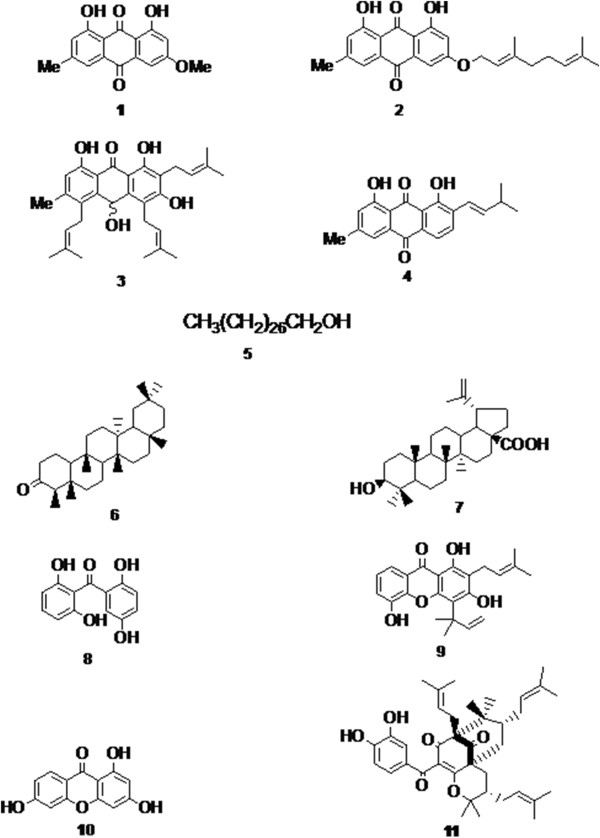
Results: Five known compounds: physcion (1), 1,8-dihydroxy-3-geranyloxy-6-methylanthraquinone (2), kenganthranol B (3), vismiaquinone (4), and octacosanol (5) were isolated from the leaves of P. aurantiacum while six compounds including friedelin (6), betulinic acid (7), 2,2',5,6'-tetrahydroxybenzophenone (8), allanxanthone A (9), 1,3,6- trihydroxyxanthone (10) and isogarcinol (11) were isolated from H. lanceolatum. Compound 8 and 4 exhibited the highest antibacterial and antifungal activities with MIC ranges of 2-8 μg/ml and 4-32 μg/ml respectively. P. aurantiacum crude extract (Rsa50 = 6.359 ± 0.101) showed greater radical scavenging activity compared with H. lanceolatum extract (Rsa50 = 30.996 ± 0.879). Compound 11 showed the highest radical scavenging activity (RSa50 = 1.012 ± 0.247) among the isolated compounds, comparable to that of L-arscobic acid (RSa50 = 0.0809 ± 0.045).
Conclusions: The experimental findings show that the ethyl acetate and methanol extracts and isolated compounds from P. aurantiacum and H. lanceolatum stem bark possess significant antimicrobial and antioxidant activities justifying the use of these plants in traditional medicine, which may be developed as phytomedicines.
Figures

References
-
- Venkata SP, Murali MC, Prameela K, Sravani R, Raju BA. Screening of Antimicrobial and Antioxidant Potentials of Acacia caesia, Dillenia pentagyna and Buchanania lanzan from Maredumilli Forest of India. J Pharm Res. 2012;5(3):1734–1738.
-
- Hutchinson J, Dalziel JM. Flora of West Tropical Africa (Revised by Keay RWJ). Part 1. 2. The Whitefriars Press Ltd, London and Tonbridge; 1954.
Publication types
MeSH terms
Substances
LinkOut - more resources
Full Text Sources
Medical
