


Are personal health records safe? A review of free web-accessible personal health record privacy policies
- PMID: 22917868
- PMCID: PMC3510685
- DOI: 10.2196/jmir.1904
Are personal health records safe? A review of free web-accessible personal health record privacy policies
Abstract
Background: Several obstacles prevent the adoption and use of personal health record (PHR) systems, including users' concerns regarding the privacy and security of their personal health information.
Objective: To analyze the privacy and security characteristics of PHR privacy policies. It is hoped that identification of the strengths and weaknesses of the PHR systems will be useful for PHR users, health care professionals, decision makers, and designers.
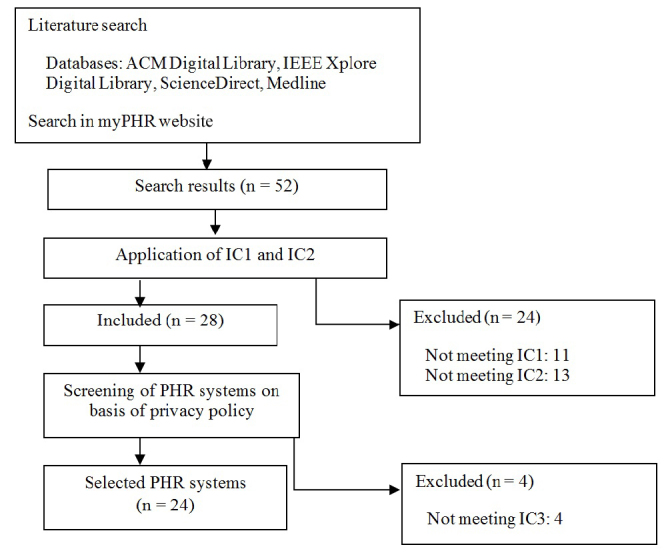
Methods: We conducted a systematic review using the principal databases related to health and computer science to discover the Web-based and free PHR systems mentioned in published articles. The privacy policy of each PHR system selected was reviewed to extract its main privacy and security characteristics.
Results: The search of databases and the myPHR website provided a total of 52 PHR systems, of which 24 met our inclusion criteria. Of these, 17 (71%) allowed users to manage their data and to control access to their health care information. Only 9 (38%) PHR systems permitted users to check who had accessed their data. The majority of PHR systems used information related to the users' accesses to monitor and analyze system use, 12 (50%) of them aggregated user information to publish trends, and 20 (83%) used diverse types of security measures. Finally, 15 (63%) PHR systems were based on regulations or principles such as the US Health Insurance Portability and Accountability Act (HIPAA) and the Health on the Net Foundation Code of Conduct (HONcode).
Conclusions: Most privacy policies of PHR systems do not provide an in-depth description of the security measures that they use. Moreover, compliance with standards and regulations in PHR systems is still low.
Conflict of interest statement
None declared.
Figures
References
-
- Liu LS, Shih PC, Hayes GR. Barriers to the adoption and use of personal health record systems. Proceedings of the iConference; iConference; Feb 8-11, 2011; Seattle, WA, USA. New York, NY: ACM; 2011. pp. 363–70. - DOI
-
- US Department of Health and Human Services, Office for Civil Rights. 2008. Dec 15, [2011-08-05]. Personal Health Records and the HIPAA Privacy Rule http://www.hhs.gov/ocr/privacy/hipaa/understanding/special/healthit/phrs....
-
- Fernandez-Luque L, Karlsen R, Bonander J. Review of extracting information from the Social Web for health personalization. J Med Internet Res. 2011 Jan;13(1):e15. doi: 10.2196/jmir.1432. http://www.jmir.org/2011/1/e15/v13i1e15 - DOI - PMC - PubMed
-
- Tang PC, Ash JS, Bates DW, Overhage JM, Sands DZ. Personal health records: definitions, benefits, and strategies for overcoming barriers to adoption. J Am Med Inform Assoc. 2006 Apr;13(2):121–6. doi: 10.1197/jamia.M2025. http://jamia.bmj.com/cgi/pmidlookup?view=long&pmid=16357345M2025 - DOI - PMC - PubMed
-
- Adida B, Kohane IS. GenePING: secure, scalable management of personal genomic data. BMC Genomics. 2006 Apr;7:93. doi: 10.1186/1471-2164-7-93. http://www.biomedcentral.com/1471-2164/7/931471-2164-7-93 - DOI - PMC - PubMed
Publication types
MeSH terms
LinkOut - more resources
Full Text Sources
Medical
Miscellaneous
