. 2013 Jan 1;64(6):68-74.
doi: 10.1016/j.neuroimage.2012.07.064. Epub 2012 Aug 16.

Expected reward modulates encoding-related theta activity before an event

Affiliations

Expected reward modulates encoding-related theta activity before an event

Matthias J Gruber et al. Neuroimage. .

Abstract

Oscillatory brain activity in the theta frequency range (4-8 Hz) before the onset of an event has been shown to affect the likelihood of successfully encoding the event into memory. Recent work has also indicated that frontal theta activity might be modulated by reward, but it is not clear how reward expectancy, anticipatory theta activity, and memory formation might be related. Here, we used scalp electroencephalography (EEG) to assess the relationship between these factors. EEG was recorded from healthy adults while they memorized a series of words. Each word was preceded by a cue that indicated whether a high or low monetary reward would be earned if the word was successfully remembered in a later recognition test. Frontal theta power between the presentation of the reward cue and the onset of a word was predictive of later memory for the word, but only in the high reward condition. No theta differences were observed before word onset following low reward cues. The magnitude of prestimulus encoding-related theta activity in the high reward condition was correlated with the number of high reward words that were later confidently recognized. These findings provide strong evidence for a link between reward expectancy, theta activity, and memory encoding. Theta activity before event onset seems to be especially important for the encoding of motivationally significant stimuli. One possibility is that dopaminergic activity during reward anticipation mediates frontal theta activity related to memory.


Figures

Fig. 1
Fig. 1
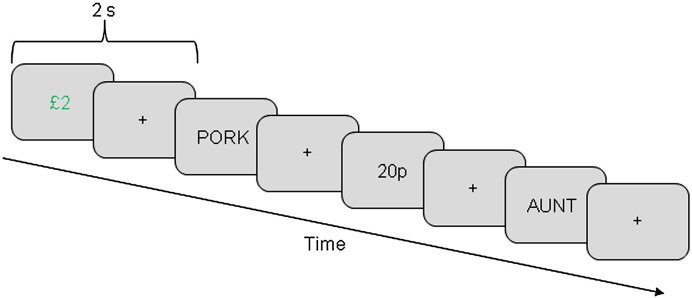
Experimental procedure of the encoding phase. Each word (e.g. ‘pork’ or ‘aunt’) was preceded by either a low or a high reward cue (‘20p’ written in black or ‘£2’ written in green, respectively). The reward cue indicated the amount of money that would be received if the upcoming item was remembered in a later recognition test. The interval between cue and word was constant (i.e. 2 s) and was used for the analyses of encoding-related theta activity.
Fig. 2
Fig. 2
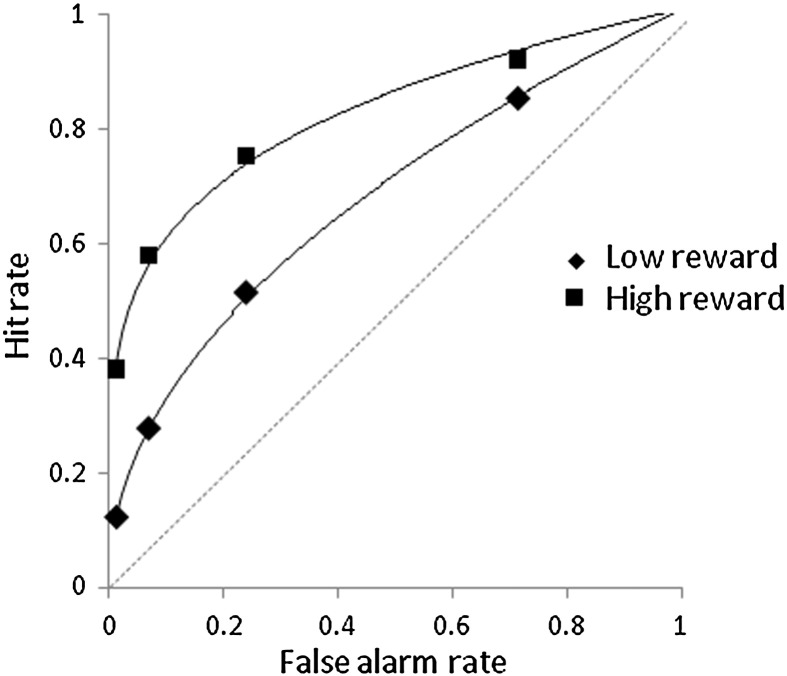
Recognition memory performance. Receiver operating characteristic (ROC) curves for words in the low and high reward conditions.
Fig. 3
Fig. 3
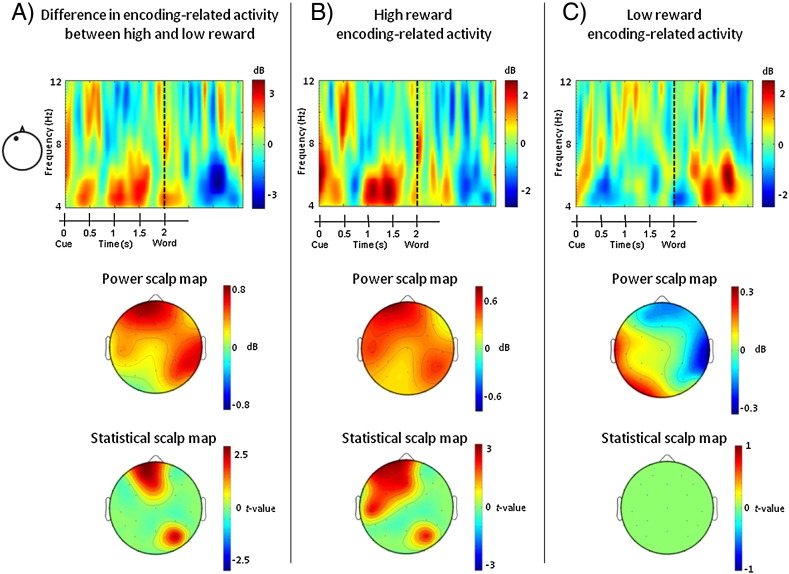
Encoding-related theta activity before word onset. Top row: Time–frequency representations of the difference in oscillatory power at a frontal scalp site between words that were later confidently recognized or forgotten (i.e. encoding-related activity). The frontal electrode represents site 50 from montage 10, www.easycap.de/easycap/e/electrodes/13_M10.htm, equivalent to Fp1 in the 10/10 system; the data were spatially smoothed for display purposes. The time–frequency representations display the difference in encoding-related activity between the low and high reward conditions (A), encoding-related activity in the high reward condition (B), and encoding-related activity in the low reward condition (C). A prestimulus subsequent memory effect in the theta frequency band can be seen in the middle of the cue-word interval in the high reward condition only. Middle row: Scalp maps depicting the location of encoding-related theta activity in the 1–0.4 s interval before word onset (i.e. 1–1.6 s interval after cue onset). The maps depict encoding-related theta power between the low and high reward conditions (A), the high reward condition (B), and the low reward condition (C). Bottom row: Statistical scalp maps corresponding to the power scalp maps displayed in the middle row. Instead of the data, the maps show the statistics of the permutation tests on encoding-related theta power in the 1–0.4 s interval before word onset. The color coding represents the value of the t statistics where significant differences were found (p < 0.05). A frontal prestimulus subsequent memory effect in the theta frequency band is only evident in the high reward condition.
Fig. 4
Fig. 4
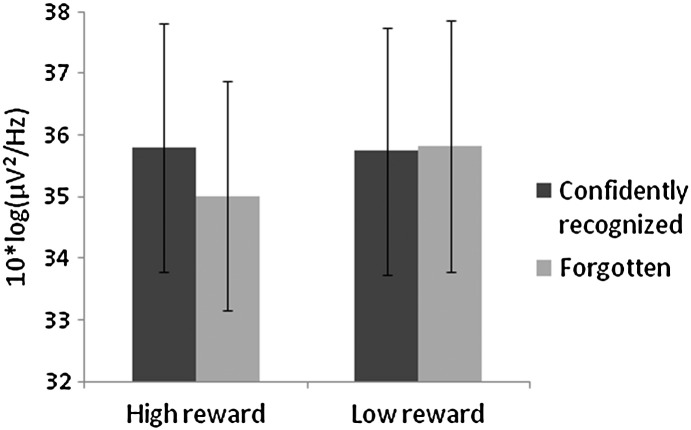
Absolute theta power preceding words that were later remembered versus forgotten in the low and high reward conditions. Values represent power averaged across the 1–0.4 s interval before word onset at site 50 from montage 10, www.easycap.de/easycap/e/electrodes/13_M10.htm, equivalent to Fp1 in the 10/10 system.
Fig. 5
Fig. 5
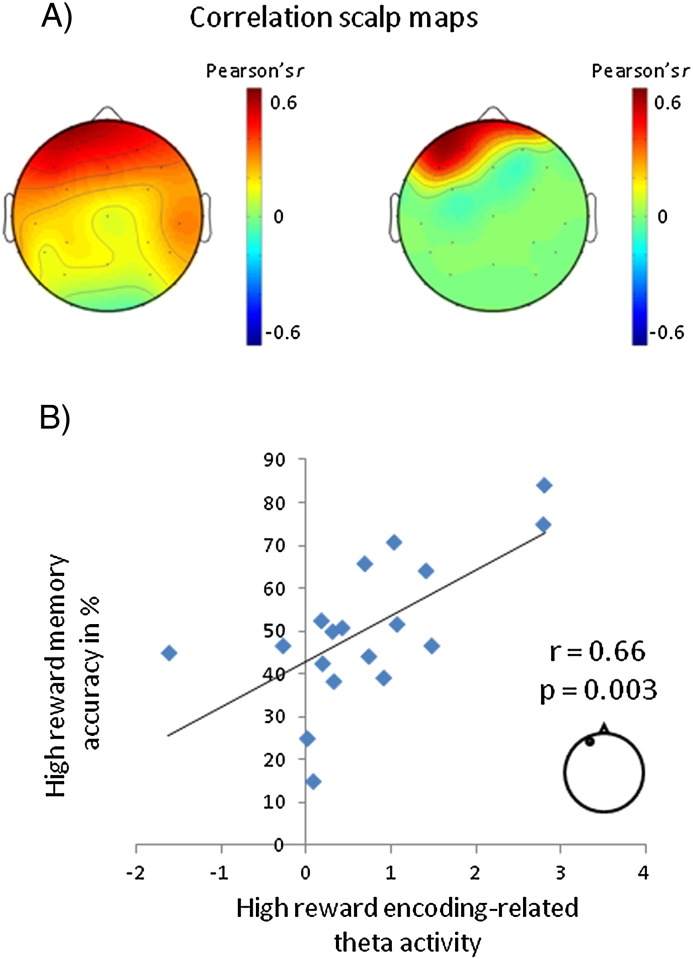
Relationship between prestimulus encoding-related theta activity and memory performance. (A) Representation of the correlation coefficients (Pearson's r) at each scalp site. The scalp maps show the correlation between participants' memory accuracy for confidently recognized high reward words and their prestimulus subsequent memory effects (theta power averaged over the 1–0.4 s interval before word onset). The scalp map on the left displays all r values; the map on the right only those that were significant (p < 0.05). For this analysis, all 18 participants were included that had at least 12 trials each for later remembered and forgotten words in the high reward condition. (B) Scatterplot of participants' memory accuracy for confidently recognized high reward words and prestimulus subsequent memory effects (averaged over the 1–0.4 s interval before word onset) at a frontal scalp location. Each dot represents the subsequent memory effect from one participant. As in the previous figures, the frontal scalp location represents site 50 from montage 10, www.easycap.de/easycap/e/electrodes/13_M10.htm, equivalent to Fp1 in the 10/10 system. As in (A), the plot includes all 18 participants with at least 12 remembered and forgotten trials in the high reward condition.

References

    1. Adcock R.A., Thangavel A., Whitfield-Gabrieli S., Knutson B., Gabrieli J.D.E. Reward-motivated learning: mesolimbic activation precedes memory formation. Neuron. 2006;50(3):507–517. - PubMed
    1. Addante R.J., Watrous A.J., Yonelinas A.P., Ekstrom A.D., Ranganath C. Prestimulus theta activity predicts correct source memory retrieval. Proc. Natl. Acad. Sci. U. S. A. 2011;108(26):10702–107078. - PMC - PubMed
    1. Ballard I.C., Murty V.P., Carter R.M., MacInnes J.J., Huettel S.A., Adcock R.A. Dorsolateral prefrontal cortex drives mesolimbic dopaminergic regions to initiate motivated behavior. J. Neurosci. 2011;31(28):10340–10346. - PMC - PubMed
    1. Bell A.J., Sejnowski T.J. An information-maximization approach to blind separation and blind deconvolution. Neural Comput. 1995;7(6):1129–1159. - PubMed
    1. Benchenane K., Peyrache A., Khamassi M., Tierney P.L., Gioanni Y., Battaglia F.P., Wiener S.I. Coherent theta oscillations and reorganization of spike timing in the hippocampal-prefrontal network upon learning. Neuron. 2010;66(6):921–936. - PubMed

Publication types