


Metabolic syndrome and gallstone disease
- PMID: 22919256
- PMCID: PMC3422804
- DOI: 10.3748/wjg.v18.i31.4215
Metabolic syndrome and gallstone disease
Abstract
Aim: To investigate the association between metabolic syndrome (MetS) and the development of gallstone disease (GSD).
Methods: A cross-sectional study was conducted in 7570 subjects (4978 men aged 45.0 ± 8.8 years, and 2592 women aged 45.3 ± 9.5 years) enrolled from the physical check-up center of the hospital. The subjects included 918 patients with gallstones (653 men and 265 women) and 6652 healthy controls (4325 men and 2327 women) without gallstones. Body mass index (BMI), waist circumference, blood pressure, fasting plasma glucose (FPG) and serum lipids and lipoproteins levels were measured. Colorimetric method was used to measure cholesterol, high-density lipoprotein cholesterol (HDL-C) and low-density lipoprotein cholesterol (LDL-C). Dextrose oxidizing enzyme method was used to measure FPG. Subjects were asked to complete a questionnaire that enquired about the information on demographic data, age, gender, histories of diabetes mellitus, hypertension, and chronic liver disease and so on. Metabolic syndrome was diagnosed according to the Adult Treatment Panel III (ATP III) criteria. Gallstones were defined by the presence of strong intraluminal echoes that were gravity-dependent or attenuated ultrasound transmission.
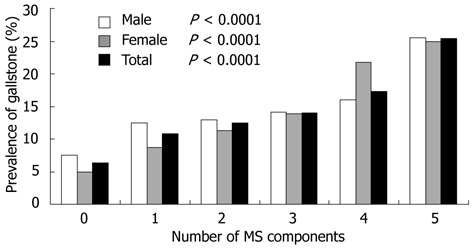
Results: Among the 7570 subjects, the prevalence of the gallstone disease was 12.1% (13.1% in men and 10.2% in women). BMI, waist circumference, systolic blood pressure, diastolic blood pressure, fasting blood glucose and serum triglyceride (TG) in cases group were higher than in controls, while serum high-density lipid was lower than in controls. There were significant differences in the waist circumference, blood pressure, FPG and TG between cases and controls. In an age-adjusted logistic regression model, metabolic syndrome was associated with gallstone disease. The age-adjusted odds ratio of MetS for GSD in men was 1.29 [95% confidence interval (CI), 1.09-1.52; P = 0.0030], and 1.68 (95% CI, 1.26-2.25; P = 0.0004) in women; the overall age-adjusted odds ratio of MetS for GSD was 1.42 (95% CI, 1.23-1.64; P < 0.0001). The men with more metabolic disorders had a higher prevalence of gallstone disease, the trend had statistical significance (P < 0.0001). The presence of 5 components of the MetS increased the risk of gallstone disease by 3.4 times (P < 0.0001). The prevalence of GSD in women who had 5 components of MetS was 5 times higher than in those without MetS component. The more the components of MetS, the higher the prevalence of GSD (P < 0.0001). The presence of 5 components of the MetS increased the risk of gallstone disease by 4.0 times.
Conclusion: GSD appears to be strongly associated with MetS, and the more the components of MetS, the higher the prevalence of GSD.
Keywords: Dyslipidemia; Gallstone disease; Hypertension; Metabolic syndrome; Obesity.
Figures
References
-
- Further Study of Risk Factors for Stroke and Coronary Heart Disease Cooperation Group. The prevalence of metabolic syndrome in a 11 provinces cohort in China. Zhonghua Yufang Yixue Zazhi. 2002;36:298–300. - PubMed
-
- Gu D, Gupta A, Muntner P, Hu S, Duan X, Chen J, Reynolds RF, Whelton PK, He J. Prevalence of cardiovascular disease risk factor clustering among the adult population of China: results from the International Collaborative Study of Cardiovascular Disease in Asia (InterAsia) Circulation. 2005;112:658–665. - PubMed
-
- Zuo H, Shi Z, Hu X, Wu M, Guo Z, Hussain A. Prevalence of metabolic syndrome and factors associated with its components in Chinese adults. Metabolism. 2009;58:1102–1108. - PubMed
-
- Nervi F, Miquel JF, Alvarez M, Ferreccio C, García-Zattera MJ, González R, Pérez-Ayuso RM, Rigotti A, Villarroel L. Gallbladder disease is associated with insulin resistance in a high risk Hispanic population. J Hepatol. 2006;45:299–305. - PubMed
MeSH terms
Substances
LinkOut - more resources
Full Text Sources
Medical
Miscellaneous
