Prolonged sulforaphane treatment does not enhance tumorigenesis in oncogenic K-ras and xenograft mouse models of lung cancer
- PMID: 22919281
- PMCID: PMC3424666
- DOI: 10.4103/1477-3163.98459
Prolonged sulforaphane treatment does not enhance tumorigenesis in oncogenic K-ras and xenograft mouse models of lung cancer
Abstract
Background: Sulforaphane (SFN), an activator of nuclear factor erythroid-2 related factor 2 (Nrf2), is a promising chemopreventive agent which is undergoing clinical trial for several diseases. Studies have indicated that there is gain of Nrf2 function in lung cancer and other solid tumors because of mutations in the inhibitor Kelch-like ECH-associated protein 1 (Keap1). More recently, several oncogenes have been shown to activate Nrf2 signaling as the main prosurvival pathway mediating ROS detoxification, senescence evasion, and neoplastic transformation. Thus, it is important to determine if there is any risk of enhanced lung tumorigenesis associated with prolonged administration of SFN using mouse models of cancer.
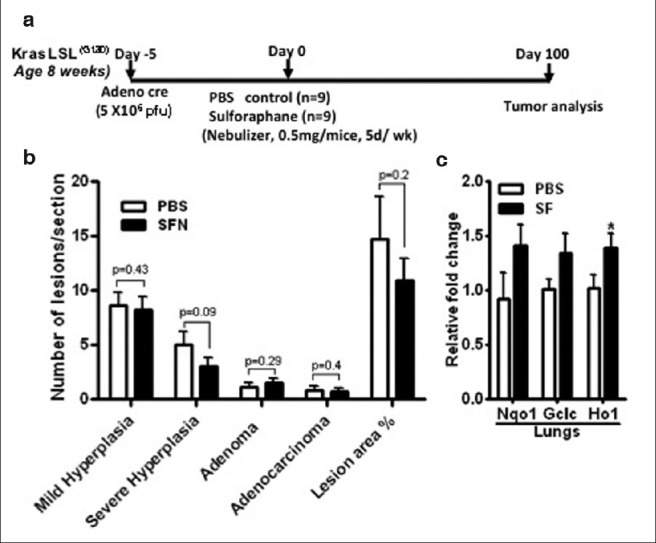
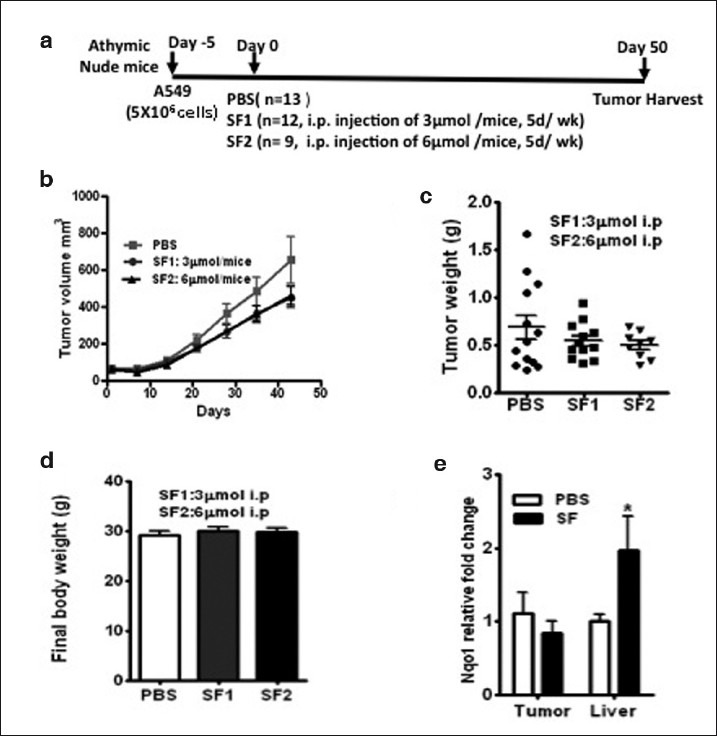
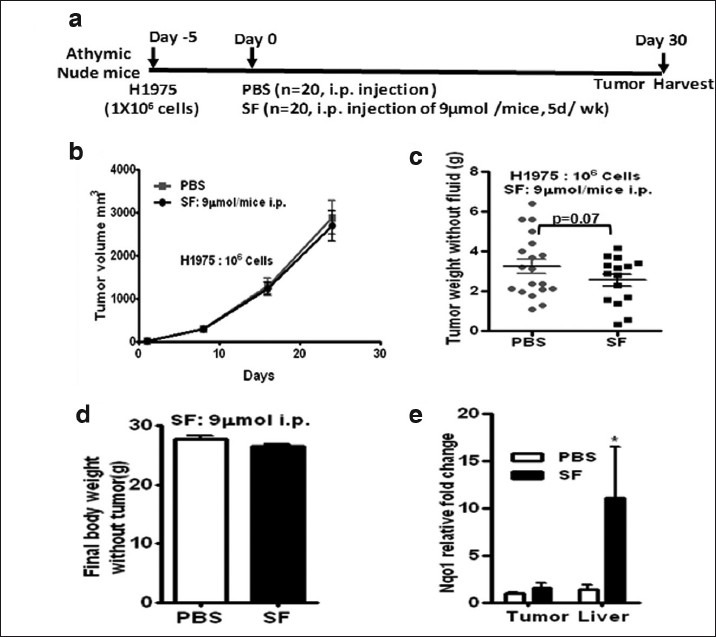
Materials and methods: We evaluated the effect of prolonged SFN treatment on oncogenic K-ras (K-ras(LSL-G12D))-driven lung tumorigenesis. One week post mutant-K-ras expression, mice were treated with SFN (0.5 mg, 5 d/wk) for 3 months by means of a nebulizer. Fourteen weeks after mutant K-ras expression (K-ras(LSL-G12D)), mice were sacrificed, and lung sections were screened for neoplastic foci. Expression of Nrf2-dependent genes was measured using real time RT-PCR. We also determined the effect of prolonged SFN treatment on the growth of preclinical xenograft models using human A549 (with mutant K-ras and Keap1 allele) and H1975 [with mutant epidermal growth factor receptor (EGFR) allele] nonsmall cell lung cancer cells.
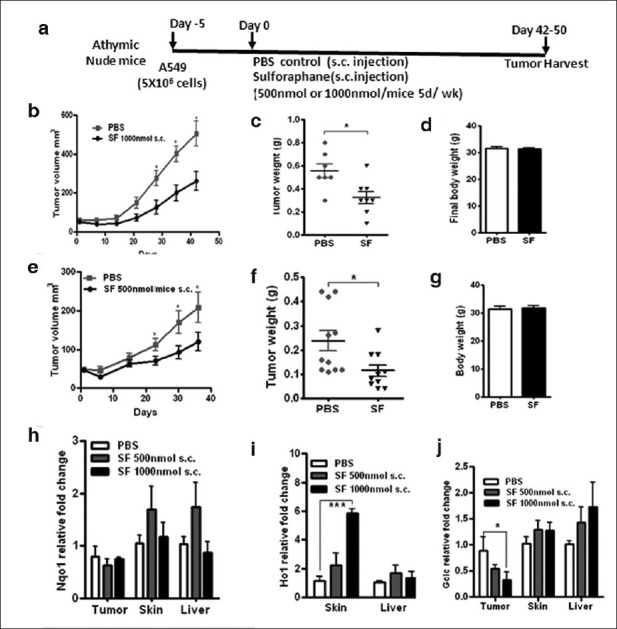
Results: Systemic SFN administration did not promote the growth of K-ras(LSL-G12D)-induced lung tumors and had no significant effect on the growth of A549 and H1975 established tumor xenografts in nude mice. Interestingly, localized delivery of SFN significantly attenuated the growth of A549 tumors in nude mice, suggesting an Nrf2-independent antitumorigenic activity of SFN.
Conclusions: Our results demonstrate that prolonged SFN treatment does not promote lung tumorigenesis in various mouse models of lung cancer.
Keywords: EGFR; K-ras; Keap1; Nrf2; lung cancer; sulforaphane.
Conflict of interest statement
Figures
References
-
- London SJ, Yuan JM, Chung FL, Gao YT, Coetzee GA, Ross RK, et al. Isothiocyanates, glutathione S-transferase M1 and T1 polymorphisms, and lung-cancer risk: a prospective study of men in Shanghai, China. Lancet. 2000;356:724–9. - PubMed
-
- Ambrosone CB, McCann SE, Freudenheim JL, Marshall JR, Zhang Y, Shields PG. Breast cancer risk in premenopausal women is inversely associated with consumption of broccoli, a source of isothiocyanates, but is not modified by GST genotype. J Nutr. 2004;134:1134–8. - PubMed
-
- Michaud DS, Spiegelman D, Clinton SK, Rimm EB, Willett WC, Giovannucci EL. Fruit and vegetable intake and incidence of bladder cancer in a male prospective cohort. J Natl Cancer Inst. 1999;91:605–13. - PubMed
-
- Tang L, Zirpoli GR, Guru K, Moysich KB, Zhang Y, Ambrosone CB, et al. Consumption of raw cruciferous vegetables is inversely associated with bladder cancer risk. Cancer Epidemiol Biomarkers Prev. 2008;17:938–44. - PubMed
Grants and funding
LinkOut - more resources
Full Text Sources
Molecular Biology Databases
Research Materials
Miscellaneous