


Polynucleotide phosphorylase has an impact on cell biology of Campylobacter jejuni
- PMID: 22919622
- PMCID: PMC3417634
- DOI: 10.3389/fcimb.2012.00030
Polynucleotide phosphorylase has an impact on cell biology of Campylobacter jejuni
Abstract
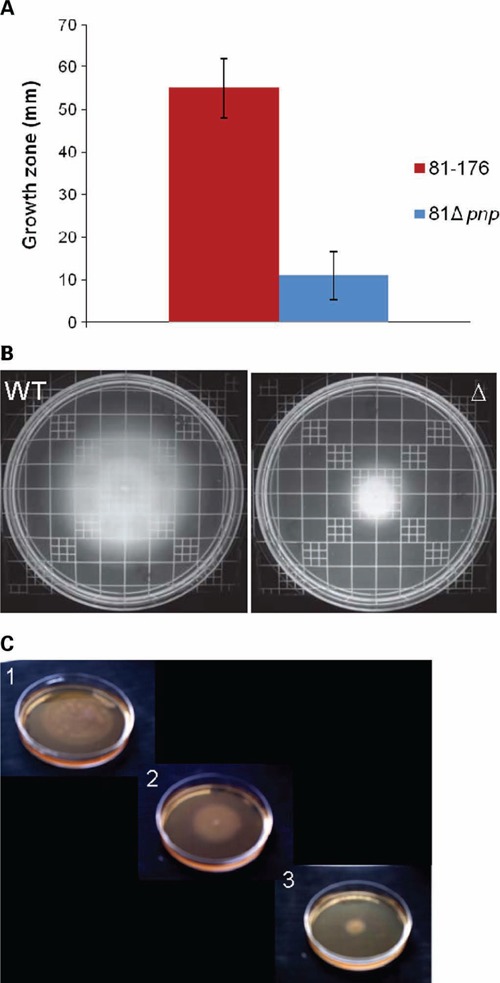
Polynucleotide phosphorylase (PNPase), encoded by the pnp gene, is known to degrade mRNA, mediating post-transcriptional regulation and may affect cellular functions. The role of PNPase is pleiotropic. As orthologs of the two major ribonucleases (RNase E and RNase II) of Escherichia coli are missing in the Campylobacter jejuni genome, in the current study the focus has been on the C. jejuni ortholog of PNPase. The effect of PNPase mutation on C. jejuni phenotypes and proteome was investigated. The inactivation of the pnp gene reduced significantly the ability of C. jejuni to adhere and to invade Ht-29 cells. Moreover, the pnp mutant strain exhibited a decrease in C. jejuni swimming ability and chick colonization. To explain effects of PNPase on C. jejuni 81-176 phenotype, the proteome of the pnp mutant and parental strains were compared. Overall, little variation in protein production was observed. Despite the predicted role of PNPase in mRNA regulation, the pnp mutation did not induce profound proteomic changes suggesting that other ribonucleases in C. jejuni might ensure this biological function in the absence of PNPase. Nevertheless, synthesis of proteins which are involved in virulence (LuxS, PEB3), motility (N-acetylneuraminic acid synthetase), stress-response (KatA, DnaK, Hsp90), and translation system (EF-Tu, EF-G) were modified in the pnp mutant strain suggesting a more specific role of PNPase in C. jejuni. In conclusion, PNPase deficiency induces limited but important consequences on C. jejuni biology that could explain swimming limitation, chick colonization delay, and the decrease of cell adhesion/invasion ability.
Keywords: 2D-electrophoresis; Campylobacter jejuni; chick colonization; in vitro virulence tests; polynucleotide phosphorylase.
Figures




Comment in
-
Exoribonucleases as modulators of virulence in pathogenic bacteria.Front Cell Infect Microbiol. 2012 May 11;2:65. doi: 10.3389/fcimb.2012.00065. eCollection 2012. Front Cell Infect Microbiol. 2012. PMID: 22919656 Free PMC article. No abstract available.
References
-
- Andersen M. T., Brøndsted L., Pearson B. M., Mulholland F., Parker M., Pin C., Wells J. M., Ingmer H. (2005). Diverse roles for HspR in Campylobacter jejuni revealed by the proteome, transcriptome and phenotypic characterization of an hspR mutant. Microbiology 151 905–915 - PubMed
-
- Andrade J. M., Pobre V., Silva I. J., Domingues S., Arraiano C. M. (2009). The role of 3′–5′ exoribonucleases in RNA degradation. Prog. Mol. Biol. Transl. Sci. 85187–229 - PubMed
-
- Arraiano C. M., Andrade J. M., Domingues S., Guinote I. B., Malecki M., Matos R. G., Moreira R. N., Pobre V., Reis F. P., Saramago M., Silva I. J., Viegas S. C. (2010). The critical role of RNA processing and degradation in the control of gene expression. FEMS Microbiol Rev. 34 883–923 - PubMed
Publication types
MeSH terms
Substances
LinkOut - more resources
Full Text Sources
Research Materials
Miscellaneous
