


Comment
doi: 10.3389/fcimb.2012.00065.
eCollection 2012.
Exoribonucleases as modulators of virulence in pathogenic bacteria
Affiliations
- PMID: 22919656
- PMCID: PMC3417396
- DOI: 10.3389/fcimb.2012.00065
Item in Clipboard
Comment
Exoribonucleases as modulators of virulence in pathogenic bacteria
Front Cell Infect Microbiol.
.
No abstract available
Figures
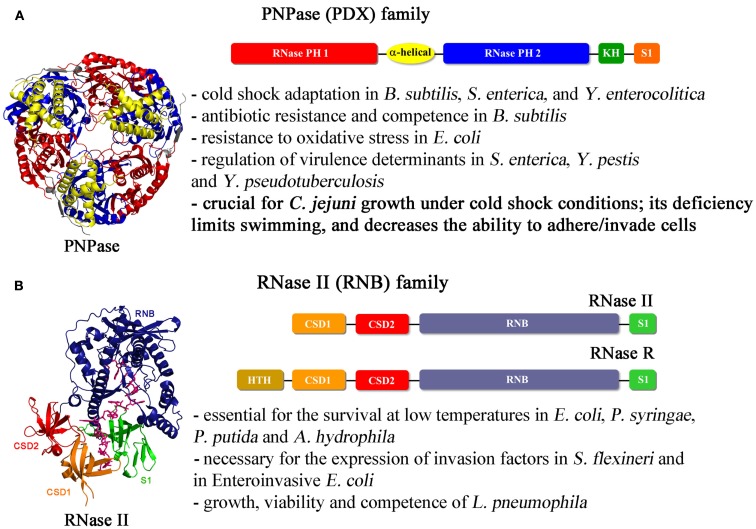
Schematic representation of the domains found in the exoribonucleases from PNPase and RNase II families and structures of representative members. (A) Top: PNPase (PDX family) primary structure: two RNase PH catalytic domains followed by two RNA binding domains (KH and S1). PNPase is a trimer and assembles in a donut like shape (on the left; Shi et al., 2008). The S1 binding domain was shown to restore PNPase deletion effect in Yersinia (Rosenzweig et al., 2007). (B) Top: linear representation of RNase II and RNase R domains: the central catalytic RNB, and the CSD1, CSD1, and S1 RNA binding domains. Members of the family can have additional domains at the N-terminal region, namely Helix-Turn-Helix in RNase R. On the left is represented the E. coli RNase II–RNA complex crystal structure, showing the distinct domains of the enzyme, and the 13-mer bound RNA (Frazão et al., 2006). The RNB domain (in blue), is the responsible for the catalytic activity of the protein which, for example, is important for the development of competence in L. pneumophila (Charpentier et al., 2008).
Comment on
-
Polynucleotide phosphorylase has an impact on cell biology of Campylobacter jejuni.Front Cell Infect Microbiol. 2012 Mar 14;2:30. doi: 10.3389/fcimb.2012.00030. eCollection 2012. Front Cell Infect Microbiol. 2012. PMID: 22919622 Free PMC article.
References
-
- Arraiano C. M., Andrade J. M., Domingues S., Guinote I. B., Malecki M., Matos R. G., Moreira R. N., Pobre V., Reis F. P., Saramago M., Silva I. J., Viegas S. C. (2010). The critical role of RNA processing and degradation in the control of gene expression. FEMS Microbiol. Rev. 34, 883–92310.1111/j.1574-6976.2010.00242.x - DOI - PubMed
Publication types
MeSH terms
Substances
LinkOut - more resources
Full Text Sources
