


Altered behavioral phenotypes in soluble epoxide hydrolase knockout mice: effects of traumatic brain injury
- PMID: 22922090
- PMCID: PMC3932494
- DOI: 10.1016/j.prostaglandins.2012.07.005
Altered behavioral phenotypes in soluble epoxide hydrolase knockout mice: effects of traumatic brain injury
Abstract
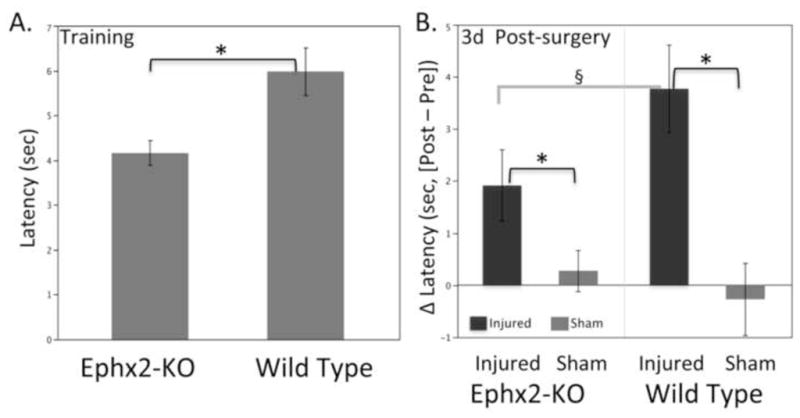
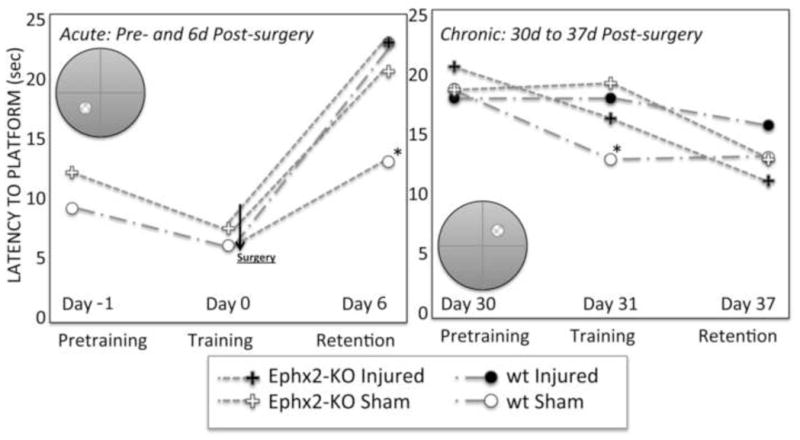
After traumatic brain injury (TBI), arachidonic acid (ArA) is released from damaged cell membranes and metabolized to many bioactive eicosanoids, including several epoxyeicosatrienoic acids (EETs). Soluble epoxide hydrolase (Ephx2, sEH) appears to be the predominant pathway for EET metabolism to less active dihydroxyeicosatrienoates (DHETs). Prior studies indicate that brain levels of EETs increase transiently after TBI and EETs have antiinflammatory and neuroprotective activities which may benefit the injured brain. If the net effect of increased EET levels in the injured brain is beneficial to recovery, then Ephx2 gene disruption would be expected to enhance elevated EET levels and improve recovery in the injured brain. Thus, Ephx2-KO (Ephx2(-/-) bred onto pure C57Bl/6 background) mice were compared to wild-type controls in a unilateral controlled cortical impact model of TBI. Before injury, animals behaved comparably in open field activity and neurologic reflexes. Interestingly, the Ephx2-KO mice showed improved motor coordination on a beam walk task, yet showed indications of defective learning in a test of working spatial memory. After surgery, brain-injured Ephx2-KO mice again had less of a deficit in the beam walk than wild-type, and the difference in latency (post-pre) showed a trend of protection for Ephx2-KO mice after TBI. Brain-injured mice showed no genotype differences in working memory. Surprisingly, sham-operated Ephx2-KO mice exhibited an injured phenotype for working memory, compared to sham-operated wild-type mice. Brain eicosanoid levels were measured using liquid chromatography with tandem mass spectrometry. Of the 20 eicosanoids evaluated, only 8,9-EET was elevated in the Ephx2-KO cerebral cortex (37 d post-surgery, in both sham and injured). Tissue DHET levels were below the limit of quantification. These results reflect a significant contribution of sEH deficiency in coordination of ambulatory movements and working spatial memory in the mouse. Further investigation of differential sEH expression and EET levels at earlier time points and across other brain regions may shed light on these behavioral differences.
Copyright © 2012. Published by Elsevier Inc.
Figures
References
-
- Campbell WB. New role for epoxyeicosatrienoic acids as anti-inflammatory mediators. Trends Pharmacol Sci. 2000;21:125–7. - PubMed
-
- Alkayed NJ, Narayanan J, Gebremedhin D, Medhora M, Roman RJ, Harder DR. Molecular characterization of an arachidonic acid epoxygenase in rat brain astrocytes. Stroke. 1996;27:971–9. - PubMed
-
- Harder DR, Alkayed NJ, Lange AR, Gebremedhin D, Roman RJ. Functional hyperemia in the brain: hypothesis for astrocyte-derived vasodilator metabolites. Stroke. 1998;29:229–34. - PubMed
Publication types
MeSH terms
Substances
Grants and funding
LinkOut - more resources
Full Text Sources
Other Literature Sources
Molecular Biology Databases
Research Materials
