


Review
doi: 10.1007/s12035-012-8325-2.
Epub 2012 Aug 25.
Molecular chaperones, α-synuclein, and neurodegeneration
Affiliations
- PMID: 22923346
- PMCID: PMC3537861
- DOI: 10.1007/s12035-012-8325-2
Item in Clipboard
Review
Molecular chaperones, α-synuclein, and neurodegeneration
Mol Neurobiol.
2013 Apr.
Abstract
Parkinson's disease (PD) is a devastating neurological condition that affects about 1 % of people older than 65 years of age. In PD, dopaminergic neurons in the mid-brain slowly accumulate cytoplasmic inclusions (Lewy bodies, LBs) of the protein alpha-synuclein (α-syn) and then gradually lose function and die off. Cell death is thought to be causally linked to the aggregation/fibrillization of α-syn. This review focuses on new findings about the structure of α-syn, about how α-syn cooperates with Hsp70 and Hsp40 chaperones to promote neurotransmitter release, and about cell-to-cell transfer of pathogenic forms of α-syn and how Hsp70 might protect against this disease process.
Figures
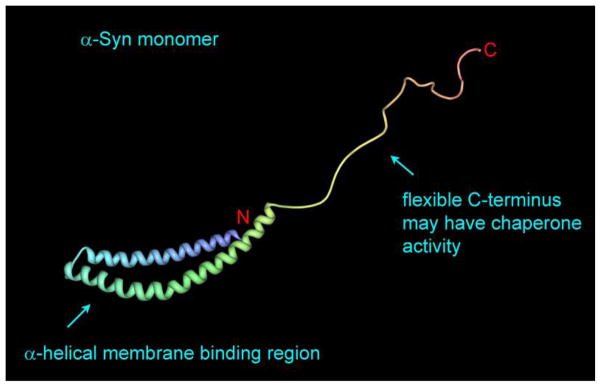
Monomeric α-syn bound to a micelle. The N-terminal residues (1–95) form two α-helices that adopt a hairpin-like structure, while the C-terminal residues are unstructured. Protein data bank file: 1XQ8 [32].
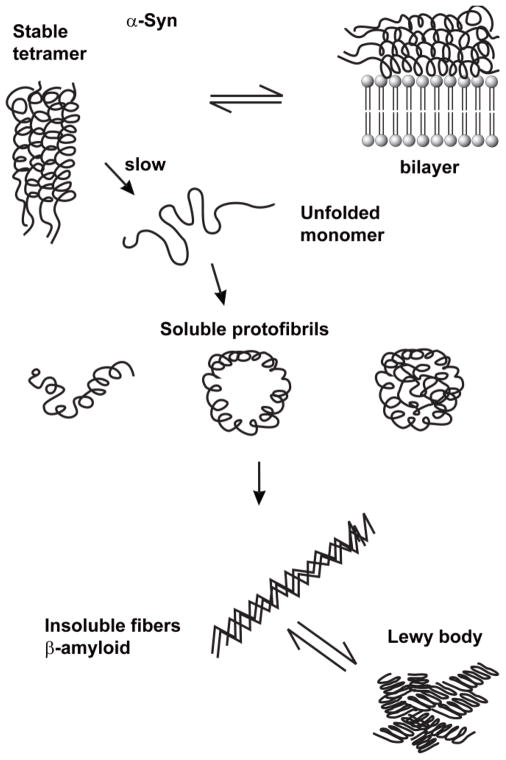
Model for α-syn aggregate/fibril formation. The α-syn tetramer is thermodynamically favored inside cells because of the high expression level of this protein. The tetramers could dissolve into unfolded monomers because of post-translational modifications, dilution, or unknown factors. Unfolded monomers can aggregate into soluble high molecular mass protofibrils and insoluble β-amyloid fibers. Emerging evidence indicates that a pathogenic conformation of α-syn is transmitted from cell-to-cell, and this transmission causes disease spread through the brain. For simplicity, in Figs. 2–4 the α-syn tetramer is depicted as a four-helix bundle where each monomer is an α-helix with a flexible tail. In the physiological α-syn tetramer, each monomer has been suggested to adopt the hair-pin-like structure shown in Fig. 1 [20].
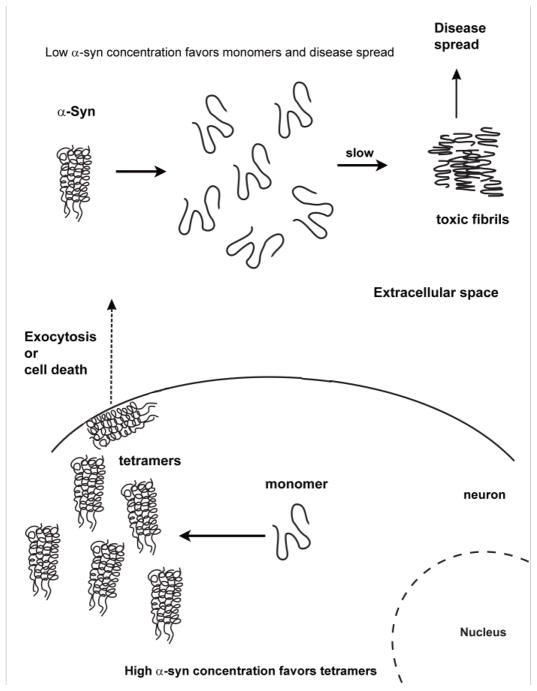
Model of α-syn toxicity and disease spread. The model stipulates that a high concentration of α-syn inside cells favors the non-infectious tetramer whereas a low concentration outside the cells favors the potentially toxic monomer. Probably most of the monomeric α-syn in the extracellular space is degraded by proteases; nevertheless, in time, toxic α-syn conformations can form and infect neighboring cells.
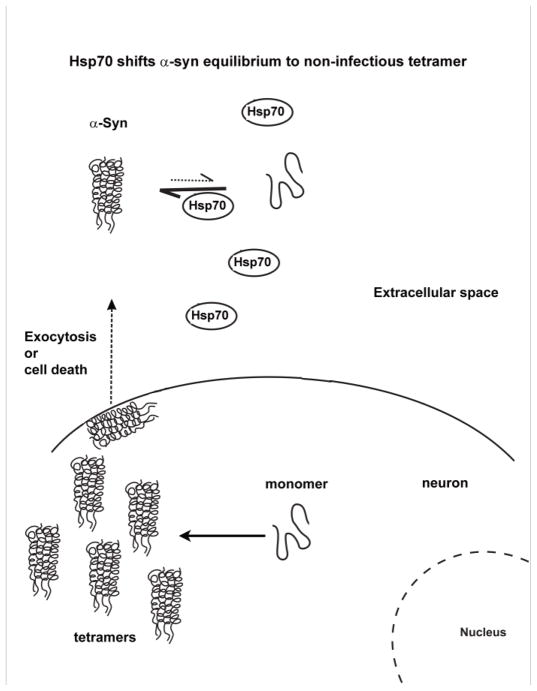
Hsp70 protects against toxic extracellular forms of α-syn. Hsp70/Hsc70 chaperones are known to be secreted, perhaps via exosomes, from a variety of cells in response to stress. Hsp70/Hsc70 chaperones protect against α-syn-induced cell death in a variety of organisms, and Hsp70 was recently shown to reduce the infectivity of extracellular α-syn. The figure illustrates that in the extracellular milieu Hsp70 shifts the α-syn equilibrium to the non-infectious tetramer.
References
-
- Moore DJ, West AB, Dawson VL, Dawson TM. Molecular pathophysiology of Parkinson’s disease. Annu Rev Neurosci. 2005;28:57–87. - PubMed
-
- Lee VM, Trojanowski JQ. Mechanisms of Parkinson’s disease linked to pathological alpha-synuclein: new targets for drug discovery. Neuron. 2006;52:33–38. - PubMed
-
- Breydo L, Wu JW, Uversky VN. alpha-Synuclein misfolding and Parkinson’s disease. Biochim Biophys Acta. 2011;1822:261–285. - PubMed
-
- Polymeropoulos MH, Lavedan C, Leroy E, Ide SE, Dehejia A, et al. Mutation in the alpha-synuclein gene identified in families with Parkinson’s disease. Science. 1997;276:2045–2047. - PubMed
-
- Kruger R, Kuhn W, Muller T, Woitalla D, Graeber M, et al. Ala30Pro mutation in the gene encoding alpha-synuclein in Parkinson’s disease. Nat Genet. 1998;18:106–108. - PubMed
Publication types
MeSH terms
Substances
Grants and funding
LinkOut - more resources
Full Text Sources
Medical
Miscellaneous
