


Seasonality, incidence and prognosis in atrial fibrillation and stroke in Denmark and New Zealand
- PMID: 22923628
- PMCID: PMC3432837
- DOI: 10.1136/bmjopen-2012-001210
Seasonality, incidence and prognosis in atrial fibrillation and stroke in Denmark and New Zealand
Abstract
Objectives: There are relatively few large studies of seasonal variation in the occurrence of stroke in patients with atrial fibrillation (AF). We investigated the seasonal variation in incidence rates of hospitalisation with stroke in patients from Denmark and New Zealand.
Design: Cohort study.
Setting: Nationwide hospital discharge data from Denmark and New Zealand.
Participants: 243 381 (median age 75) subjects having a first-time hospitalisation with AF in Denmark and 51 480 (median age 76) subjects in New Zealand constituted the study population. Subjects with previous hospitalisation with stroke were excluded. PRIMARY AND SECONDARY EFFECT MEASURES: Peak-to-trough ratio of the seasonal variation in incidence rates of stroke in AF patients adjusted for an overall trend was primary effect measure and was assessed using a log-linear Poisson regression model. Secondary effect measures were incidence rate ratios of AF and 30-day case fatality for stroke patients.
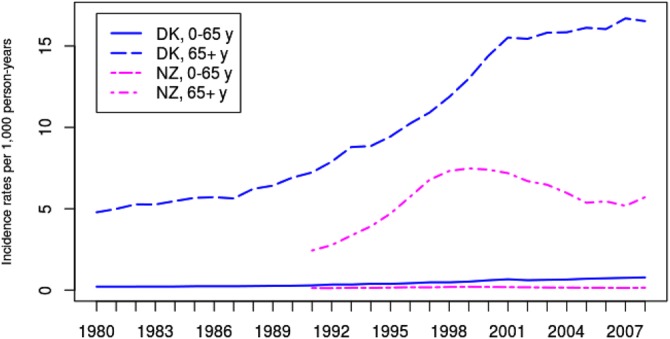
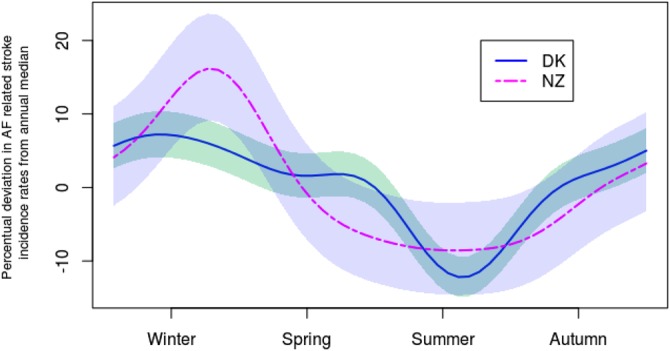
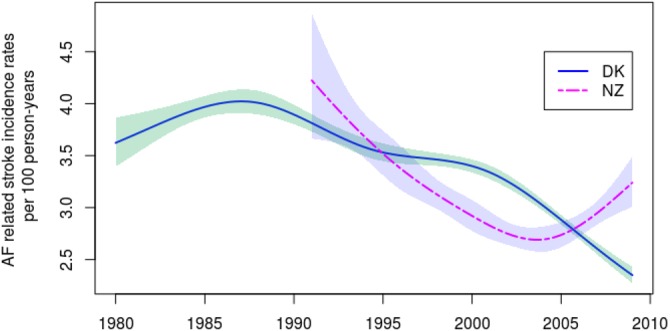
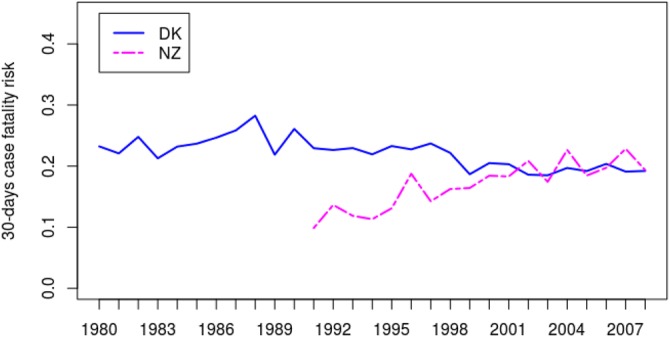
Results: Incidence rates of AF per 1000 person-years in Denmark increased by 5.4% (95% CI 5.3% to 5.7%) for patients aged <65 and 5% (95% CI 4.9% to 5.1%) for patients aged ≥65, whereas the increase was 0.2% (95% CI -0.2% to 0.6%) for patients aged <65 and 2.6% (95% CI 2.4% to 2.8%) for patients aged ≥65 in New Zealand. In Denmark 36 088 subjects were hospitalised with stroke, and 7518 subjects in New Zealand, both showing peaks during winter with peak-to-trough ratios of 1.22 and 1.27, respectively and a decreasing trend. The 30-day case fatality risk for stroke patients having AF is now (2000-2008) about 20% in both countries.
Conclusions: Although incidence rates of hospitalisation with stroke in patients with AF have decreased in recent years, stroke remains a common AF complication with a high case fatality risk. The marked winter peak in incidence rates of hospitalisation with stroke in AF patients suggests that there are opportunities to reduce this complication. Further studies are necessary to identify how to optimise treatment of AF and prevention of stroke.
Figures
References
-
- Atrial Fibrillation Working Group Independent predictors of stroke in patients with atrial fibrillation: a systematic review. Neurology 2007;69:546–54 - PubMed
-
- Hughes M, Lip GYH. Stroke and thromboembolism in atrial fibrillation: a systematic review of stroke risk factors, risk stratification schema and cost effectiveness data. Thromb Haemostasis 2008;99:295–304 - PubMed
-
- Rasmussen LH, Larsen TB, Due KM, et al. Impact of vascular disease in predicting stroke and death in patients with atrial fibrillation: the Danish Diet, Cancer and Health cohort study. J Thromb Haemostasis 2011;9:1301–7 - PubMed
-
- Spencer FA, Goldberg RJ, Becker RC, et al. Seasonal distribution of acute myocardial infarction in the second National Registry of Myocardial Infarction. J Am Coll Cardiol 1998;31:1226–33 - PubMed
-
- Manfredini R, Manfredini F, Boari B, et al. Seasonal and weekly patterns of hospital admissions for nonfatal and fatal myocardial infarction. Am J Emerg Med 2009;27:1097–103 - PubMed
LinkOut - more resources
Full Text Sources
Molecular Biology Databases
