


Matrix control of transforming growth factor-β function
- PMID: 22923731
- PMCID: PMC3529568
- DOI: 10.1093/jb/mvs089
Matrix control of transforming growth factor-β function
Abstract
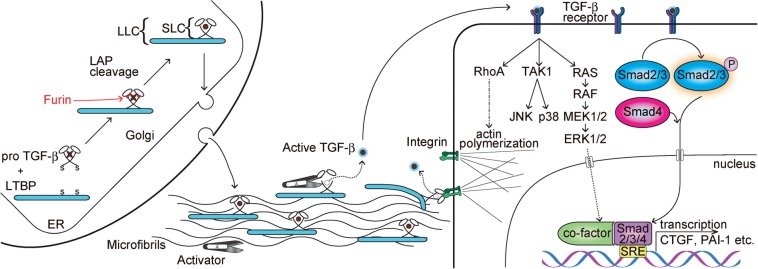
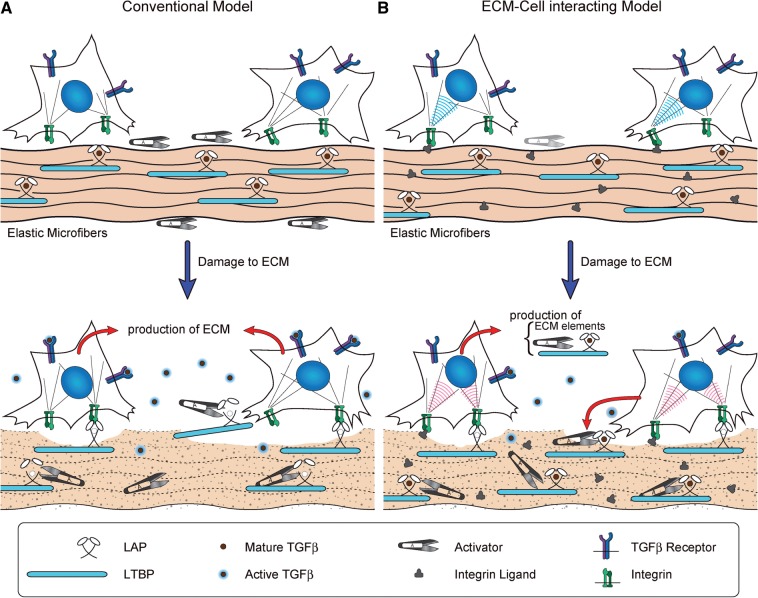
The cytokine transforming growth factor-beta (TGF-β) has multiple effects in both physiological and pathological conditions. TGF-β is secreted as part of a tripartite complex from which it must be released in order to bind to its receptor. Sequestration of latent TGF-β in the extracellular matrix (ECM) is crucial for proper mobilization of the latent cytokine and its activation. However, contrary to expectation, loss-of-function mutations in genes encoding certain matrix proteins that bind TGF-β yield elevated, rather than decreased, TGF-β levels, posing a 'TGF-β paradox.' In this review, we discuss recent findings concerning the relationship of TGF-β, ECM molecules, and latent TGF-β activation and propose a model to resolve the 'TGF-β paradox.'
Figures
References
-
- Massague J. TGF-beta signal transduction. Annu. Rev. Biochem. 1998;67:753–791. - PubMed
-
- Verrecchia F, Mauviel A. Transforming growth factor-beta signaling through the Smad pathway: role in extracellular matrix gene expression and regulation. J. Invest. Dermatol. 2002;118:211–215. - PubMed
-
- Blobe GC, Schiemann WP, Lodish HF. Role of transforming growth factor beta in human disease. N. Engl. J. Med. 2000;342:1350–1358. - PubMed
-
- Yoshinaga K, Obata H, Jurukovski V, Mazzieri R, Chen Y, Zilberberg L, Huso D, Melamed J, Prijatelj P, Todorovic V, Dabovic B, Rifkin DB. Perturbation of transforming growth factor (TGF)-beta1 association with latent TGF-beta binding protein yields inflammation and tumors. Proc. Natl Acad. Sci. USA. 2008;105:18758–18763. - PMC - PubMed
Publication types
MeSH terms
Substances
Grants and funding
LinkOut - more resources
Full Text Sources
Other Literature Sources
