Longitudinal relationships between fatigue and depression in cancer patients with depression and/or pain
- PMID: 22924447
- PMCID: PMC4058321
- DOI: 10.1037/a0029773
Longitudinal relationships between fatigue and depression in cancer patients with depression and/or pain
Abstract
Objective: Fatigue is one of the most common and debilitating symptoms reported by cancer patients, yet relatively little is understood about its etiology. Recently, as researchers have begun to focus attention on cancer-related fatigue (CRF), depression has emerged as its strongest correlate. Few longitudinal studies, however, have examined directionality of the relationship between the two symptoms. Our aim was to evaluate the directionality of the association between depression and CRF.
Method: The study used a single-group cohort design of longitudinal data (N = 329) from a randomized controlled trial of an intervention for pain and depression in a heterogeneous sample of cancer patients. Participants met criteria for clinically significant pain and/or depression. Our hypothesis that depression would predict change in fatigue over 3 months was tested using latent variable cross-lagged panel analysis.
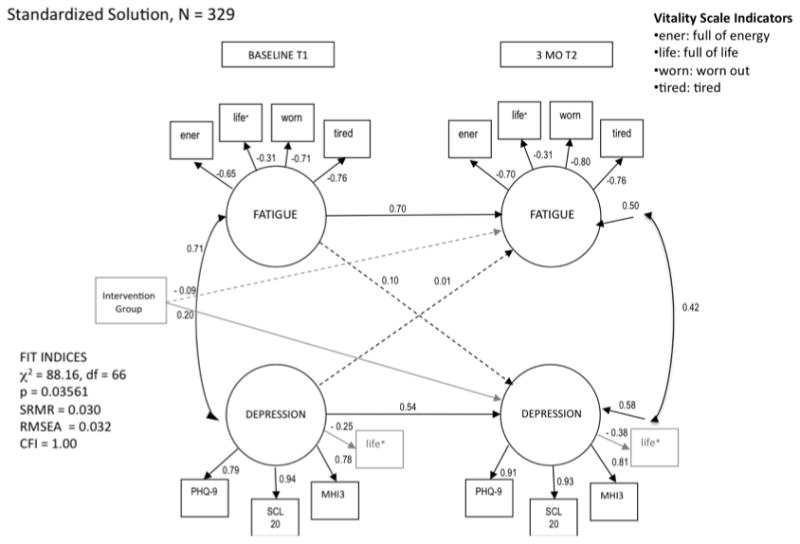
Results: Depressive symptoms and fatigue were strongly correlated in the sample (baseline correlation of latent variables = 0.71). Although the model showed good fit to the data, χ(2) (66, N = 329) = 88.16, p = .04, SRMR = 0.030, RMSEA = 0.032, and CFI = 1.00, neither structural path linking depression and fatigue was significant, suggesting neither symptom preceded and predicted the other.
Conclusions: Our findings did not support hypotheses regarding the directionality of the relationship between depressive symptoms and fatigue. The clinical implication is that depression-specific treatments may not be sufficient to treat CRF and that instead, interventions specifically targeting fatigue are needed.
Figures
References
-
- Berger AM, Abernethy AP, Atkinson A, Barsevick AM, Brietbart WS, Cella D, et al. NCCN Clinical Practice Guidelines in Oncology: Cancer-related Fatigue. 2010 1.2010. 2010. - PubMed
-
- Bottomley A. Depression in cancer patients: a literature review. European Journal of Cancer Care. 1998;7:181–191. - PubMed
-
- Bower JE, Ganz PA, Desmond KA, Bernaards C, Rowland JH, Meyerowitz BE, et al. Fatigue in long-term breast carcinoma survivors. Cancer. 2006;106(4):751–758. - PubMed
Publication types
MeSH terms
Grants and funding
LinkOut - more resources
Full Text Sources
Other Literature Sources
Medical
Miscellaneous