


Parent-child shared time from middle childhood to late adolescence: developmental course and adjustment correlates
- PMID: 22925042
- PMCID: PMC3502683
- DOI: 10.1111/j.1467-8624.2012.01826.x
Parent-child shared time from middle childhood to late adolescence: developmental course and adjustment correlates
Abstract
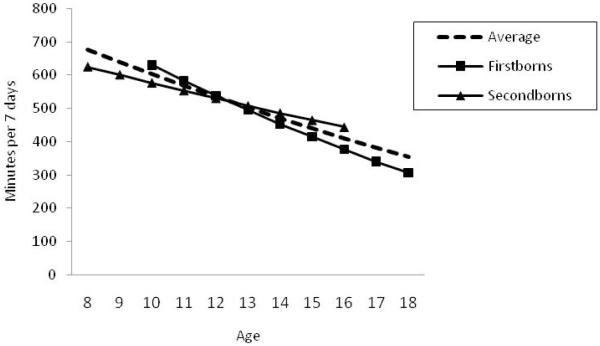
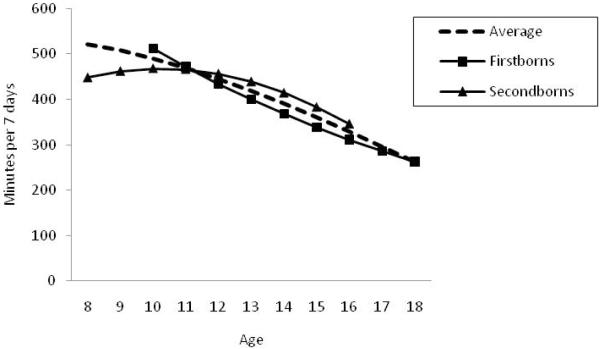
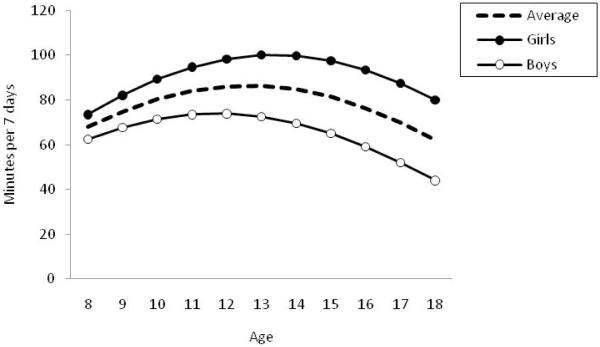
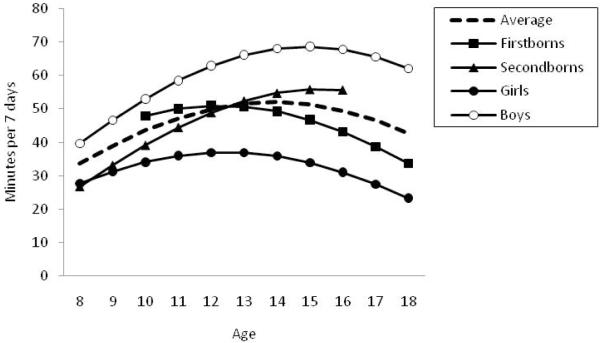
The development and adjustment correlates of parent-child social (parent, child, and others present) and dyadic time (only parent and child present) from age 8 to 18 were examined. Mothers, fathers, and firstborns and secondborns from 188 White families participated in both home and nightly phone interviews. Social time declined across adolescence, but dyadic time with mothers and fathers peaked in early and middle adolescence, respectively. In addition, secondborns' social time declined more slowly than firstborns', and gendered time use patterns were more pronounced in boys and in opposite-sex sibling dyads. Finally, youths who spent more dyadic time with their fathers, on average, had higher general self-worth, and changes in social time with fathers were positively linked to changes in social competence.
© 2012 The Authors. Child Development © 2012 Society for Research in Child Development, Inc.
Figures
References
-
- Ackard DM, Neumark-Sztainer D, Story M, Perry C. Parent-child connectedness and behavioral and emotional health among adolescents. American Journal of Preventive Medicine. 2006;30:59–66. doi:10.1016/j.amepre.2005.09.013. - PubMed
-
- Aiken LS, West SG. Multiple regression: Testing and interpreting interactions. Sage; Thousand Oaks, CA: 1991.
-
- Almeida DM, Galambos NL. Examining father involvement and the quality of father-adolescent relations. Journal of Research on Adolescence. 1991;1:155–172. doi: 10.1207/s15327795jra0102_3.
-
- Braiker HB, Kelley HH. Conflict in the development of close relationships. In: Burgess RL, Huston TL, editors. Social exchange in developing relationships. Academic; New York: 1979. pp. 135–168.
-
- Bronfenbrenner U. The ecology of human development: Experiments in nature and design. Harvard University Press; Cambridge, MA: 1979.
