. 2013 Jan:49:49-56.
doi: 10.1016/j.nbd.2012.08.010. Epub 2012 Aug 25.

Cellular toxicity of mutant SOD1 protein is linked to an easily soluble, non-aggregated form in vitro

Affiliations

Cellular toxicity of mutant SOD1 protein is linked to an easily soluble, non-aggregated form in vitro

Terrell E Brotherton et al. Neurobiol Dis. 2013 Jan.

Abstract

Mutations in superoxide dismutase 1 (SOD1) are found in approximately 20% of patients with familial amyotrophic lateral sclerosis. The propensity of mutant SOD1 to form aggregates in pathologically affected cells (i.e. motor neurons) has implicated these poorly soluble protein aggregates and/or their misfolded soluble precursors as being instrumental to the disease process. We investigated the relative solubility and toxicity of four different mutant SOD1 proteins in a cell-based model system and demonstrate that the mutant, misfolded SOD1 proteins that are the most soluble are also the most toxic. This toxicity was ameliorated by upregulating heat-shock protein chaperones in order to refold the soluble, misfolded protein, regardless of the presence of poorly soluble SOD1. We further demonstrate that increasing the solubility of a SOD1 mutant protein that is both poorly soluble and non-toxic, as compared to other mutant proteins, resulted in remarkably increased toxicity of the mutant SOD1. Again, this increased toxicity was attenuated by upregulating heat-shock protein chaperones in order to refold the soluble, misfolded proteins. These findings implicate easily soluble, misfolded SOD1 as being toxic to the cell and support the hypothesis that reducing solubility of mutant SOD1 proteins through aggregation may occur as a self-protective response in the cell.

Keywords: Aggregation; Amyotrophic lateral sclerosis; Misfold; SOD1; Solubility.


Figures

FIGURE 1
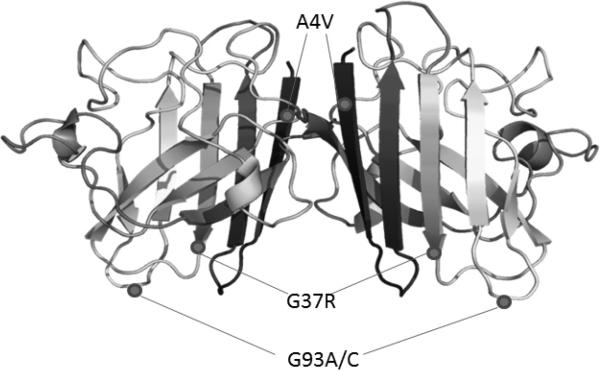
FIGURE 1. Localization of SOD1 mutants in metallated homodimeric structure
A4V, G37R, G93A, and G93C are identified in the hSOD1 homodimer. Structure modified from Protein Data Bank, PDB 2C9V (Strange, Antonyuk, Hough, et al., 2006).
FIGURE 2
FIGURE 2. Solubility, but not toxicity, differs across non-stressed hSOD1 mutants
A) CHO cells transiently expressing wild-type (WT), A4V, G37R, G93A, or G93C hSOD1 for 48 hours were separated into readily and detergent-soluble fractions and detected through immunoblot using a pan-SOD1 antibody. β-actin levels demonstrate equal protein loading. NT indicates non-transfected cells. B) Levels of readily and detergent-soluble hSOD1 were quantified through optical densitometry; the percent readily soluble hSOD1 was expressed over the total hSOD1 detected for each mutant. Wild-type and G93C protein were the most soluble, A4V was the least soluble. C) 48 hours following transient transfection, viability was assessed through membrane integrity. Toxicity was expressed as the percentage of dead cells over the total number of cells. The mutants did not differ from each other in terms of toxicity, however all mutants exhibited a weak toxicity in comparison to wild-type hSOD1. Values represent the means ± SEM and significance is relative to the wild-type hSOD1 condition (* = p<0.05, ** = p<0.001).
FIGURE 3
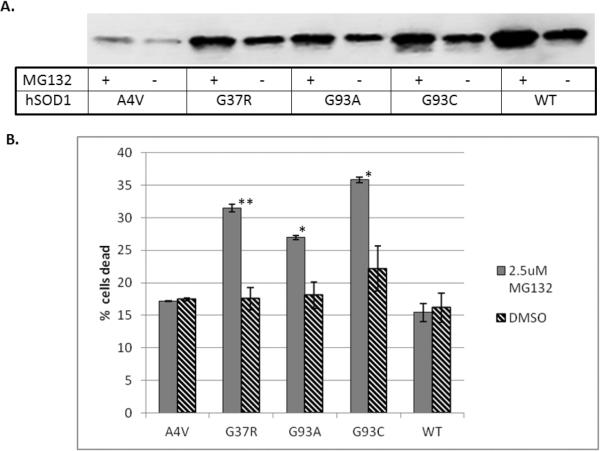
FIGURE 3. SOD1-related toxicity correlates directly with relative solubility
A) 24 hours after SOD1 transfection, CHO cells were exposed to the proteasome inhibitor MG-132 (2.5 μM) for 24 hours. The homogenates were separated into readily soluble and detergent-soluble fractions and then detected through immunoblot using a pan-SOD1 antibody. The immunoblots demonstrate that the levels of readily soluble protein increase in the presence of MG-132. B) Proteasome inhibition differentially affects SOD1-related toxicity in cells expressing the different hSOD1 mutants. Values represent the means of at least 3 independent experiments, ± SEM. Significance is based on comparison of means between MG132 and DMSO treatments (* = p<0.05, ** = p<0.005).
FIGURE 4
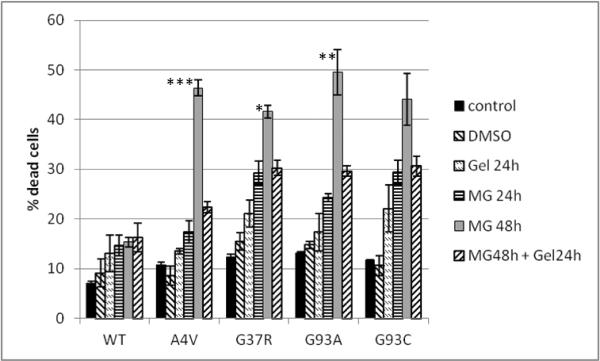
FIGURE 4. Upregulating Hsp70 ameliorates toxicity induced by proteasome inhibition
Transiently transfected CHO cells were treated at 24 hours post transfection with: DMSO (veh); 2.5 μM MG-132 for 24 hours;10 μM geldanamycin (Gel) for 24 hours; 2.5 μM MG-132 for 48 hours; or 2.5 μM MG-132 for 48 hours with the cells simultaneously being exposed to 10 μM geldanamycin for the last 24 hours. Values represent the means of 3 independent experiments, ± SEM. Statistical analysis was based on comparisons of cell death in the MG48 condition vs. the MG48 + Gel24h condition for each mutant (*=p<0.05, **=p<0.01, ***=p<0.001).
FIGURE 5
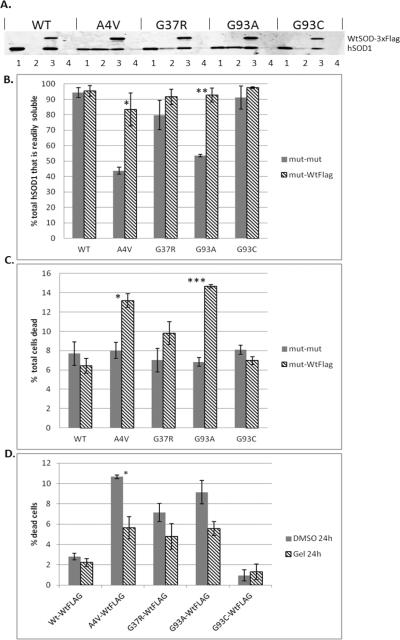
FIGURE 5. Wild-type hSOD1 increases both mutant hSOD1 solubility and toxicity; thus increased toxicity can be rescued by upregulating Hsp70
A) CHO cells were transiently transfected with equal total amounts of mutant hSOD1 (mut-mut) or mutant and wild-type-3xFLAG (mut-WtFLAG) hSOD1 DNA; 48 hours later protein was separated into readily soluble and detergent-soluble fractions, and detected on immunoblot with a pan-SOD1 antibody. Lane (1) = readily soluble mut-mut, (2) = detergent-soluble mut-mut, (3) = readily soluble mut-WtFLAG, (4) = detergent-soluble mut-WtFLAG; the Wt-3xFLAG protein has a slightly higher molecular weight. B) Bands were quantified using optical densitometry, confirming that co-expression with WT hSOD1 increases the proportion of readily soluble mutant protein for A4V and G93A. C) The increased proportion of readily soluble mutant SOD1 protein corresponds with toxicity. Wild-type hSOD1 induced toxicity in A4V and G93A expressing cells relative to the mut-mut condition. D) Induction of heat shock proteins with geldanamycin (10 μM for 24 hours) protects against toxicity created by co-expressing A4V with WT hSOD1 protein. For B and C, statistical comparisons are mut-WtFLAG vs. the mut-mut condition. For D statistical comparisons are with the DMSO condition for each hSOD1 mutant. Values represent the means of at least 3 independent experiments ± SEM (* = p<0.05, ** = p< 0.001, *** = p<0.0001).
FIGURE 6
FIGURE 6. Presence of wild-type hSOD1 increases mutant hSOD1 vulnerability to proteasome inhibition
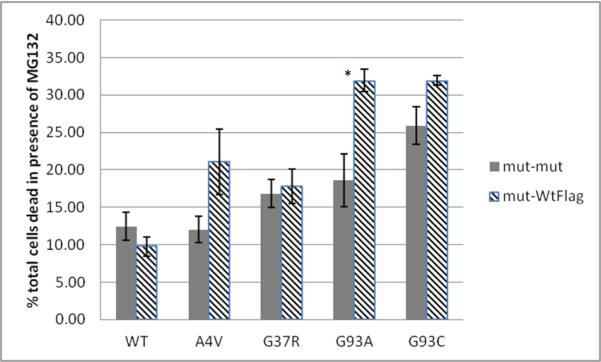
CHO cells were transiently transfected with equal total levels of mutant (mut-mut) hSOD1 or mutant and wild-type-3×FLAG (mut-WtFLAG) hSOD1 DNA and allowed to express for 24 hours before being exposed to 2.5 μM MG-132 for 24 hours. Viability was assessed via membrane integrity. Values represent the means of at least 3 independent experiments ± SEM. Statistical comparisons are mut-WtFLAG vs. the mut-mut condition (* = p< 0.05).
FIGURE 7
FIGURE 7. Misfolded and soluble SOD1 is more toxic than aggregated SOD1
Mutant SOD1 is initially present as soluble, natively folded (circles) and soluble, misfolded (hexagons) protein. Proteasome inhibition slows protein turnover, increasing levels of soluble, misfolded and poorly soluble, potentially aggregated SOD1 (hexagon conglomerates) and is associated with increased cell toxicity. Up-regulating heat shock protein chaperones while maintaining proteasome inhibition targets soluble, misfolded protein for re-folding but does not decrease levels of poorly soluble, aggregated SOD1 and is associated with low levels of cell toxicity. The presence of poorly soluble, aggregated SOD1 alone is not enough to initiate toxicity; in contrast, misfolded, soluble SOD1 must be present for cell toxicity.

References

    1. Banci L, Bertini I, Durazo A, Girotto S, Gralla EB, Martinelli M, et al. Metal-free superoxide dismutase forms soluble oligomers under physiological conditions: A possible general mechanism for familial ALS. P Natl Acad Sci USA. 2007;104:11263–11267. - PMC - PubMed
    1. Batulan Z, Shinder GA, Minotti S, He BP, Doroudchi M, Nalbantoglu J, et al. High threshold for induction of the stress response in motor neurons is associated with failure to activate HSF1. J Neurosci. 2003;23:5789–5798. - PMC - PubMed
    1. Batulan Z, Taylor DM, Aarons RJ, Minotti S, Doroudchi MM, Nalbantoglu J, et al. Induction of multiple heat shock proteins and neuroprotection in a primary culture model of familial amyotrophic lateral sclerosis. Neurobiol Dis. 2006;24:213–225. - PubMed
    1. Beckmann RP, Mizzen LA, Welch WJ. Interaction of Hsp-70 with Newly Synthesized Proteins - Implications for Protein Folding and Assembly. Science. 1990;248:850–854. - PubMed
    1. Bodner RA, Outeiro TF, Altmann S, Maxwell MM, Cho SH, Hyman BT, et al. Pharmacological promotion of inclusion formation: A therapeutic approach for Huntington's and Parkinson's diseases. P Natl Acad Sci USA. 2006;103:4246–4251. - PMC - PubMed

Publication types