Self-reported bruxism mirrors anxiety and stress in adults
- PMID: 22926484
- PMCID: PMC3548648
- DOI: 10.4317/medoral.18232
Self-reported bruxism mirrors anxiety and stress in adults
Abstract
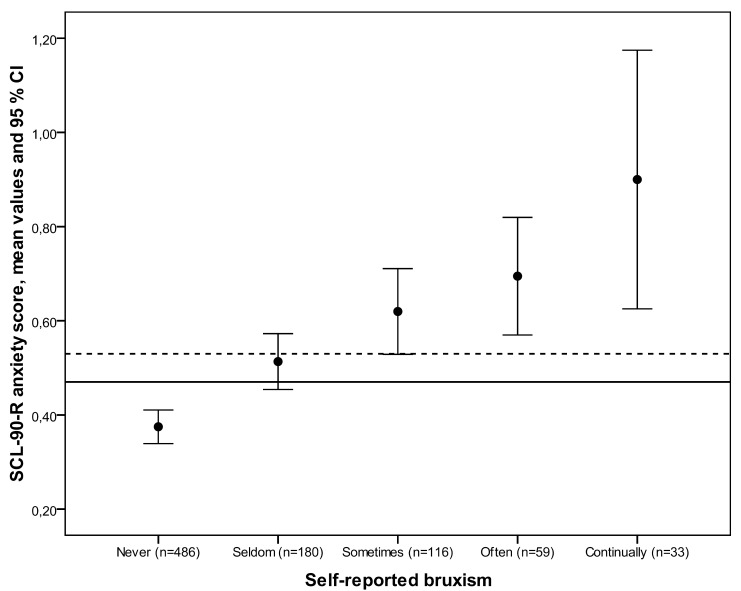
Objectives: The aims were to analyze whether the levels of self-reported bruxism and anxiety associate among otherwise healthy subjects, and to investigate the independent effects of anxiety and stress experience on the probability of self-reported bruxism.
Study design: As part of a study on irregular shift work, a questionnaire was mailed to all employees of the Finnish Broadcasting Company with irregular shift work (number of subjects: n=750) and to an equal number of randomly selected employees in the same company with regular eight-hour daytime work.
Results: The response rates were 82.3% (56.6 % men) and 34.3 % (46.7 % men), respectively. Among the 874 respondents, those aware of more frequent bruxism reported significantly more severe anxiety (p<0.001). Adjusted by age and gender, frequent bruxers were more than two times more likely to report severe stress (odds ratio 2.5; 95% confidence interval 1.5-4.2) and anxiety (odds ratio 2.2; 95% confidence interval 1.3-3.6) than non-or-mild bruxers.
Conclusions: Present findings suggest that self-reported bruxism and psychological states such as anxiety or stress may be related in working age subjects.
Figures
References
-
- Olkinuora M. Psychosocial aspects in a series of bruxists compared with a group of non-bruxists. Proc Finn Dent Soc. 1972;68:200–8. - PubMed
-
- Heller RF, Forgione AG. An evaluation of bruxism control: massed negative practice and automated relaxation training. J Dent Res. 1975;54:1120–3. - PubMed
-
- Funch DP, Gale EN. Factors associated with nocturnal bruxism and its treatment. J Behav Med. 1980;3:385–97. - PubMed
-
- Kampe T, Edman G, Bader G, Tagdae T, Karlsson S. Personality traits in a group of subjects with long-standing bruxing behaviour. J Oral Rehabil. 1997;24:588–93. - PubMed
-
- Manfredini D, Landi N, Fantoni F, Segù M, Bosco M. Anxiety symptoms in clinically diagnosed bruxers. J Oral Rehabil. 2005;32:584–8. - PubMed
MeSH terms
LinkOut - more resources
Full Text Sources
Other Literature Sources
Medical
Research Materials