


New synaptic and molecular targets for neuroprotection in Parkinson's disease
- PMID: 22927178
- PMCID: PMC4161019
- DOI: 10.1002/mds.25096
New synaptic and molecular targets for neuroprotection in Parkinson's disease
Abstract
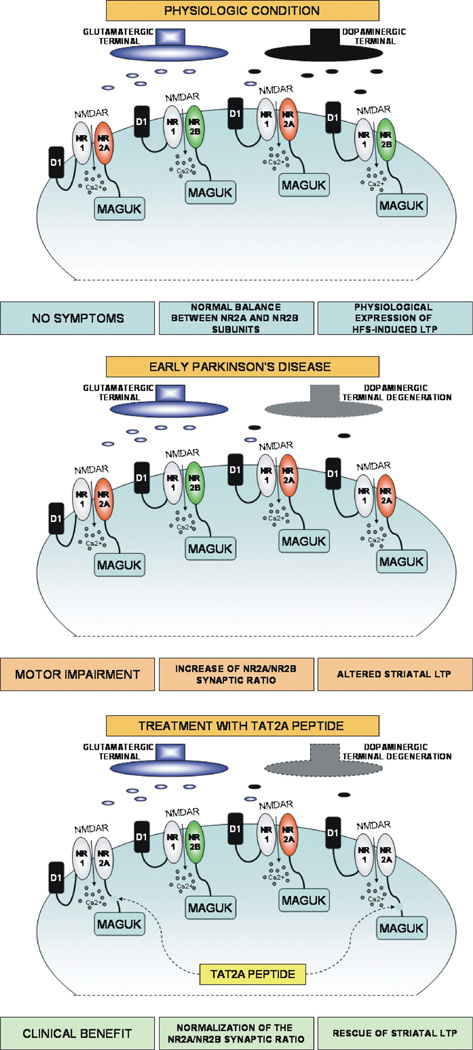
The defining anatomical feature of Parkinson's disease (PD) is the degeneration of substantia nigra pars compacta (SNc) neurons, resulting in striatal dopamine (DA) deficiency and in the subsequent alteration of basal ganglia physiology. Treatments targeting the dopaminergic system alleviate PD symptoms but are not able to slow the neurodegenerative process that underlies PD progression. The nucleus striatum comprises a complex network of projecting neurons and interneurons that integrates different neural signals to modulate the activity of the basal ganglia circuitry. In this review we describe new potential molecular and synaptic striatal targets for the development of both symptomatic and neuroprotective strategies for PD. In particular, we focus on the interaction between adenosine A2A receptors and dopamine D2 receptors, on the role of a correct assembly of NMDA receptors, and on the sGC/cGMP/PKG pathway. Moreover, we also discuss the possibility to target the cell death program parthanatos and the kinase LRRK2 in order to develop new putative neuroprotective agents for PD acting on dopaminergic nigral neurons as well as on other basal ganglia structures.
Copyright © 2013 Movement Disorders Society.
Conflict of interest statement
Full financial disclosures and author roles may be found in the online version of this article.
Figures


References
-
- Calabresi P, Filippo MD, Ghiglieri V, Tambasco N, Picconi B. Levodopa-induced dyskinesias in patients with Parkinson’s disease: filling the bench-to-bedside gap. Lancet Neurol. 2010;9:1106–1117. - PubMed
-
- Lang AE, Obeso JA. Challenges in Parkinson’s disease: restoration of the nigrostriatal dopamine system is not enough. Lancet Neurol. 2004;3:309–316. - PubMed
-
- Olanow CW, Kieburtz K, Schapira AH. Why have we failed to achieve neuroprotection in Parkinson’s disease? Ann Neurol. 2008;64(Suppl 2):S101–S110. - PubMed
-
- Stephens B, Mueller AJ, Shering AF, et al. Evidence of a break-down of corticostriatal connections in Parkinson’s disease. Neuroscience. 2005;132:741–754. - PubMed
-
- Deutch AY. Striatal plasticity in parkinsonism: dystrophic changes in medium spiny neurons and progression in Parkinson’s disease. J Neural Transm Suppl. 2006:67–70. - PubMed
Publication types
MeSH terms
Substances
Grants and funding
LinkOut - more resources
Full Text Sources
Medical
Miscellaneous
