. 2012 Sep 11;109(37):14930-5.
doi: 10.1073/pnas.1203574109. Epub 2012 Aug 27.

Structural and mechanistic insights into bisphenols action provide guidelines for risk assessment and discovery of bisphenol A substitutes

Affiliations

Structural and mechanistic insights into bisphenols action provide guidelines for risk assessment and discovery of bisphenol A substitutes

Vanessa Delfosse et al. Proc Natl Acad Sci U S A. .

Abstract

Bisphenol A (BPA) is an industrial compound and a well known endocrine-disrupting chemical with estrogenic activity. The widespread exposure of individuals to BPA is suspected to affect a variety of physiological functions, including reproduction, development, and metabolism. Here we report that the mechanisms by which BPA and two congeners, bisphenol AF and bisphenol C (BPC), bind to and activate estrogen receptors (ER) α and β differ from that used by 17β-estradiol. We show that bisphenols act as partial agonists of ERs by activating the N-terminal activation function 1 regardless of their effect on the C-terminal activation function 2, which ranges from weak agonism (with BPA) to antagonism (with BPC). Crystallographic analysis of the interaction between bisphenols and ERs reveals two discrete binding modes, reflecting the different activities of compounds on ERs. BPA and 17β-estradiol bind to ERs in a similar fashion, whereas, with a phenol ring pointing toward the activation helix H12, the orientation of BPC accounts for the marked antagonist character of this compound. Based on structural data, we developed a protocol for in silico evaluation of the interaction between bisphenols and ERs or other members of the nuclear hormone receptor family, such as estrogen-related receptor γ and androgen receptor, which are two known main targets of bisphenols. Overall, this study provides a wealth of tools and information that could be used for the development of BPA substitutes devoid of nuclear hormone receptor-mediated activity and more generally for environmental risk assessment.


Conflict of interest statement

The authors declare no conflict of interest.

Figures
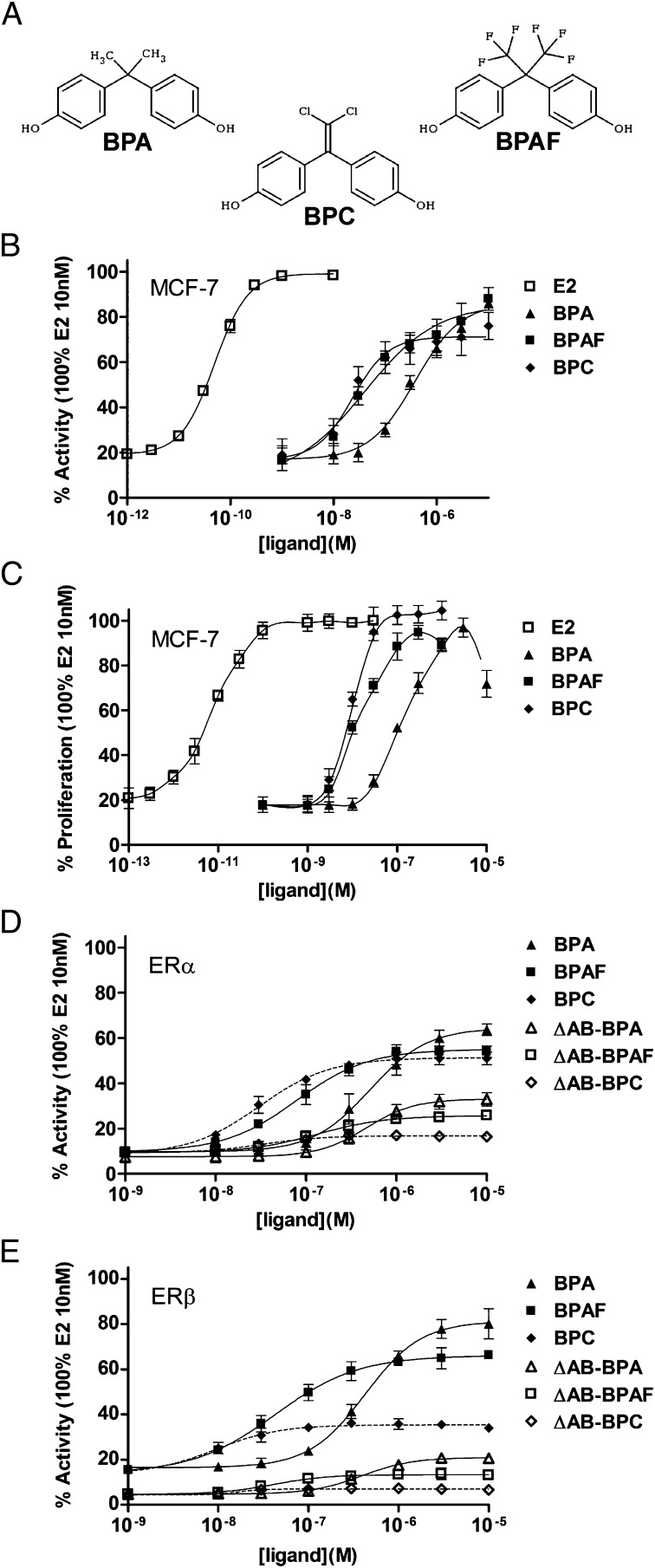
Fig. 1.
Fig. 1.
Dose–response curve for bisphenols in reporter cell lines. (A) Chemical structures of some bisphenols used in this study. (B) MELN, (D) HELN-ERα and -ΔAB-ERα, and (E) HELN-ERβ and -ΔAB-ERβ luciferase assays of BPA, BPAF, and BPC. (C) Proliferative response of BPA, BPAF, and BPC in MELN cells. The maximal luciferase and proliferation activity (100%) was obtained with 10 nM E2. Values are the mean ± SD from three separate experiments.
Fig. 2.
Fig. 2.
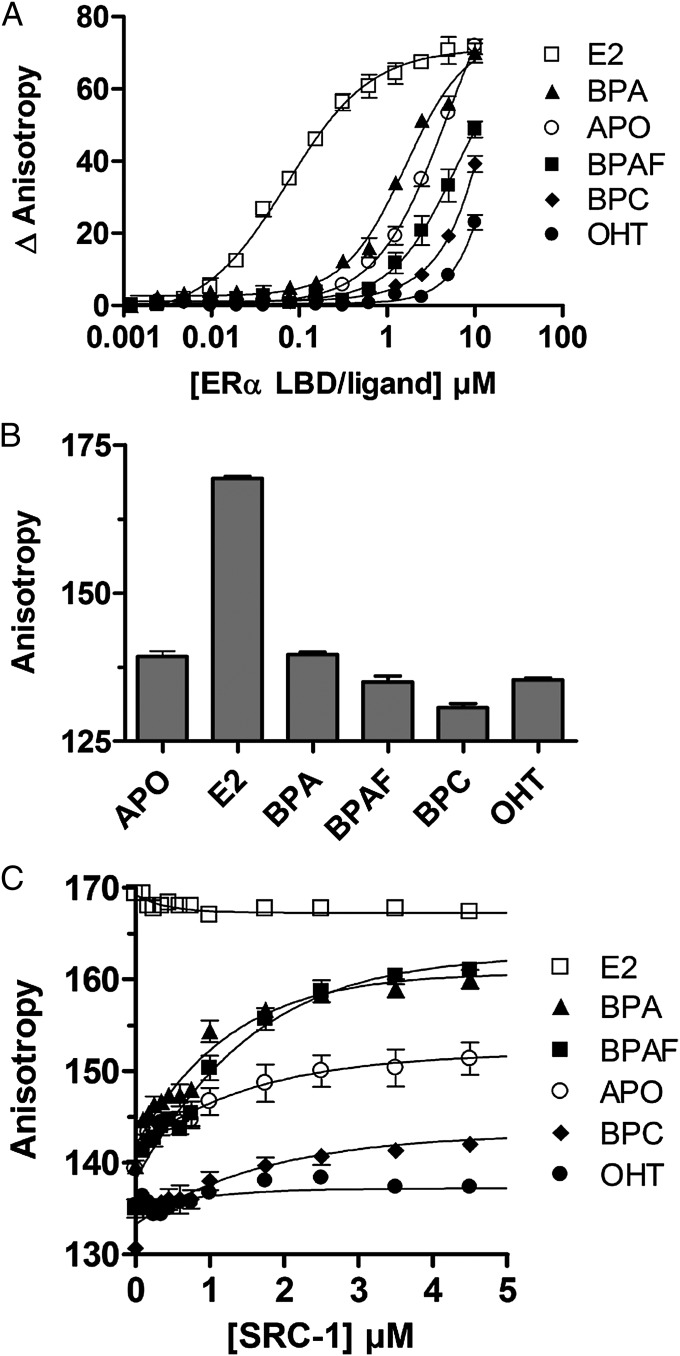
Bisphenol-induced coactivator recruitment and structural dynamics. (A) Titration of fluorescein-labeled SRC-1 NR2 peptide by ERα LBD in the absence of ligand or in the presence of E2 (agonist), OHT (antagonist), BPA, BPAF, or BPC. (B) Anisotropy measurements of fluorescein-labeled ERα LBD in the presence of saturating concentrations of bisphenols, E2, or OHT. (C) Similar experiments performed in the presence of increasing concentrations of the coactivator-derived peptide SRC-1 NR2.
Fig. 3.
Fig. 3.
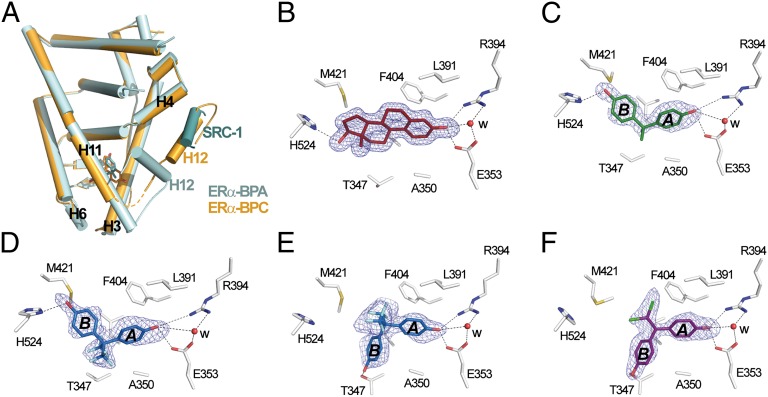
Two different binding modes of bisphenols. (A) The whole structure of the ERα Y537S LBD in complex with SRC-1 NR2 and BPA (cyan) superimposed on that of WT ERα LBD bound to BPC (orange). The orange dashed line denotes residues not visible in the electron density map. (BF) Interaction networks of E2 (B), BPA (C), BPAF (D and E), and BPC (F) with LBP residues in ERα. Oxygen, nitrogen, sulfur, fluorine, and chlorine atoms are colored in red, blue, yellow, cyan, and green, respectively. Hydrogen bonds are indicated by black dashed lines. For clarity, not all protein–ligand interactions are depicted. The blue electron density represents a Fo-Fc simulated annealing omit map contoured at 3σ.
Fig. 4.
Fig. 4.
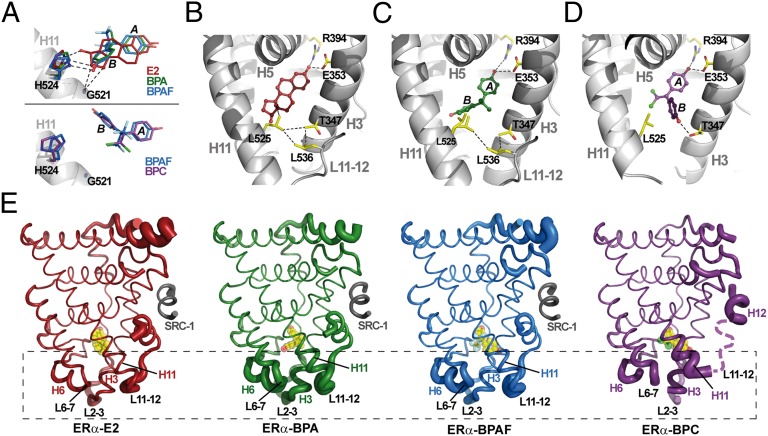
Bisphenol binding promotes ERα structural dynamics. (A) Differential interactions of bisphenols and E2 with G521 and H524. (B) The interaction of E2 with L525 strengthens a van der Waals interactions network involving T347 (H3), L525 (H11), and L536 (L11–L12). (C) Because of a lack of contact with BPA, L525 is not stabilized and adopts two different conformations. (D) In the BPC-bound ERα structure, T347 rotates by 180° to form a hydrogen bond with the bisphenol, resulting in the disruption of the hydrophobic network. (E) Ribbon representation of ERα LBD in complex with E2 (red), BPA (green), BPAF (blue), and BPC (purple; dashed line denotes missing residues). Ligands are shown in yellow. The diameter of the ribbon is directly proportional to the temperature factor B and highlights the dynamics all along the polypeptide chain.

References

    1. Vandenberg LN, et al. Exposure to environmentally relevant doses of the xenoestrogen bisphenol-A alters development of the fetal mouse mammary gland. Endocrinology. 2007;148:116–127. - PMC - PubMed
    1. Dekant W, Völkel W. Human exposure to bisphenol A by biomonitoring: Methods, results and assessment of environmental exposures. Toxicol Appl Pharmacol. 2008;228:114–134. - PubMed
    1. Vandenberg LN, et al. Urinary, circulating, and tissue biomonitoring studies indicate widespread exposure to bisphenol A. Environ Health Perspect. 2010;118:1055–1070. - PMC - PubMed
    1. Zalko D, Jacques C, Duplan H, Bruel S, Perdu E. Viable skin efficiently absorbs and metabolizes bisphenol A. Chemosphere. 2011;82:424–430. - PubMed
    1. Crain DA, et al. An ecological assessment of bisphenol-A: Evidence from comparative biology. Reprod Toxicol. 2007;24:225–239. - PubMed

Publication types

MeSH terms