


doi: 10.1073/pnas.1209746109.
Epub 2012 Aug 27.
Signing at the beginning makes ethics salient and decreases dishonest self-reports in comparison to signing at the end
Affiliations
- PMID: 22927408
- PMCID: PMC3458378
- DOI: 10.1073/pnas.1209746109
Item in Clipboard
Signing at the beginning makes ethics salient and decreases dishonest self-reports in comparison to signing at the end
Proc Natl Acad Sci U S A.
.
Retraction in
-
Retraction for Shu et al., Signing at the beginning makes ethics salient and decreases dishonest self-reports in comparison to signing at the end.Proc Natl Acad Sci U S A. 2021 Sep 21;118(38):e2115397118. doi: 10.1073/pnas.2115397118. Proc Natl Acad Sci U S A. 2021. PMID: 34518237 Free PMC article. No abstract available.
Abstract
Many written forms required by businesses and governments rely on honest reporting. Proof of honest intent is typically provided through signature at the end of, e.g., tax returns or insurance policy forms. Still, people sometimes cheat to advance their financial self-interests-at great costs to society. We test an easy-to-implement method to discourage dishonesty: signing at the beginning rather than at the end of a self-report, thereby reversing the order of the current practice. Using laboratory and field experiments, we find that signing before-rather than after-the opportunity to cheat makes ethics salient when they are needed most and significantly reduces dishonesty.
Conflict of interest statement
The authors declare no conflict of interest.
Figures
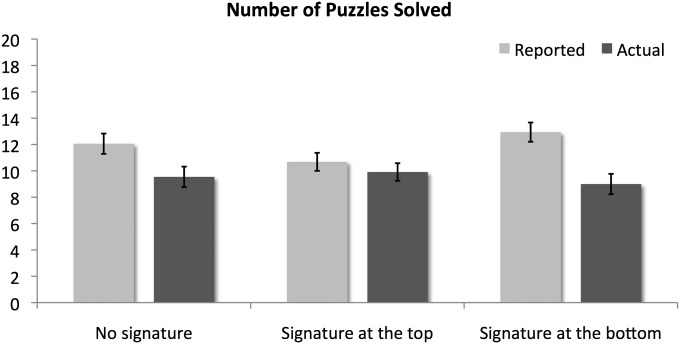
Reported and actual number of math puzzles solved by condition, experiment 1 (n = 101). Error bars represent SEM.
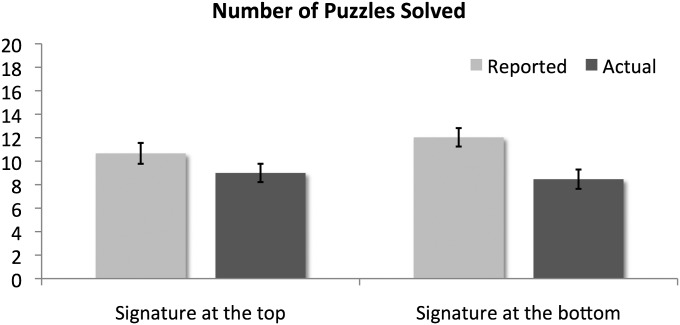
Reported and actual number of math puzzles solved by condition, experiment 2 (n = 60). Error bars represent SEM.
References
-
- US Department of Treasury (2009). Update on Reducing the Federal Tax Gap and Improving Voluntary Compliance. Available at http://www.irs.gov/pub/newsroom/tax_gap_report_-final_version.pdf. Accessed August 2, 2012.
-
- Coalition Against Insurance Fraud . Coalition Against Insurance Fraud Annual Report. Washington, DC: CAIF; 2006.
-
- Mazar N, Amir O, Ariely D. The dishonesty of honest people: A theory of self-concept maintenance. J Mark Res. 2008;45:633–644.
-
- Shu LL, Gino F, Bazerman MH. Dishonest deed, clear conscience: When cheating leads to moral disengagement and motivated forgetting. Pers Soc Psychol Bull. 2011;37:330–349. - PubMed
-
- Haley KJ, Fessler DMT. Nobody’s watching? Subtle cues affect generosity in an anonymous economic game. Evol Hum Behav. 2005;26:245–256.
Publication types
MeSH terms
LinkOut - more resources
Full Text Sources
Medical
