


Tools used to assess medical students competence in procedural skills at the end of a primary medical degree: a systematic review
- PMID: 22927716
- PMCID: PMC3427596
- DOI: 10.3402/meo.v17i0.18398
Tools used to assess medical students competence in procedural skills at the end of a primary medical degree: a systematic review
Abstract
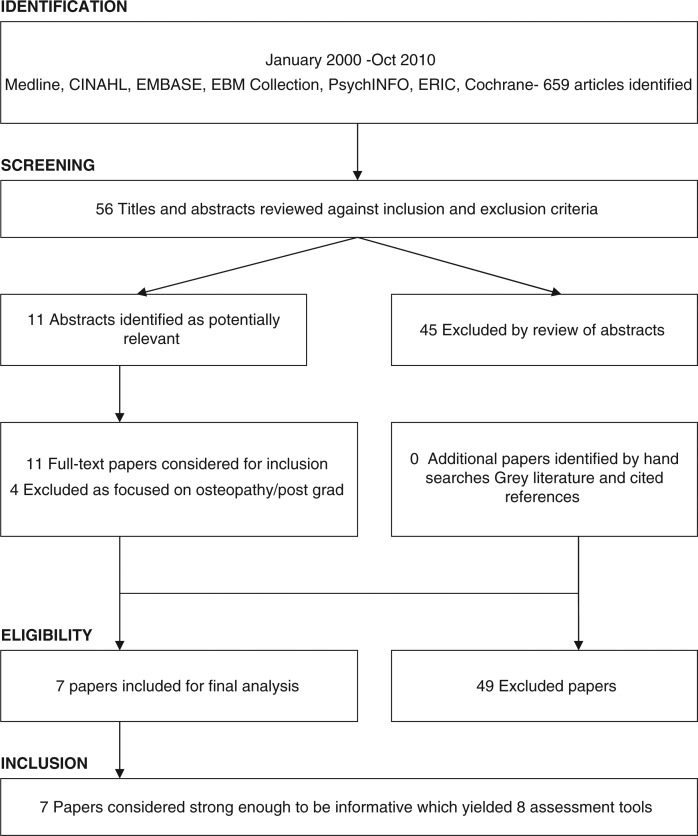
The objective was to systematically review the literature to identify and grade tools used for the end point assessment of procedural skills (e.g., phlebotomy, IV cannulation, suturing) competence in medical students prior to certification. The authors searched eight bibliographic databases electronically - ERIC, Medline, CINAHL, EMBASE, Psychinfo, PsychLIT, EBM Reviews and the Cochrane databases. Two reviewers independently reviewed the literature to identify procedural assessment tools used specifically for assessing medical students within the PRISMA framework, the inclusion/exclusion criteria and search period. Papers on OSATS and DOPS were excluded as they focused on post-registration assessment and clinical rather than simulated competence. Of 659 abstracted articles 56 identified procedural assessment tools. Only 11 specifically assessed medical students. The final 11 studies consisted of 1 randomised controlled trial, 4 comparative and 6 descriptive studies yielding 12 heterogeneous procedural assessment tools for analysis. Seven tools addressed four discrete pre-certification skills, basic suture (3), airway management (2), nasogastric tube insertion (1) and intravenous cannulation (1). One tool used a generic assessment of procedural skills. Two tools focused on postgraduate laparoscopic skills and one on osteopathic students and thus were not included in this review. The levels of evidence are low with regard to reliability - κ = 0.65-0.71 and minimum validity is achieved - face and content. In conclusion, there are no tools designed specifically to assess competence of procedural skills in a final certification examination. There is a need to develop standardised tools with proven reliability and validity for assessment of procedural skills competence at the end of medical training. Medicine graduates must have comparable levels of procedural skills acquisition entering the clinical workforce irrespective of the country of training.
Keywords: assessment tools; clinical skills; competence; competence assessment; final medical examination; medical students; medical trainees; procedural skills; student physicians; surgical skills; technical skills.
Figures
References
-
- Frank JR, editor. Better standards. Better physicians. Better care. Ottawa: The Royal College of Physicians and Surgeons of Canada; 2005. The CanMEDS 2005 physician competency framework. Available from: http://rcpsc.medical.org/canmeds/CanMEDS20705/index.php.
-
- Van der Vleuten C. Pitfalls in the pursuit of objectivity: issues of relaibility. Med Educ. 1991;25:110–8. - PubMed
-
- Harden R. Assessment of clinical competence using an objective structured clinical examination (OSCE) Med Educ. 1979;13:41–5. - PubMed
-
- Kogan J. Tools for direct observation and assessment of clinical skills of medical trainees: a systematic review. JAMA. 2009;302:1316–26. - PubMed
Publication types
MeSH terms
LinkOut - more resources
Full Text Sources
