


Thermal adaptation of the archaeal and bacterial lipid membranes
- PMID: 22927779
- PMCID: PMC3426160
- DOI: 10.1155/2012/789652
Thermal adaptation of the archaeal and bacterial lipid membranes
Abstract
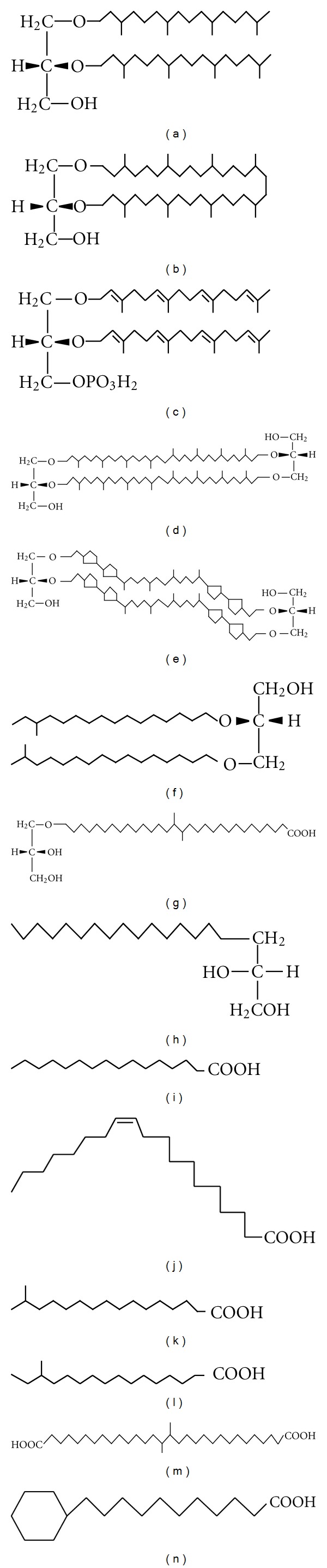
The physiological characteristics that distinguish archaeal and bacterial lipids, as well as those that define thermophilic lipids, are discussed from three points of view that (1) the role of the chemical stability of lipids in the heat tolerance of thermophilic organisms: (2) the relevance of the increase in the proportion of certain lipids as the growth temperature increases: (3) the lipid bilayer membrane properties that enable membranes to function at high temperatures. It is concluded that no single, chemically stable lipid by itself was responsible for the adaptation of surviving at high temperatures. Lipid membranes that function effectively require the two properties of a high permeability barrier and a liquid crystalline state. Archaeal membranes realize these two properties throughout the whole biological temperature range by means of their isoprenoid chains. Bacterial membranes meet these requirements only at or just above the phase-transition temperature, and therefore their fatty acid composition must be elaborately regulated. A recent hypothesis sketched a scenario of the evolution of lipids in which the "lipid divide" emerged concomitantly with the differentiation of archaea and bacteria. The two modes of thermal adaptation were established concurrently with the "lipid divide."
Figures
References
-
- Koga Y. Early evolution of membrane lipids: how did the lipid divide occur? Journal of Molecular Evolution. 2011;72(3):274–282. - PubMed
-
- Koga Y, Morii H. Special methods for the analysis of ether lipid structure and metabolism in archaea. Analytical Biochemistry. 2006;348(1):1–14. - PubMed
-
- Koga Y, Nakano M. A dendrogram of archaea based on lipid component parts composition and its relationship to rRNA phylogeny. Systematic and Applied Microbiology. 2008;31(3):169–182. - PubMed
Publication types
MeSH terms
Substances
LinkOut - more resources
Full Text Sources
Other Literature Sources
