


Perinatal Na+ overload programs raised renal proximal Na+ transport and enalapril-sensitive alterations of Ang II signaling pathways during adulthood
- PMID: 22928034
- PMCID: PMC3425503
- DOI: 10.1371/journal.pone.0043791
Perinatal Na+ overload programs raised renal proximal Na+ transport and enalapril-sensitive alterations of Ang II signaling pathways during adulthood
Abstract
Background: High Na(+) intake is a reality in nowadays and is frequently accompanied by renal and cardiovascular alterations. In this study, renal mechanisms underlying perinatal Na(+) overload-programmed alterations in Na(+) transporters and the renin/angiotensin system (RAS) were investigated, together with effects of short-term treatment with enalapril in terms of reprogramming molecular alterations in kidney.
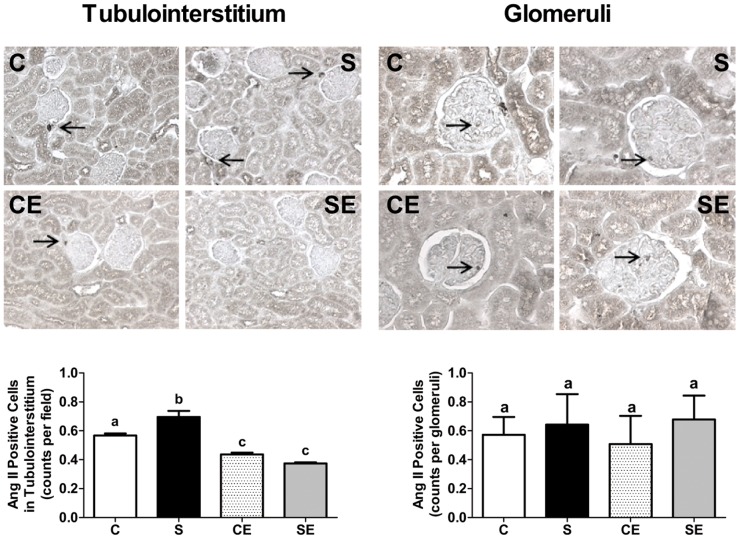
Methodology/principal findings: Male adult Wistar rats were obtained from dams maintained throughout pregnancy and lactation on a standard diet and drinking water (control) or 0.17 M NaCl (saline group). Enalapril (100 mg/l), an angiotensin converting enzyme inhibitor, was administered for three weeks after weaning. Ninety day old offspring from dams that drank saline presented with proximal tubules exhibiting increased (Na(+)+K(+))ATPase expression and activity. Ouabain-insensitive Na(+)-ATPase activity remained unchanged but its response to angiotensin II (Ang II) was lost. PKC, PKA, renal thiobarbituric acid reactive substances (TBARS), macrophage infiltration and collagen deposition markedly increased, and AT(2) receptor expression decreased while AT(1) expression was unaltered. Early treatment with enalapril reduced expression and activity of (Na(+)+K(+))ATPase, partially recovered the response of Na(+)-ATPase to Ang II, and reduced PKC and PKA activities independently of whether offspring were exposed to high perinatal Na(+) or not. In addition, treatment with enalapril per se reduced AT(2) receptor expression, and increased TBARS, macrophage infiltration and collagen deposition. The perinatally Na(+)-overloaded offspring presented high numbers of Ang II-positive cortical cells, and significantly lower circulating Ang I, indicating that programming/reprogramming impacted systemic and local RAS.
Conclusions/significance: Maternal Na(+) overload programmed alterations in renal Na(+) transporters and in its regulation, as well as severe structural lesions in adult offspring. Enalapril was beneficial predominantly through its influence on Na(+) pumping activities in adult offspring. However, side effects including down-regulation of PKA, PKC and AT(2) receptors and increased TBARS could impair renal function in later life.
Conflict of interest statement
Figures


References
-
- Marin ECS, Balbi APC, Francescato HDC, Alves da Silva CG, Costa RS, et al. (2008) Renal structure and function evaluation of rats from dams that received increased sodium intake during pregnancy and lactation submitted or not to 5/6 nephrectomy. Renal Fail 30: 547–555. - PubMed
-
- Cardoso HD, Cabral EV, Vieira-Filho LD, Vieyra A, Paixão AD (2009) Fetal development and renal function in adult rats prenatally subjected to sodium overload. Pediatr Nephrol 4: 1959–1965. - PubMed
-
- Contreras RJ, Wong DL, Henderson R, Curtis KS, Smith JC (2000) High dietary NaCl early in development enhances mean arterial pressure of adult rats. Physiol Behav 71: 173–181. - PubMed
-
- da Silva AA, de Noronha IL, de Oliveira IB, Malheiros DM, Heimann JC (2003) Renin-angiotensin system function and blood pressure in adult rats after perinatal salt overload. Nutr Metab Cardiovasc Dis 13: 133–139. - PubMed
-
- Balbi AP, Costa RS, Coimbra TM (2004) Postnatal renal development of rats from mothers that received increased sodium intake. Pediatr Nephrol 19: 1212–1218. - PubMed
Publication types
MeSH terms
Substances
LinkOut - more resources
Full Text Sources
Research Materials
Miscellaneous
