


Is autism a member of a family of diseases resulting from genetic/cultural mismatches? Implications for treatment and prevention
- PMID: 22928103
- PMCID: PMC3420574
- DOI: 10.1155/2012/910946
Is autism a member of a family of diseases resulting from genetic/cultural mismatches? Implications for treatment and prevention
Abstract
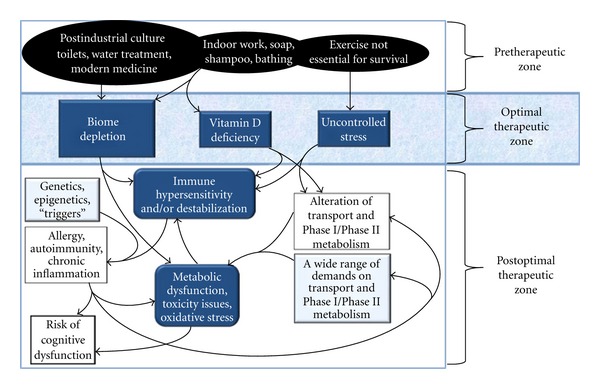
Several lines of evidence support the view that autism is a typical member of a large family of immune-related, noninfectious, chronic diseases associated with postindustrial society. This family of diseases includes a wide range of inflammatory, allergic, and autoimmune diseases and results from consequences of genetic/culture mismatches which profoundly destabilize the immune system. Principle among these consequences is depletion of important components, particularly helminths, from the ecosystem of the human body, the human biome. Autism shares a wide range of features in common with this family of diseases, including the contribution of genetics/epigenetics, the identification of disease-inducing triggers, the apparent role of immunity in pathogenesis, high prevalence, complex etiologies and manifestations, and potentially some aspects of epidemiology. Fortunately, using available resources and technology, modern medicine has the potential to effectively reconstitute the human biome, thus treating or even avoiding altogether the consequences of genetic/cultural mismatches which underpin this entire family of disease. Thus, if indeed autism is an epidemic of postindustrial society associated with immune hypersensitivity, we can expect that the disease is readily preventable.
Figures
References
-
- Bilbo SD, Wray GA, Perkins SE, Parker W. Reconstitution of the human biome as the most reasonable solution for epidemics of allergic and autoimmune diseases. Medical Hypotheses. 2011;77(4):494–504. - PubMed
-
- Ramaekers VT, Blau N, Sequeira JM, Nassogne MC, Quadros EV. Folate receptor autoimmunity and cerebral folate deficiency in low-functioning autism with neurological deficits. Neuropediatrics. 2007;38(6):276–281. - PubMed
-
- Mostafa GA, Al-Ayadhi LY. The relationship between the increased frequency of serum antineuronal antibodies and the severity of autism in children. European Journal of Pediatric Neurology. In press. - PubMed
-
- Ashwood P, Wakefield AJ. Immune activation of peripheral blood and mucosal CD3+ lymphocyte cytokine profiles in children with autism and gastrointestinal symptoms. Journal of Neuroimmunology. 2006;173(1-2):126–134. - PubMed
-
- Ashwood P, Wills S, Van De Water J. The immune response in autism: a new frontier for autism research. Journal of Leukocyte Biology. 2006;80(1):1–15. - PubMed
LinkOut - more resources
Full Text Sources
