Review
. 2013 May;37(3):286-302.
doi: 10.1111/j.1574-6976.2012.00352.x. Epub 2012 Sep 20.

Trichodesmium--a widespread marine cyanobacterium with unusual nitrogen fixation properties

Affiliations
Free PMC article
Review

Trichodesmium--a widespread marine cyanobacterium with unusual nitrogen fixation properties

Birgitta Bergman et al. FEMS Microbiol Rev. 2013 May.
Free PMC article

Abstract

The last several decades have witnessed dramatic advances in unfolding the diversity and commonality of oceanic diazotrophs and their N2 -fixing potential. More recently, substantial progress in diazotrophic cell biology has provided a wealth of information on processes and mechanisms involved. The substantial contribution by the diazotrophic cyanobacterial genus Trichodesmium to the nitrogen influx of the global marine ecosystem is by now undisputable and of paramount ecological importance, while the underlying cellular and molecular regulatory physiology has only recently started to unfold. Here, we explore and summarize current knowledge, related to the optimization of its diazotrophic capacity, from genomics to ecophysiological processes, via, for example, cellular differentiation (diazocytes) and temporal regulations, and suggest cellular research avenues that now ought to be explored.


Figures

Fig. 1
Fig. 1
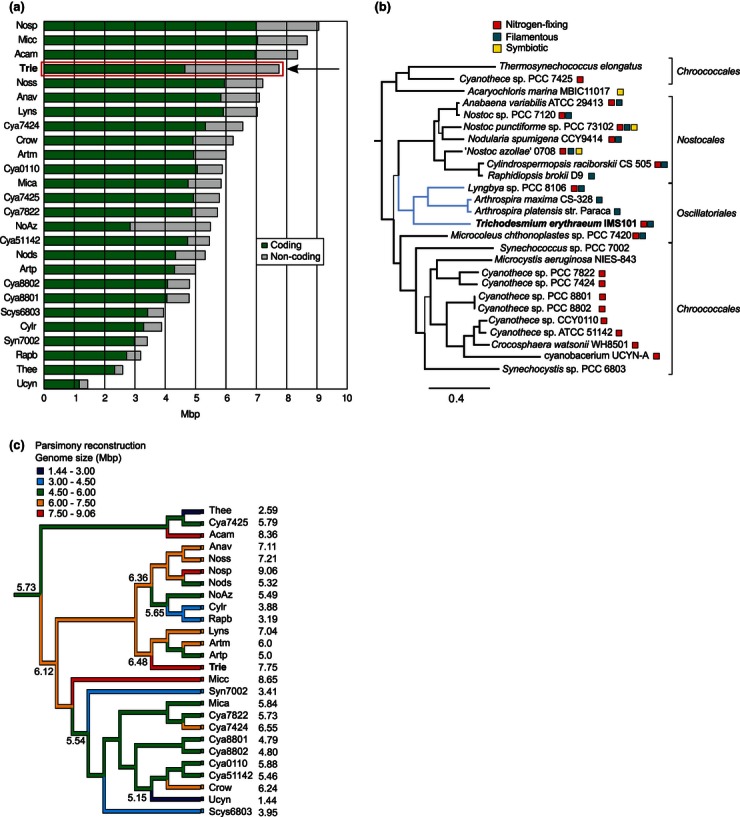
Phylogeny and genome properties of Trichodesmium IMS101. (a) Genome sizes and proportions of coding and noncoding nucleotides in genomes of organisms included in (b) and (c). Genomes are sorted by total size. The genome of Trichodesmium IMS101 is indicated by an arrow. (b) Maximum-likelihood phylogenetic tree based on a concatenated alignment of 285 single-copy orthologs. The tree is a subtree of a larger phylogeny of 58 cyanobacteria (see Larsson et al., 2011). Specific phenotypes for cyanobacteria are shown by the colored boxes next to the tip labels. The clade containing Trichodesmium (order Oscillatoriales) is highlighted with blue branches. Thick and thin branches indicate bootstrap support values (200 replicates) of 100 and between 58 and 84, respectively. Bar, 0.4 expected substitutions per site. (c) Ancestral genome sizes (reconstructed by parsimony) in the phylogeny from b. Organism names are abbreviated (see below for full names). Contemporary genome sizes (Mbp) are shown in the right margin and at specific nodes in the tree. Organism abbreviations are as follows: Acam = Acaryochloris marina MBIC11017, Anav = Anabaena variabilis ATCC29413, Artm = Arthrospira maxima CS328, Artp = Arthrospira platensis str. Paraca, Crow = Crocosphaera watsonii WH8501, Cya0110 = Cyanothece sp. CCY0110, Cya51142 = Cyanothece sp. ATCC51142, Cya7424 = Cyanothece sp. PCC7424, Cya7425 = Cyanothece sp. PCC7425, Cya7822 = Cyanothece sp. PCC7822, Cya8801 = Cyanothece sp. PCC8801, Cya8802 = Cyanothece sp. PCC 8802, Cylr = Cylindrospermopsis raciborskii CS505, Lyns = Lyngbya sp. PCC 8106, Mica = Microcystis aeruginosa NIES 843, Micc = Microcoleus chthonoplastes PCC7420, NoAz = ‘Nostoc azollae’ 0708, Nods = Nodularia spumigena CCY9414, Nosp = Nostoc punctiforme PCC73102, Noss = Nostoc sp. PCC7120, Rapb = Raphidiopsis brookii D9, Scys6803 = Synechocystis sp. PCC6803, Syn7002 = Synechococcus sp. PCC7002, Thee = Thermosynechococcus elongatus, Trie = Trichodesmium erythraeum IMS101, Ucyn = cyanobacterium UCYN-A. The figures are adapted from Larsson et al. (2011) with the author's permission.
Fig. 2
Fig. 2
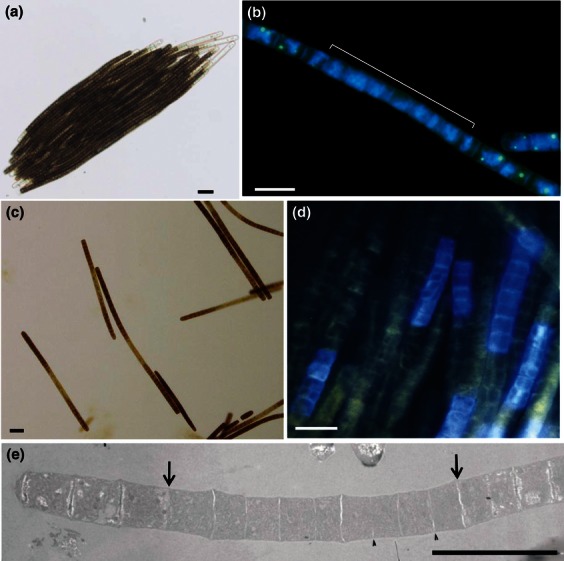
Morphological characteristics of Trichodesmium trichomes, with emphasis on cell differentiation and their nitrogenase containing cell type, the diazocytes. (a) A light micrograph depicting a dark pigmented colony consisting of longitudinally arranged trichomes of a newly isolated strain, T. erythraeum TNZ0801. Scale bar, 25 μm. (b) The DNA distribution in cells of a Trichodesmium IMS101 trichome visualized after staining with the dye 4′,6-diamidino-2-phenylindole (DAPI), fluorescing blue. Note the DNA presence in all cells, the centrally located diazocyte-like zone (marked) being recognized as they are devoid of the yellow/green fluorescent granules representing polyphosphate storage. Scale bar, 20 μm. (c) Trichomes of Trichodesmium IMS101 stained with Lugol's solution. Note several lighter-stained central diazocyte zones, in which catabolic carbon metabolism has degraded the Lugol-stainable stored carbon supplies. Scale bar 20 μm. (d) Fluorescence in situ immunolocalization of NifH into groups of adjacent cells, diazocytes, in central areas of intact trichomes of Trichodesmium IMS101. The NifH protein is detected as a blue fluorescence due to a secondary anti-NifH-antibody coupled to a blue-fluorescing chromophore. Scale bar, 10 μm. (e) Transmission electron micrograph depicting a longitudinally sectioned trichome of Trichodesmium IMS101. Note the more homogenous zone of cells, representing diazocytes between the arrows. Arrowheads point to ongoing cell division (the formation of division septa) in two of the diazocytes. Scale bar, 20 μm.
Fig. 3
Fig. 3
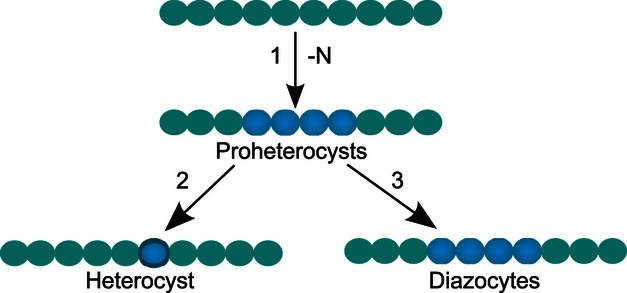
A potential evolutionary scenarium for the development of the diazocytic phenotype in Trichodesmium. (1) An ancient nonheterocystous filamentous cyanobacterium, a forerunner of Nostocales and Oscillatoriales (Fig. 1b and c), under nitrogen deprivation conditions develop strings of proheterocysts (as in Anabaena-type spp.; Wilcox et al., 1975). (2) The majority of the proheterocysts revert back into vegetative cells, while one continus the evolution into a thick-walled heterocyst, the dominating nitrogen-fixing phenotype in limnic and terrestrial ecosystems today. (3) In oceans, this proheterocystous phenotype may have been retained and evolved into the strings of diazocytes we see in Trichodesmium spp. today, while the closest relatives (Fig. 1b) either fix nitrogen in the dark (Lyngbya spp.; e.g. Lundgren et al., 2003) or have lost the capacity to fix nitrogen (Arthrospira spp.; Larsson et al., 2011; Latysheva et al., 2012).
Fig. 4
Fig. 4
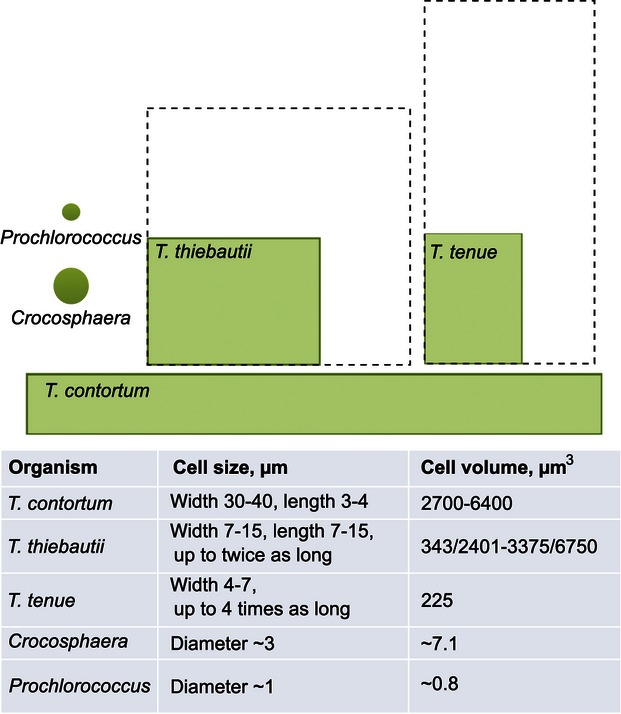
Schematic illustration of approximate cell size differences of Trichodesmium species and some unicellular cyanobacteria. The approximate cell sizes and volumes of different species of Trichodesmium are compared to the cell volumes of representatives of the nondiazotrophic but ubiquitous unicellular cyanobacterial genus Prochlorococcus and the unicellular diazotrophic genus Croccosphaera. Note the many-fold larger volume of the Trichodesmium cells. Hatched line shows maximum cell sizes. Trichodesmium cell sizes are according to Janson et al. (1995).

References

    1. Achilles KM, Church TM, Wilhelm SW, Luther GW, Hutchins DA. Bioavailability of iron to Trichodesmium colonies in the western subtropical Atlantic Ocean. Limnol Oceanogr. 2003;48:2250–2255.
    1. Andresen E, Lohscheider J, Setlikova E, Adamska I, Simek M, Küpper H. Acclimation of Trichodesmium erythraeum ISM101 to high and low irradiance analysed on the physiological, biophysical and biochemical level. New Phytol. 2010;185:173–188. - PubMed
    1. Badger MR, Price GD, Long BM, Woodger FJ. The environmental plasticity and ecological genomics of the cyanobacterial CO2 concentrating mechanism. J Exp Bot. 2006;57:249–265. - PubMed
    1. Bergman B, Carpenter EJ. Nitrogenase confined to randomly distributed trichomes in the marine cyanobacterium Trichodesmium-Thiebautii. J Phycol. 1991;27:158–165.
    1. Bergman B, Siddiqui PJ, Carpenter EJ, Peschek GA. Cytochrome oxidase: subcellular distribution and relationship to nitrogenase expression in the nonheterocystous marine cyanobacterium Trichodesmium thiebautii. Appl Environ Microbiol. 1993;59:3239–3244. - PMC - PubMed

Publication types

MeSH terms