. 2012 Sep 15;26(18):2075-87.
doi: 10.1101/gad.197020.112. Epub 2012 Aug 28.

Cyclin D3 coordinates the cell cycle during differentiation to regulate erythrocyte size and number

Affiliations

Cyclin D3 coordinates the cell cycle during differentiation to regulate erythrocyte size and number

Vijay G Sankaran et al. Genes Dev. .

Abstract

Genome-wide association studies (GWASs) have identified a genetic variant of moderate effect size at 6p21.1 associated with erythrocyte traits in humans. We show that this variant affects an erythroid-specific enhancer of CCND3. A Ccnd3 knockout mouse phenocopies these erythroid phenotypes, with a dramatic increase in erythrocyte size and a concomitant decrease in erythrocyte number. By examining human and mouse primary erythroid cells, we demonstrate that the CCND3 gene product cyclin D3 regulates the number of cell divisions that erythroid precursors undergo during terminal differentiation, thereby controlling erythrocyte size and number. We illustrate how cell type-specific specialization can occur for general cell cycle components-a finding resulting from the biological follow-up of unbiased human genetic studies.


Figures
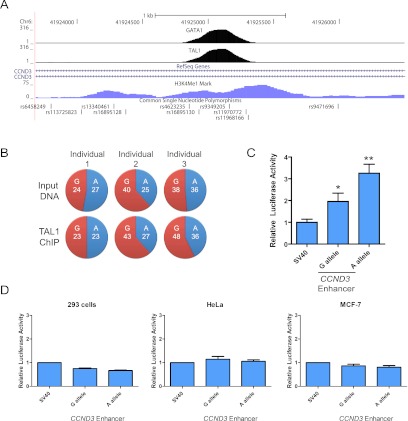
Figure 1.
Figure 1.
GWASs reveal a genetic variant affecting an erythroid-specific enhancer. (A) ChIP-seq (ChIP coupled with deep sequencing) data for GATA1, TAL1, and H3K4me1 are shown in the region surrounding rs9349205, along with other common SNPs in this region. Details of this data are described in the Materials and Methods section. (B) Allele-specific TAL1 ChIP shows no significant differences (P > 0.1 in all cases) for the number of clones with the G versus A allele at rs9349205. ChIP-PCR products were cloned and then sequenced. The number of clones from input DNA samples and TAL1 ChIP samples are shown in the top and bottom rows of the panel from three separate heterozygous individuals. (C) Results of a luciferase assay using the pGL3-SV40 promoter vector in the absence (indicated by the first bar) or presence of the erythroid-specific 280-bp enhancer region surrounding rs9349205. (Last two bars) The two alleles at rs9349205 were assayed in this experiment. The results are shown as the mean ± the standard error (n ≥ 3 per group) and are normalized to Renilla luciferase activity, and the activity of the SV40 promoter construct alone was normalized to a value of 1. (*) P < 0.05; (**) P < 0.01. (D) The erythroid-specific enhancer region surrounding rs9349205 shows no enhancer activity in human nonerythroid 293, HeLa, and MCF-7 cells. Results of a luciferase assay using the pGL3-SV40 promoter vector in the absence (indicated by the first bar) or presence of the erythroid-specific 280-bp enhancer region surrounding rs9349205. (Last two bars) The two alleles at rs9349205 were assayed in this experiment. The results are shown as the mean ± the standard error (n = 3 per group) and are normalized to Renilla luciferase activity, and the activity of the SV40 promoter construct alone was normalized to a value of 1.
Figure 2.
Figure 2.
Hematological analysis of Ccnd3 knockout mice reveals a dramatic increase in erythrocyte size with a concomitant decrease in RBC number. (AF) The hematological values from complete blood counts on mice of various genotypes are shown. The genotype +/+ indicates wild-type littermate controls, +/− indicates heterozygous animals, and −/− indicates Ccnd3 knockout animals. The data are shown as the mean, with the distribution of values for 11 +/+, three +/−, and 13 −/− animals, except for the reticulocyte percentage, which was done with five +/+, three +/−, and eight −/− animals. P-values are shown above the corresponding data and are based on a comparison with +/+ littermates. (G,H) Blood smears shown with identical (100×) magnification demonstrating the enlarged size and heterogeneity of erythrocytes from 8-wk-old Ccnd3−/− mice (H) in contrast to age-matched littermate +/+ controls (G). Bars: G,H, 5 μm.
Figure 3.
Figure 3.
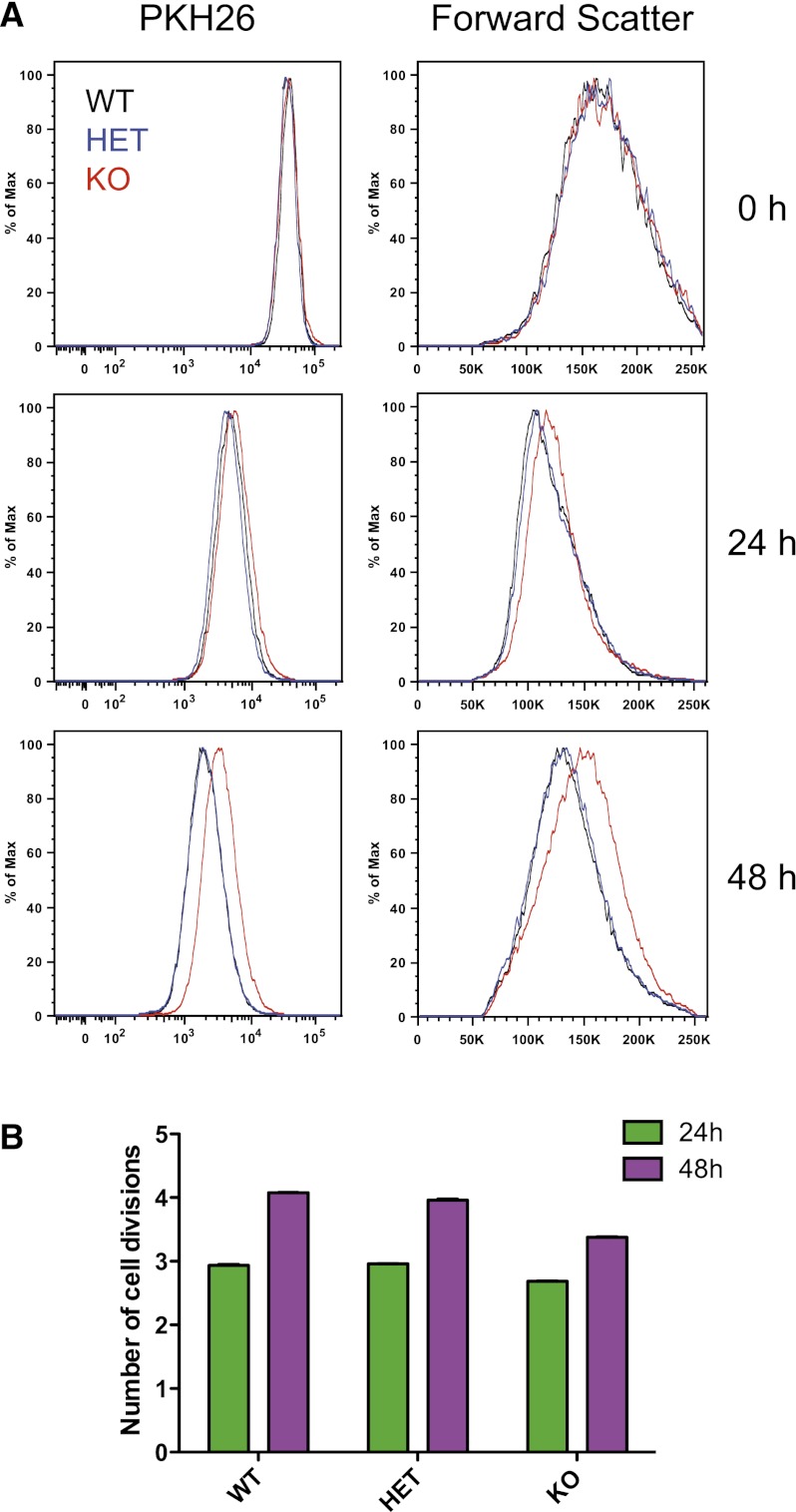
Cyclin D3 regulates the number of cell divisions and cell size during erythropoiesis. (A) PKH26 labeling and forward scatter are shown at 0, 24, and 48 h for knockout (KO), heterozygous (HET), or wild-type (WT) Ccnd3 FL cells. (B) The average number of cell divisions calculated as discussed in the Materials and Methods from the mean fluorescence intensity measurements for PKH26-labeled FL cells of the various genotypes at 24 and 48 h.
Figure 4.
Figure 4.
Cyclin D3 regulates the number of cell divisions during terminal mouse erythropoiesis. (A) Relative expression levels of Ccnd3 are shown normalized to the Ubc control and were measured by quantitative RT–PCR from samples obtained on day 2 of culture. (B) The average number of cell divisions calculated as discussed in the Materials and Methods from the mean fluorescence intensity measurements for PKH26-labeled FL cells (transduced with the luciferase shRNA, shLuc, control, or sh50 and sh79 that target Ccnd3) at 24 and 48 h. (C) An example of the PKH26 labeling, along with forward scatter measurements at 0, 24, and 48 h, is shown for sh50 compared with shLuc. (D) The distribution of cells in various phases of the cell cycle as determined by BrdU labeling for 30 min on days 1 or 2 of culture is shown.
Figure 5.
Figure 5.
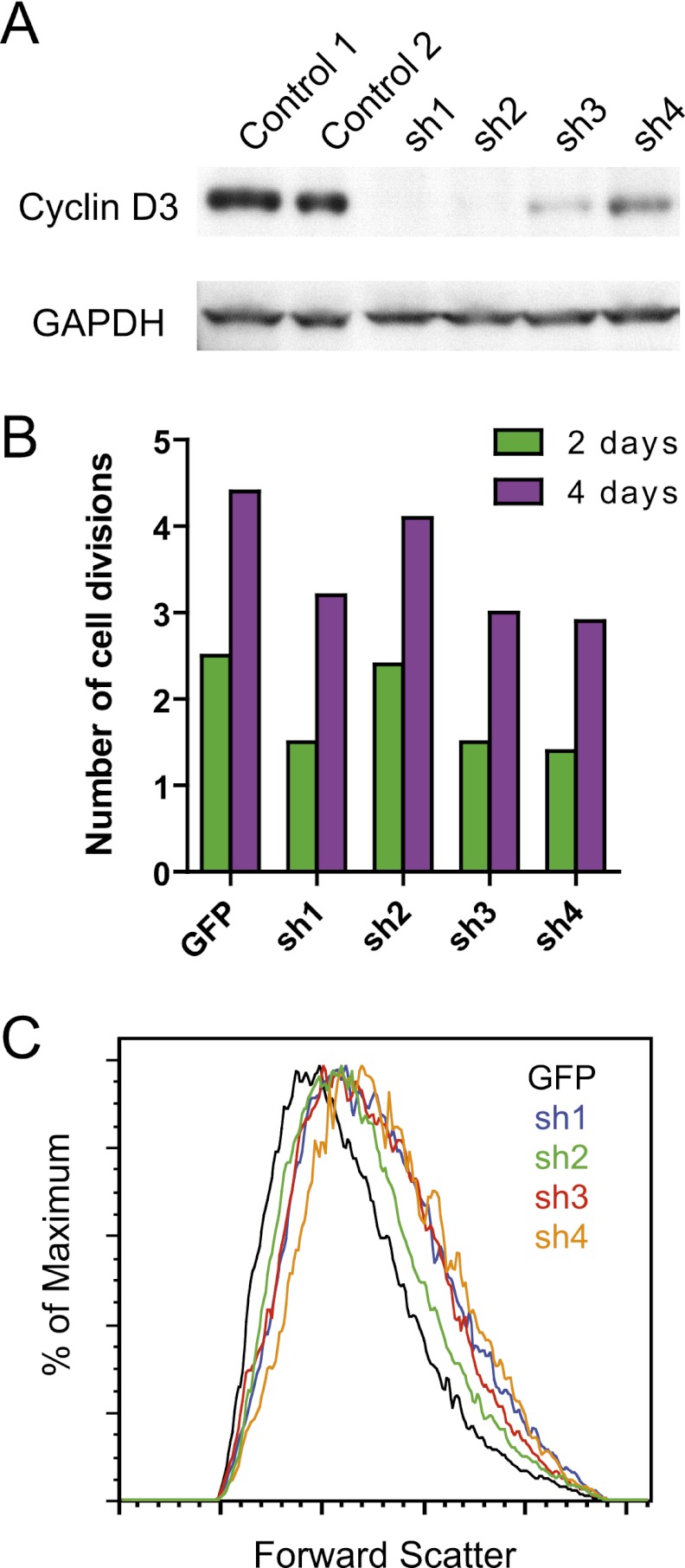
Knockdown of cyclin D3 in human erythropoiesis reduces the number of terminal divisions and results in increased cell size. (A) Knockdown of cyclin D3, as evaluated by Western blotting, in K562 cells transduced with the shRNAs targeting CCND3 (sh1–4) or the pLKO.1 control vector (Controls 1 and 2). (B) The average number of terminal divisions is shown for primary adult erythroid cells transduced with sh1–4 or a GFP control lentivirus, which was calculated as discussed in the Materials and Methods from PKH26-labeling data. The cells were labeled on day 2 of differentiation and measured at 2-d intervals. (C) Forward scatter plots are shown for the GFP control or sh1–4 transduced erythroid cells at day 8 of differentiation, at a point when the cells are near the endpoint of terminal maturation.
Figure 6.
Figure 6.
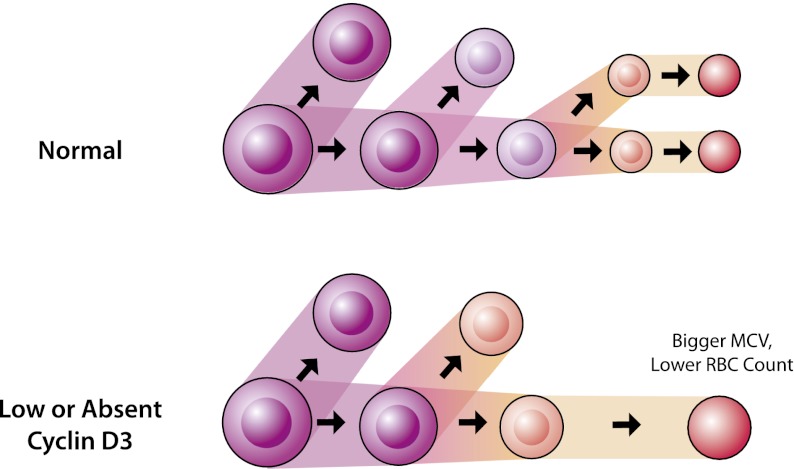
A model of how reduced or absent expression of cyclin D3 can modulate erythropoiesis and cause increased erythrocyte size and reduced RBC counts. The terminal erythroid cells (beginning at the proerythroblast stage of differentiation) undergo a reduced average number of cell divisions during terminal erythropoiesis, and therefore larger erythrocytes are produced with a reduction in the total number of RBCs. This model is supported by the human and mouse genetic data as well as the cellular studies presented here.

References

    1. 1000 Genomes Project Consortium 2010. A map of human genome variation from population-scale sequencing. Nature 467: 1061–1073 - PMC - PubMed
    1. Balarajan Y, Ramakrishnan U, Ozaltin E, Shankar AH, Subramanian SV 2011. Anaemia in low-income and middle-income countries. Lancet 378: 2123–2135 - PubMed
    1. Boylan JW, Van Liew JB, Feig PU 1991. Inverse changes in erythroid cell volume and number regulate the hematocrit in newborn genetically hypertensive rats. Proc Natl Acad Sci 88: 9848–9852 - PMC - PubMed
    1. Cheng Y, Wu W, Kumar SA, Yu D, Deng W, Tripic T, King DC, Chen KB, Zhang Y, Drautz D, et al. 2009. Erythroid GATA1 function revealed by genome-wide analysis of transcription factor occupancy, histone modifications, and mRNA expression. Genome Res 19: 2172–2184 - PMC - PubMed
    1. Ciemerych MA, Kenney AM, Sicinska E, Kalaszczynska I, Bronson RT, Rowitch DH, Gardner H, Sicinski P 2002. Development of mice expressing a single D-type cyclin. Genes Dev 16: 3277–3289 - PMC - PubMed

Publication types

LinkOut - more resources