


Family caregiver involvement for long-term care residents at the end of life
- PMID: 22929400
- PMCID: PMC3536551
- DOI: 10.1093/geronb/gbs065
Family caregiver involvement for long-term care residents at the end of life
Abstract
Objectives: To examine family caregiver involvement for long-term care (LTC) residents during the last month of life. Researchers examined direct (personal care and meals) and indirect (management and monitoring) types of caregiver involvement and the relationship between the type of involvement and predisposing, enabling, and need characteristics. Researchers also examined whether the frequency of involvement changed during the end-of-life (EOL) period.
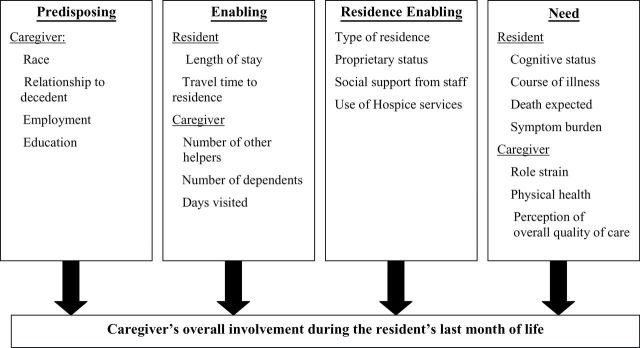
Method: Researchers used an expanded version of Andersen's Behavioral Model to conceptualize predictors of family involvement for 438 residents in 125 residential care/assisted living and nursing home settings. Bivariate and multivariate analyses examined relationships among variables.
Results: More than one-half of family caregivers monitored, managed care and assisted with meals, and 40% assisted with personal care tasks. The enabling characteristic of days visited and the need characteristic of caregiver role strain were related to each of the 4 types of involvement. However, the other correlates were distinct to the type of involvement.
Discussion: Families are involved in EOL care in LTC settings. Higher role strain is related to more involvement in each of the 4 types of involvement, suggesting that whether involvement is by desire, perceived need, or both, there is cause to more critically examine the family caregiver's desired role and need for support.
Figures
References
-
- Amirkhanyan A. A.,, Kim H. J.,, Lambright K. T. (2008). Does the public sector outperform the nonprofit and for-profit sectors? Evidence from a national panel study on nursing home quality and access. Journal of Policy Analysis and Management 27 326–353 - PubMed
-
- Andersen R. M. (1995). Revisiting the behavioral model and access to medical care: Does it matter? Journal of Health and Social Behavior 36 1–10 - PubMed
-
- Andersen R.,, Newman J. F. (1973). Societal and individual determinants of medical care utilization in the United States. The Milbank Memorial Fund Quarterly: Health and Society 51 95–124 - PubMed
-
- Andershed B. (2006). Relatives in end-of-life care - part 1: A systematic review of the literature the five last years, January 1999 – February 2004. Journal of Clinical Nursing 15 1158–1169 - PubMed
-
- Bass D. M.,, Noelker L. S. (1987). The influence of family caregivers on elder’s use of in-home services: An expanded conceptual framework. Journal of Health and Social Behavior 28 184–196 - PubMed
Publication types
MeSH terms
Grants and funding
LinkOut - more resources
Full Text Sources
Medical
