


Stability of echogenic liposomes as a blood pool ultrasound contrast agent in a physiologic flow phantom
- PMID: 22929652
- PMCID: PMC4919816
- DOI: 10.1016/j.ultrasmedbio.2012.06.012
Stability of echogenic liposomes as a blood pool ultrasound contrast agent in a physiologic flow phantom
Abstract
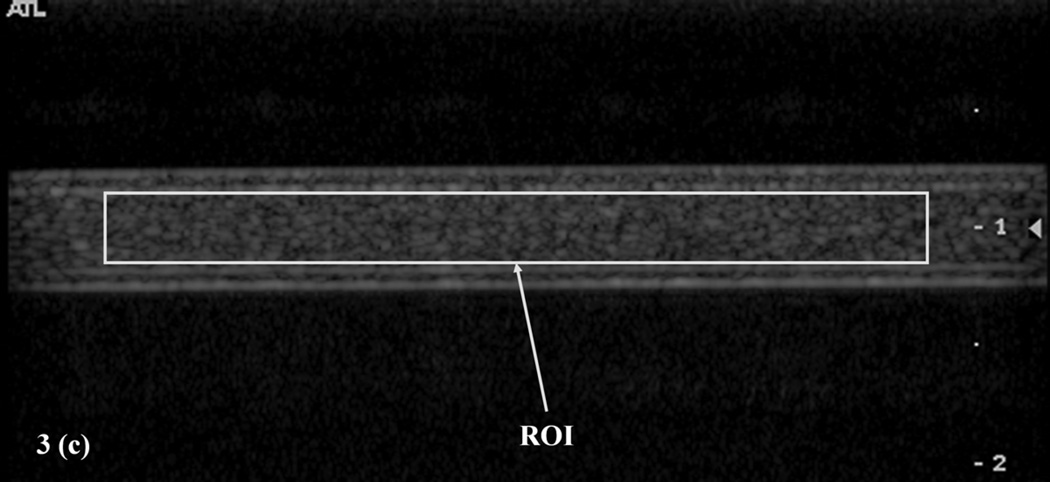
Echogenic liposomes (ELIP) are multifunctional ultrasound contrast agents (UCAs) with a lipid shell encapsulating both air and an aqueous core. ELIP are being developed for molecular imaging and image-guided therapeutic delivery. Stability of the echogenicity of ELIP in physiologic conditions is crucial to their successful translation to clinical use. In this study, we determined the effects of the surrounding media's dissolved air concentration, temperature transition and hydrodynamic pressure on the echogenicity of a chemically modified formulation of ELIP to promote stability and echogenicity. ELIP samples were diluted in porcine plasma or whole blood and pumped through a pulsatile flow system with adjustable hydrodynamic pressures and temperature. B-mode images were acquired using a clinical diagnostic scanner every 5 s for a total duration of 75 s. Echogenicity in porcine plasma was assessed as a function of total dissolved gas saturation. ELIP were added to plasma at room temperature (22 °C) or body temperature (37 °C) and pumped through a system maintained at 22 °C or 37 °C to study the effect of temperature transitions on ELIP echogenicity. Echogenicity at normotensive (120/80 mmHg) and hypertensive pressures (145/90 mmHg) was measured. ELIP were echogenic in plasma and whole blood at body temperature under normotensive to hypertensive pressures. Warming of samples from room temperature to body temperature did not alter echogenicity. However, in plasma cooled rapidly from body temperature to room temperature or in degassed plasma, ELIP lost echogenicity within 20 s at 120/80 mmHg. The stability of echogenicity of a modified ELIP formulation was determined in vitro at body temperature, physiologic gas concentration and throughout the physiologic pressure range. However, proper care should be taken to ensure that ELIP are not cooled rapidly from body temperature to room temperature as they will lose their echogenic properties. Further in vivo investigations will be needed to evaluate the optimal usage of ELIP as blood pool contrast agents.
Copyright © 2012 World Federation for Ultrasound in Medicine & Biology. Published by Elsevier Inc. All rights reserved.
Figures




References
-
- Adam D, Sapunar M, Burla E. On the relationship between encapsulated ultrasound contrast agent and pressure. Ultrasound in Medicine and Biology. 2005;31:673–686. - PubMed
-
- Aksnes E, Rahn H. Measurement of total gas pressure in blood. J Appl Physiol. 1957;10:173–178. - PubMed
-
- Al-Jamal WT, Kostarelos K. Liposomes: From a clinically established drug delivery system to a nanoparticle platform for theranostic nanomedicine. Acc Chem Res. 2011;44:1094–1104. - PubMed
-
- Mines AH. Respiratory Physiology. New York: Raven Press; 1986.
Publication types
MeSH terms
Substances
Grants and funding
LinkOut - more resources
Full Text Sources
Medical
