


External infections contribute minimally to HIV incidence among HIV sero-discordant couples in sub-Saharan Africa
- PMID: 22930346
- PMCID: PMC3595149
- DOI: 10.1136/sextrans-2012-050651
External infections contribute minimally to HIV incidence among HIV sero-discordant couples in sub-Saharan Africa
Abstract
Objective: Recent randomised clinical trials among stable HIV sero-discordant couples (SDCs) in sub-Saharan Africa (SSA) have reported that about 20-30% of new HIV infections are acquired from external sexual partners, rather than transmitted from the infected to the uninfected partner within the couple. The aim of this study is to examine whether, and to what extent, these findings are generalisable to SDCs in the wider population in SSA.
Methods: A mathematical model was constructed to calculate the fraction of new HIV-1 infections among SDCs that are due to sources external to the couple. The model was parameterised using empirical and population-based data for 20 countries in SSA. Uncertainty and sensitivity analyses were also conducted.
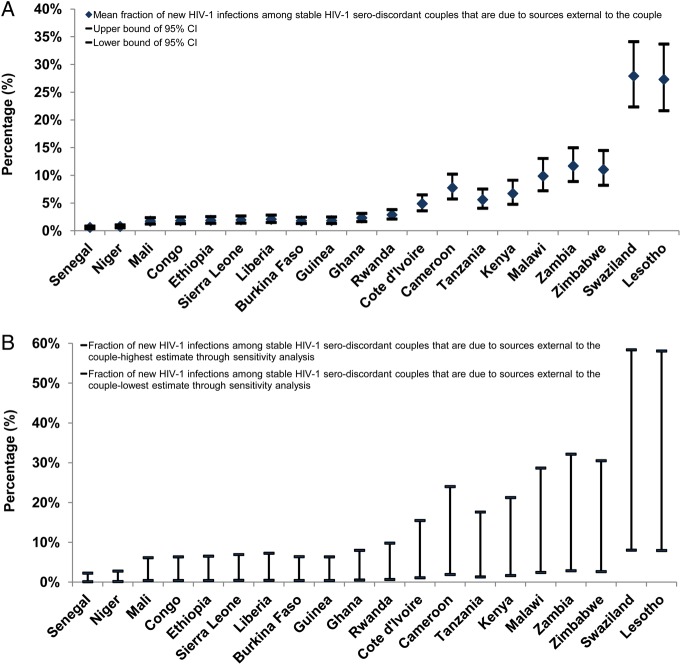
Results: The contribution of external infections among SDCs was generally modest, but it varied widely across SSA. In low HIV prevalence countries (≤ 3.0%), it ranged from 0.6-2.9%. In intermediate prevalence countries (3.0-18.0%), it ranged from 4.9-11.7%. In Swaziland and Lesotho, the world's most-intense epidemics, sizable levels of 27.9% and 27.3% were found, respectively.
Conclusions: In most countries in SSA, nearly all HIV acquisitions by the uninfected partners in SDCs appear to be due to transmissions from the HIV infected partners in the SDCs. The contribution of externally acquired infections varies with HIV population prevalence, but rarely exceeds 10% in the majority of countries. Only in hyperendemic HIV epidemics the contribution of external infections is substantial and may reach the levels reported in recent randomised clinical trials involving SDCs.
Figures
References
-
- Shelton JD. A tale of two-component generalised HIV epidemics. Lancet 2010;375:964–6 - PubMed
-
- Dunkle K, Stephenson R, Karita E, et al. New heterosexually transmitted HIV infections in married or cohabiting couples in urban Zambia and Rwanda: an analysis of survey and clinical data. Lancet 2008;371:2183–91 - PubMed
Publication types
MeSH terms
Grants and funding
LinkOut - more resources
Full Text Sources
Medical
Research Materials
