


Contribution of brain imaging to the understanding of gait disorders in Alzheimer's disease: a systematic review
- PMID: 22930697
- PMCID: PMC11008139
- DOI: 10.1177/1533317512454710
Contribution of brain imaging to the understanding of gait disorders in Alzheimer's disease: a systematic review
Abstract
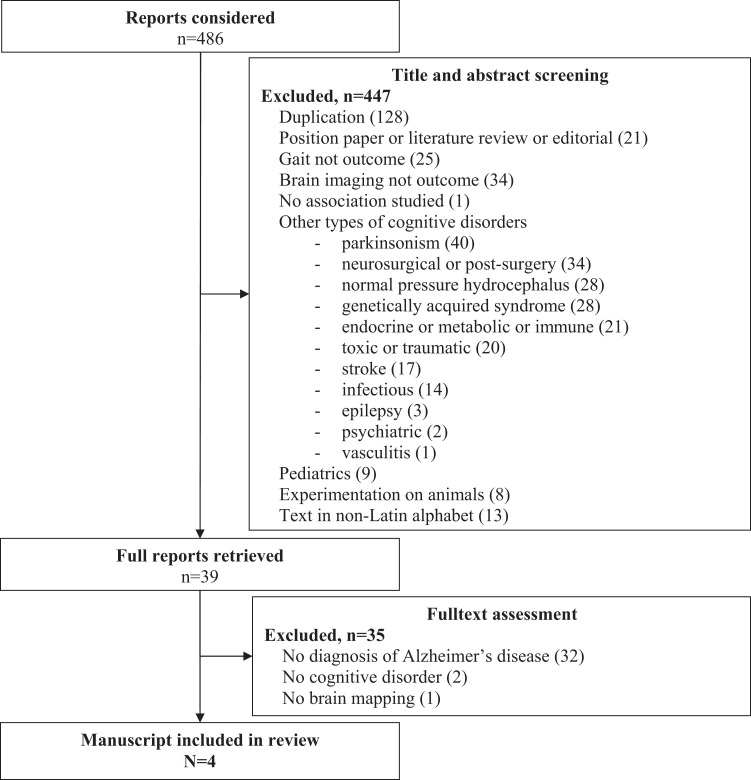
Although gait disorders are common in Alzheimer's disease (AD), determining which brain structures and related lesions are specifically involved is a goal yet to be reached. Our objective was to systematically review all published data that examined associations between gait disorders and brain imaging in AD. Of 486 selected studies, 4 observational studies met the selection criteria. The number of participants ranged from 2 to 61 community dwellers (29%-100% female) with prodromal or dementia-stage AD. Quantitative gait disorders (ie, slower gait velocity explained by shorter stride length) were associated with white matter lesions, mainly in the medial frontal lobes and basal ganglia. The nigrostriatal dopamine system was unaffected. Qualitative gait disorders (ie, higher stride length variability) correlated with lower hippocampal volume and function. Gait disorders in AD could be explained by a high burden of age-related subcortical hyperintensities on the frontal-subcortical circuits (nonspecific) together with hippocampal atrophy and hypometabolism (specific).
Conflict of interest statement
The authors declared no potential conflicts of interest with respect to the research, authorship, and/or publication of this article.
Figures
References
-
- Mazoteras Munoz V, Abellan van Kan G, Cantet C, et al. Gait and balance impairments in Alzheimer disease patients. Alzheimer Dis Assoc Disord. 2010;24(1):79–84. - PubMed
-
- Abellan van Kan G, Rolland Y, Andrieu S, et al. Gait speed at usual pace as a predictor of adverse outcomes in community-dwelling older people an International Academy on Nutrition and Aging (IANA) Task Force. J Nutr Health Aging. 2009;13(10):881–889. - PubMed
-
- Montero-Odasso M, Schapira M, Soriano ER, et al. Gait velocity as a single predictor of adverse events in healthy seniors aged 75 years and older. J Gerontol A Biol Sci Med Sci. 2005;60(10):1304–1309. - PubMed
Publication types
MeSH terms
Grants and funding
LinkOut - more resources
Full Text Sources
Medical
Miscellaneous
