


Permeases of the sap transporter are required for cathelicidin resistance and virulence of Haemophilus ducreyi in humans
- PMID: 22930807
- PMCID: PMC3529601
- DOI: 10.1093/infdis/jis525
Permeases of the sap transporter are required for cathelicidin resistance and virulence of Haemophilus ducreyi in humans
Abstract
Background: Haemophilus ducreyi encounters several classes of antimicrobial peptides (APs) in vivo and utilizes the sensitive-to-antimicrobial-peptides (Sap) transporter as one mechanism of AP resistance. A mutant lacking the periplasmic solute-binding component, SapA, was somewhat more sensitive to the cathelicidin LL-37 than the parent strain and was partially attenuated for virulence. The partial attenuation led us to question whether the transporter is fully abrogated in the sapA mutant.
Methods: We generated a nonpolar sapBC mutant, which lacks both inner membrane permeases of the Sap transporter, and tested the mutant for virulence in human volunteers. In vitro, we compared LL-37 resistance phenotypes of the sapBC and sapA mutants.
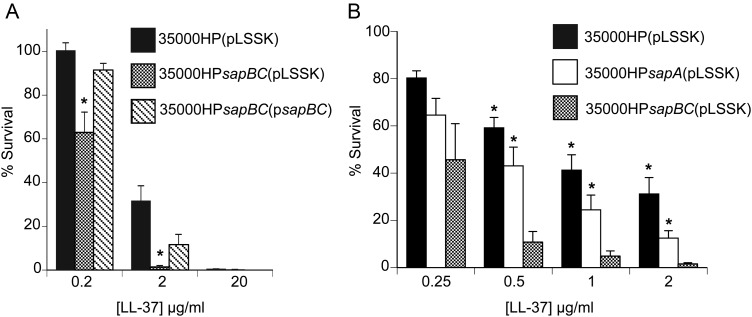
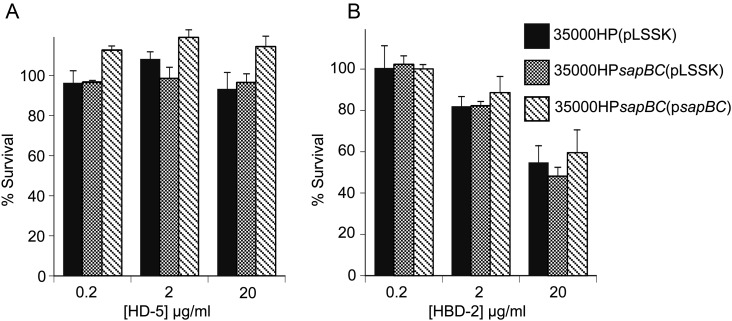
Results: Unlike the sapA mutant, the sapBC mutant was fully attenuated for virulence in human volunteers. In vitro, the sapBC mutant exhibited significantly greater sensitivity than the sapA mutant to killing by LL-37. Similar to the sapA mutant, the sapBC mutant did not affect H. ducreyi's resistance to human defensins.
Conclusions: Compared with the sapA mutant, the sapBC mutant exhibited greater attenuation in vivo, which directly correlated with increased sensitivity to LL-37 in vitro. These results strongly suggest that the SapBC channel retains activity when SapA is removed.
Figures
References
-
- Bauer ME, Townsend CA, Ronald AR, Spinola SM. Localization of Haemophilus ducreyi in naturally acquired chancroidal ulcers. Microb Infect. 2006;8:2465–8. - PubMed
Publication types
MeSH terms
Substances
Grants and funding
LinkOut - more resources
Full Text Sources
Medical
Miscellaneous
