Controlled Clinical Trial
. 2013 Feb;133(2):394-402.
doi: 10.1038/jid.2012.287. Epub 2012 Aug 30.

Rejuvenation of gene expression pattern of aged human skin by broadband light treatment: a pilot study

Affiliations
Free PMC article
Controlled Clinical Trial

Rejuvenation of gene expression pattern of aged human skin by broadband light treatment: a pilot study

Anne Lynn S Chang et al. J Invest Dermatol. 2013 Feb.
Free PMC article

Erratum in

  • J Invest Dermatol. 2013 Jun;133(6):1691

Abstract

Studies in model organisms suggest that aged cells can be functionally rejuvenated, but whether this concept applies to human skin is unclear. Here we apply 3'-end sequencing for expression quantification ("3-seq") to discover the gene expression program associated with human photoaging and intrinsic skin aging (collectively termed "skin aging"), and the impact of broadband light (BBL) treatment. We find that skin aging was associated with a significantly altered expression level of 2,265 coding and noncoding RNAs, of which 1,293 became "rejuvenated" after BBL treatment; i.e., they became more similar to their expression level in youthful skin. Rejuvenated genes (RGs) included several known key regulators of organismal longevity and their proximal long noncoding RNAs. Skin aging is not associated with systematic changes in 3'-end mRNA processing. Hence, BBL treatment can restore gene expression pattern of photoaged and intrinsically aged human skin to resemble young skin. In addition, our data reveal, to our knowledge, a previously unreported set of targets that may lead to new insights into the human skin aging process.


Figures
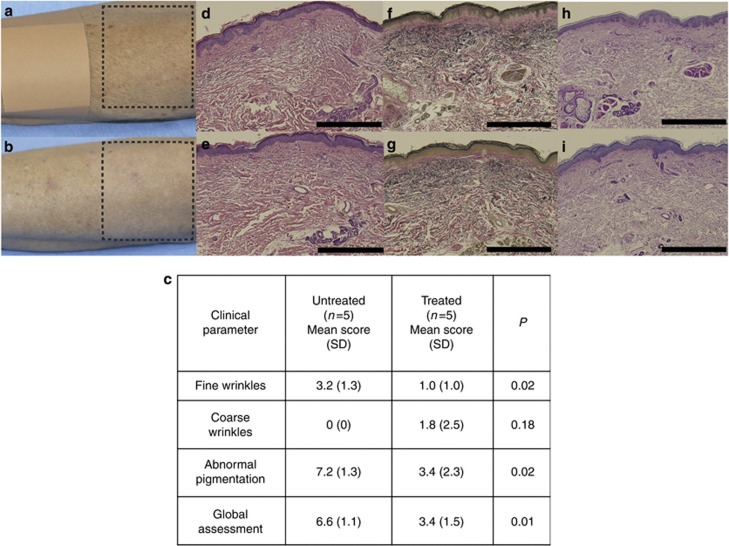
Figure 1
Figure 1
Clinical and histologic effects of broadband light (BBL) treatment. (a) Arm of a 73-year old female before BBL treatment (dashed box indicates area to be treated and bandage indicates untreated skin). (b) The same forearm after three BBL treatments with reduced fine wrinkling, hyperpigmentation, and erythema in the treated area (dashed box) compared with the untreated area. (c) Skin aging parameters show significant decreases in fine wrinkling, abnormal pigmentation, and global skin aging assessment after BBL treatment. The P-value by two-sided t-test. (d) Histology of skin before BBL treatment shows elastosis (original magnification × 200, hematoxylin and eosin (H&E) stain) and (e) reduced elastosis (original magnification × 200, H&E stain) after BBL treatment. (f) Before treatment, elastosis is prominent (original magnification × 200, von Giesen stain). (g) After treatment, elastosis is less distinct (original magnification × 200, von Giesen stain). (h) Before treatment, collagen fibers appear attenuated and disordered (original magnification × 200, periodic acid–Schiff (PAS) stain). (i) After treatment, collagen fibers are more uniform (original magnification × 200, PAS stain). Bars=1 mm each.
Figure 2
Figure 2
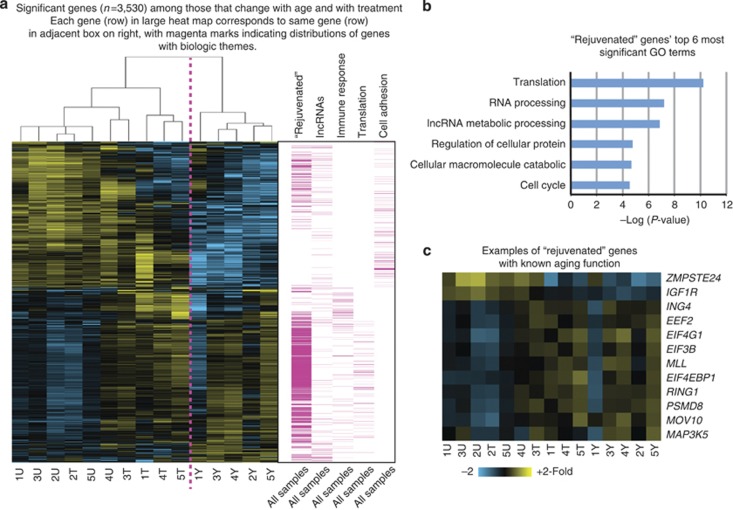
Effects of broadband light (BBL) treatment on coding and noncoding RNAs in aging skin. (a) Gene expression clustering of treated aged samples is intermediate between untreated young and untreated aged samples. Transcript levels that significantly change with untreated young versus untreated aged samples, as well as untreated aged versus treated aged samples (n=3,530 total transcripts), are shown. Columns indicate single subject sample and rows indicate gene. T, aged treated; U, aged untreated; Y, young untreated. Magenta columns are visual representations of the gene distributions on the large heat map (left) as grouped by biological function. For instance, “immune response” and “translation” related genes are on the lower half of the heat map, with yellow indicating increased levels (or “up”) in treated aged and untreated young groups; the corresponding location in the large heat map for immune response and translation are blue (or “down”) in the untreated aged group. Distributions on the large heat map of rejuvenated genes (RGs; n=1,293) and “long noncoding RNAs” (lncRNAs) are shown in the first and second magenta columns, respectively. (b) The top six most significant Gene Ontology (GO) terms among RGs. (c) Examples of RGs with known aging function.
Figure 3
Figure 3
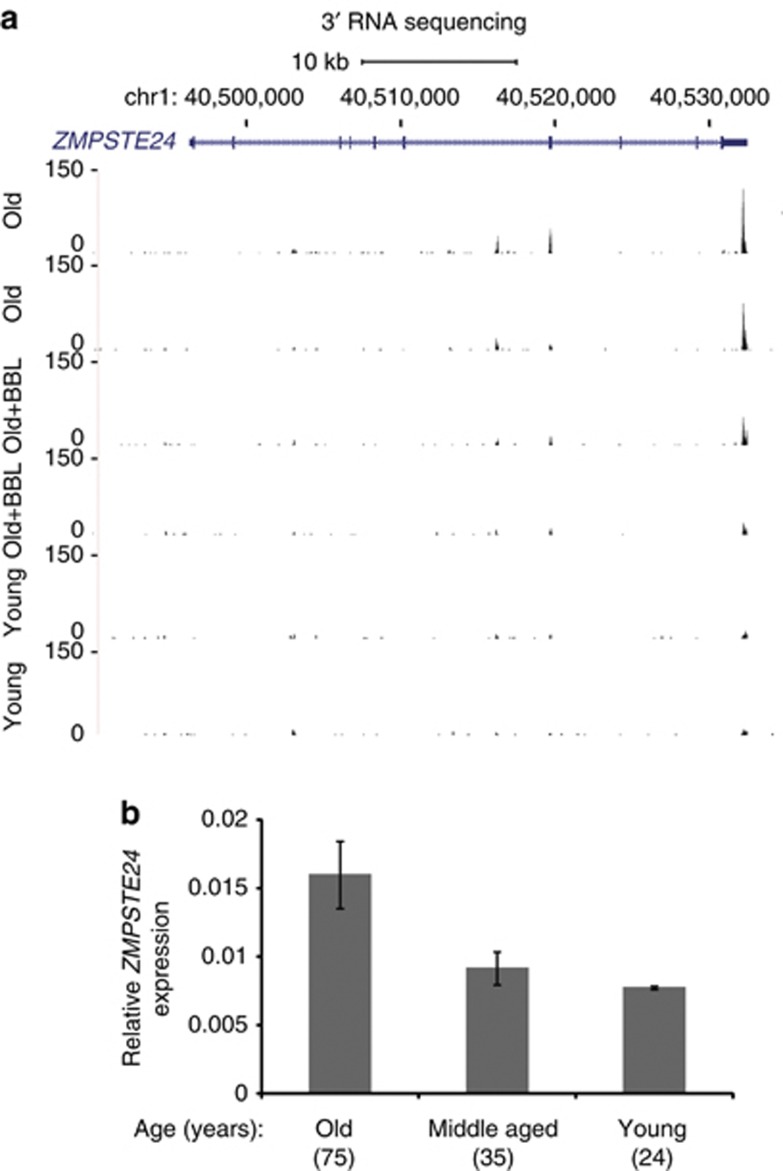
ZMPSTE24 transcript levels increase after broadband light (BBL) treatment. (a) Schematic of ZMPSTE24 locus on chromosome 1, hg18. The 3′-seq (deep sequencing of RNA 3′ end) reads were plotted for two old individuals with and without BBL treatment and two untreated young samples. (b) ZMPSTE24 transcript expression is lower in untreated old skin compared with untreated young skin by quantitative reverse transcription–PCR (RT–qPCR). ZMPSTE24 transcript expression in untreated middle-aged skin is intermediate (n=1).
Figure 4
Figure 4
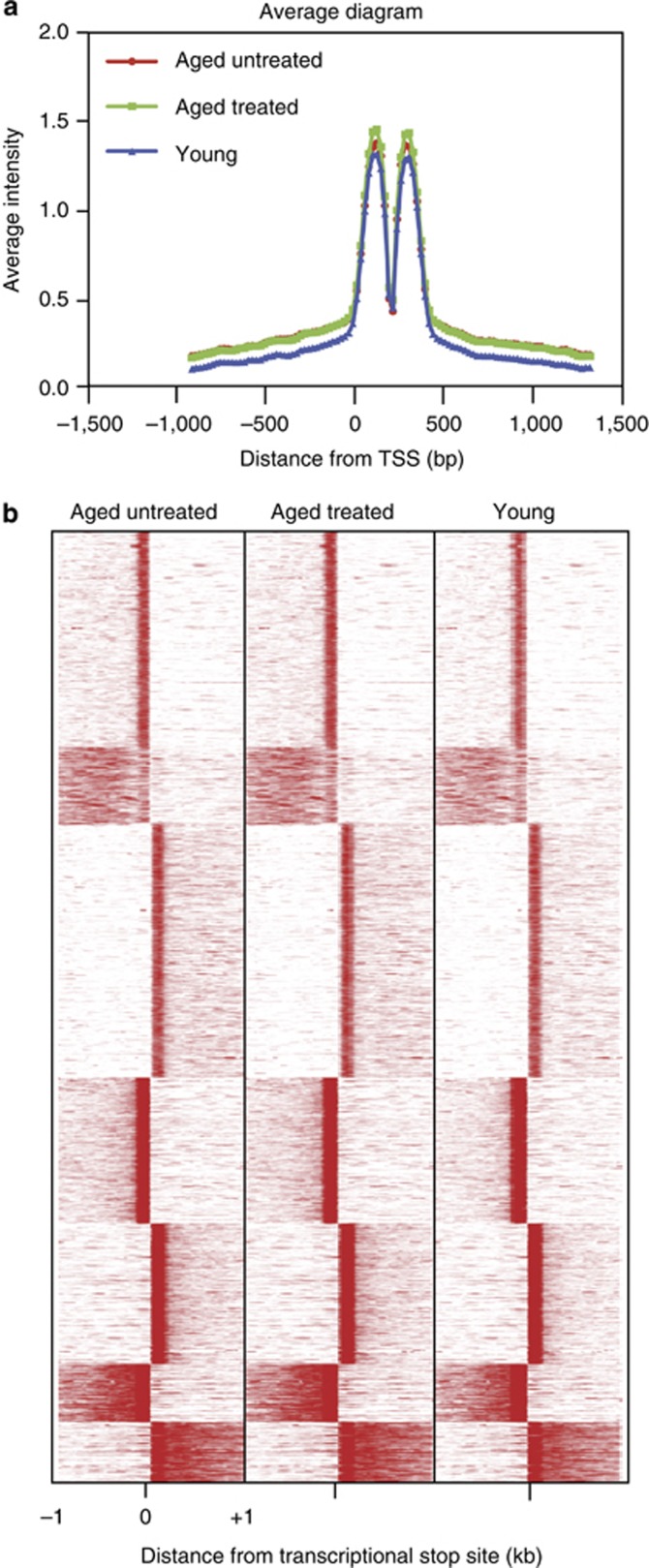
Broadband light (BBL) treatment and aging show no systematic changes of 3′-end usage. (a) Systematic comparison of all 3-seq (deep sequencing of RNA 3′ end) reads showing that the majority of reads fell into the annotated last exon (based on distance of within 1,000 bp from transcriptional start site (TSS)) for untreated aged, treated aged, and untreated young groups. The y-axis shows the average intensity of the 3-seq signal. (b) There were no systematic changes of 3′-end usage associated with aging or BBL treatment, as the reads showed similar length distributions between the untreated aged, treated aged, and untreated young groups.

References

    1. Adams S, Pankow S, Werner S, et al. Regulation of NFKB activity and keratinocytic differentiation by the RIP4 protein: implications for cutaneous wound repair. J Invest Dermatol. 2007;127:538–544. - PubMed
    1. Adler AS, Sinha S, Kawahara TLA, et al. Motif module map reveals enforcement of aging by continual NFKB activity. Genes Dev. 2007;21:3244–3257. - PMC - PubMed
    1. Beck AH, Weng Z, Witten DM, et al. 20103′-end sequencing for expression quantification (3SEQ) from archival tumor samples PLoS One 195e8768 - PMC - PubMed
    1. Bernard D, Gosselin K, Monte D, et al. Involvement of Rel/ NFkB transcription factors in keratinocyte senescence. Cancer Res. 2004;64:472–481. - PubMed
    1. Bitter Jr PH. Noninvasive rejuvenation of photodamaged skin using serial, full-face intense pulsed light treatments. Dermatol Surg. 2000;26:835–843. - PubMed

Publication types