Determinants of bone microarchitecture and mechanical properties in obese men
- PMID: 22933540
- PMCID: PMC3485587
- DOI: 10.1210/jc.2012-2246
Determinants of bone microarchitecture and mechanical properties in obese men
Abstract
Context: Recent studies have suggested that obesity in men is associated with increased fracture risk. Obesity in men is also associated with dysregulation of the GH/IGF-I and gonadal steroid axes, important regulators of bone homeostasis.
Objective: The aim of the study was to investigate body composition and endocrine determinants of bone microarchitecture and mechanical properties in obese men.
Design and setting: We conducted a cross-sectional study at a clinical research center.
Participants: Thirty-five obese men (mean age, 33.8 ± 6.4 yr; mean body mass index, 36.5 ± 5.8 kg/m(2)) participated in the study.
Outcome measures: Distal radius microarchitecture and mechanical properties were measured by three-dimensional high-resolution peripheral quantitative computed tomography and microfinite element analysis; body composition by computed tomography; bone marrow fat by proton magnetic resonance spectroscopy; total and free estradiol and testosterone; IGF-I; peak glucagon-stimulated GH; 25-hydroxyvitamin D.
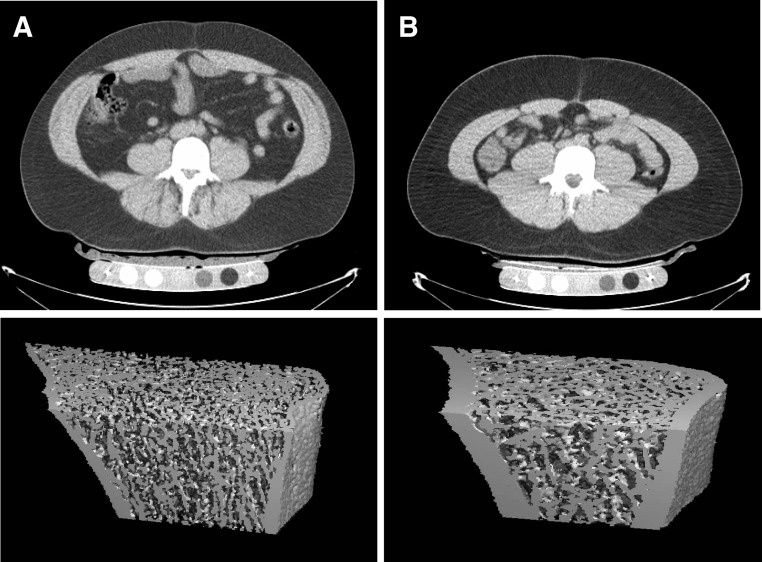
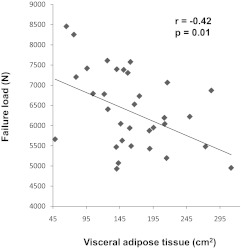
Results: Men with high visceral adipose tissue (VAT) had impaired mechanical properties compared to men with low VAT (P < 0.05), despite comparable body mass index. VAT was inversely associated and thigh muscle was positively associated with mechanical properties (P < 0.05). Bone marrow fat was inversely associated with cortical parameters (P ≤ 0.02). Free estradiol was positively associated with total density (P = 0.05). Free testosterone was positively associated with trabecular thickness and inversely with trabecular number (P ≤ 0.05). Peak stimulated GH was positively associated with trabecular thickness, as was IGF-I with cortical area (P ≤ 0.04).
Conclusion: VAT and bone marrow fat are negative predictors and muscle mass is a positive predictor of microarchitecture and mechanical properties in obese men. Testosterone, estradiol, and GH are positive determinants of trabecular microarchitecture, and IGF-I is a positive determinant of cortical microarchitecture. This supports the notion that VAT is detrimental to bone and that decreased GH and testosterone, characteristic of male obesity, may exert deleterious effects on microarchitecture, whereas higher estradiol may be protective.
Figures
References
-
- Wang YC, McPherson K, Marsh T, Gortmaker SL, Brown M. 2011. Health and economic burden of the projected obesity trends in the USA and the UK. Lancet 378:815–825 - PubMed
-
- Wyatt HR. 2003. The prevalence of obesity. Prim Care 30:267–279 - PubMed
-
- Cole ZA, Dennison EM, Cooper C. 2008. Osteoporosis epidemiology update. Curr Rheumatol Rep 10:92–96 - PubMed
-
- Dawson-Hughes B, Looker AC, Tosteson AN, Johansson H, Kanis JA, Melton LJ., 3rd 2012. The potential impact of the National Osteoporosis Foundation guidance on treatment eligibility in the USA: an update in NHANES 2005–2008. Osteoporos Int 23:811–820 - PubMed
-
- Albala C, Yáñez M, Devoto E, Sostin C, Zeballos L, Santos JL. 1996. Obesity as a protective factor for postmenopausal osteoporosis. Int J Obes Relat Metab Disord 20:1027–1032 - PubMed
Publication types
MeSH terms
Substances
Grants and funding
LinkOut - more resources
Full Text Sources
Medical