


Evaluation of methods for identification and determination of the taxonomic status of strains belonging to the Streptococcus porcinus-Streptococcus pseudoporcinus complex isolated from animal, human, and dairy sources
- PMID: 22933599
- PMCID: PMC3486230
- DOI: 10.1128/JCM.01481-12
Evaluation of methods for identification and determination of the taxonomic status of strains belonging to the Streptococcus porcinus-Streptococcus pseudoporcinus complex isolated from animal, human, and dairy sources
Erratum in
-
Correction for Shewmaker et al., Evaluation of Methods for Identification and Determination of the Taxonomic Status of Strains Belonging to the Streptococcus porcinus-Streptococcus pseudoporcinus Complex Isolated from Animal, Human, and Dairy Sources.J Clin Microbiol. 2016 Dec 28;55(1):345. doi: 10.1128/JCM.02149-16. Print 2017 Jan. J Clin Microbiol. 2016. PMID: 28031449 Free PMC article. No abstract available.
Abstract
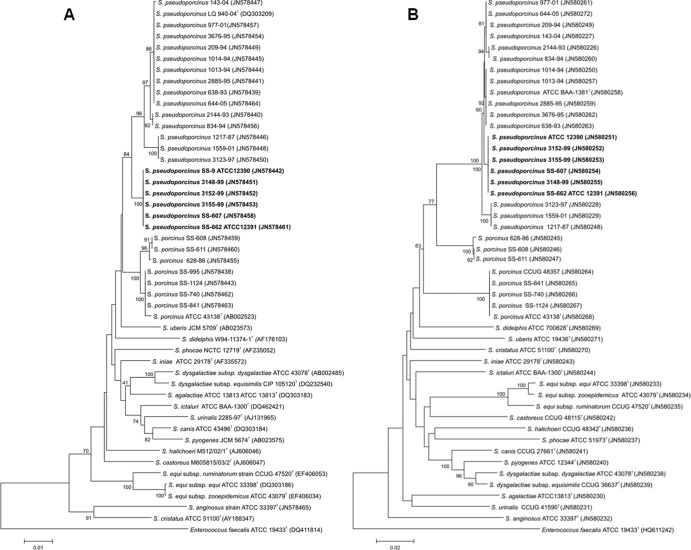
Ninety-seven animal, human, and dairy Streptococcus porcinus or Streptococcus pseudoporcinus isolates in the CDC Streptococcus strain collection were evaluated on the basis of DNA-DNA reassociation, 16S rRNA and rpoB gene sequencing, conventional biochemical and Rapid ID 32 Strep identification methods, and antimicrobial susceptibility testing to determine their taxonomic status, characteristics for species differentiation, antimicrobial susceptibility, and relevance of clinical source. Nineteen of the 97 isolates (1 human, 18 swine) were identified as S. porcinus. The remaining 72 human isolates and 6 dairy isolates were identified as S. pseudoporcinus. The use of 16S rRNA or rpoB gene sequencing was required to differentiate S. porcinus from S. pseudoporcinus. The human and dairy S. pseudoporcinus isolates were biochemically distinct from each other as well as distinct by 16S rRNA and rpoB gene sequencing. Therefore, we propose the subspecies denominations S. pseudoporcinus subsp. hominis subsp. nov. for the human isolates and S. pseudoporcinus subsp. lactis subsp. nov. for the dairy isolates. Most strains were susceptible to the antimicrobials tested, with the exception of tetracycline. Two strains of each species were also resistant to clindamycin and erythromycin and carried the erm(A) (S. pseudoporcinus) or the erm(B) (S. porcinus) gene. S. porcinus was identified from a single human isolate recovered from a wound in an abattoir worker. S. pseudoporcinus was primarily isolated from the genitourinary tract of women but was also associated with blood, placental, and wound infections. Isolates reacting with group B antiserum and demonstrating wide beta-hemolysis should be suspected of being S. pseudoporcinus and not S. agalactiae.
Figures
References
-
- Abdulmawjood A, Weiβ R, Lämmler C. 1998. Species identification of Streptococcus porcinus by restriction fragment length polymorphism analysis of 16S ribosomal DNA. Res. Vet. Sci. 65:85–86 - PubMed
-
- Balter S, et al. 2000. Epidemic nephritis in Nova Serrana, Brazil. Lancet 355:1776–1780 - PubMed
-
- Broyles LN, et al. 2009. Population-based study of invasive disease due to β-hemolytic streptococci of groups other than A and B. Clin. Infect. Dis. 48:706–712 - PubMed
Publication types
MeSH terms
Substances
Associated data
- Actions
- Actions
- Actions
- Actions
- Actions
- Actions
- Actions
- Actions
- Actions
- Actions
- Actions
- Actions
- Actions
- Actions
- Actions
- Actions
- Actions
- Actions
- Actions
- Actions
- Actions
- Actions
- Actions
- Actions
- Actions
- Actions
- Actions
- Actions
- Actions
- Actions
- Actions
- Actions
- Actions
- Actions
- Actions
- Actions
- Actions
- Actions
- Actions
- Actions
- Actions
- Actions
- Actions
- Actions
- Actions
- Actions
- Actions
- Actions
- Actions
- Actions
- Actions
- Actions
- Actions
- Actions
- Actions
- Actions
- Actions
- Actions
- Actions
- Actions
- Actions
- Actions
- Actions
- Actions
- Actions
- Actions
- Actions
- Actions
- Actions
- Actions
- Actions
- Actions
- Actions
- Actions
- Actions
LinkOut - more resources
Full Text Sources
Molecular Biology Databases
Miscellaneous
